Apparent brightness and distance
The same star looks fainter from a greater distance — its light spreads over an ever-larger sphere. The observed flux I=L/(4πd²) falls off with the square of the distance: move the star twice as far away and it shines 4× fainter. This is why absolute brightness (luminosity L) and apparent brightness (I) are two different things. Change the star's luminosity and its distance.
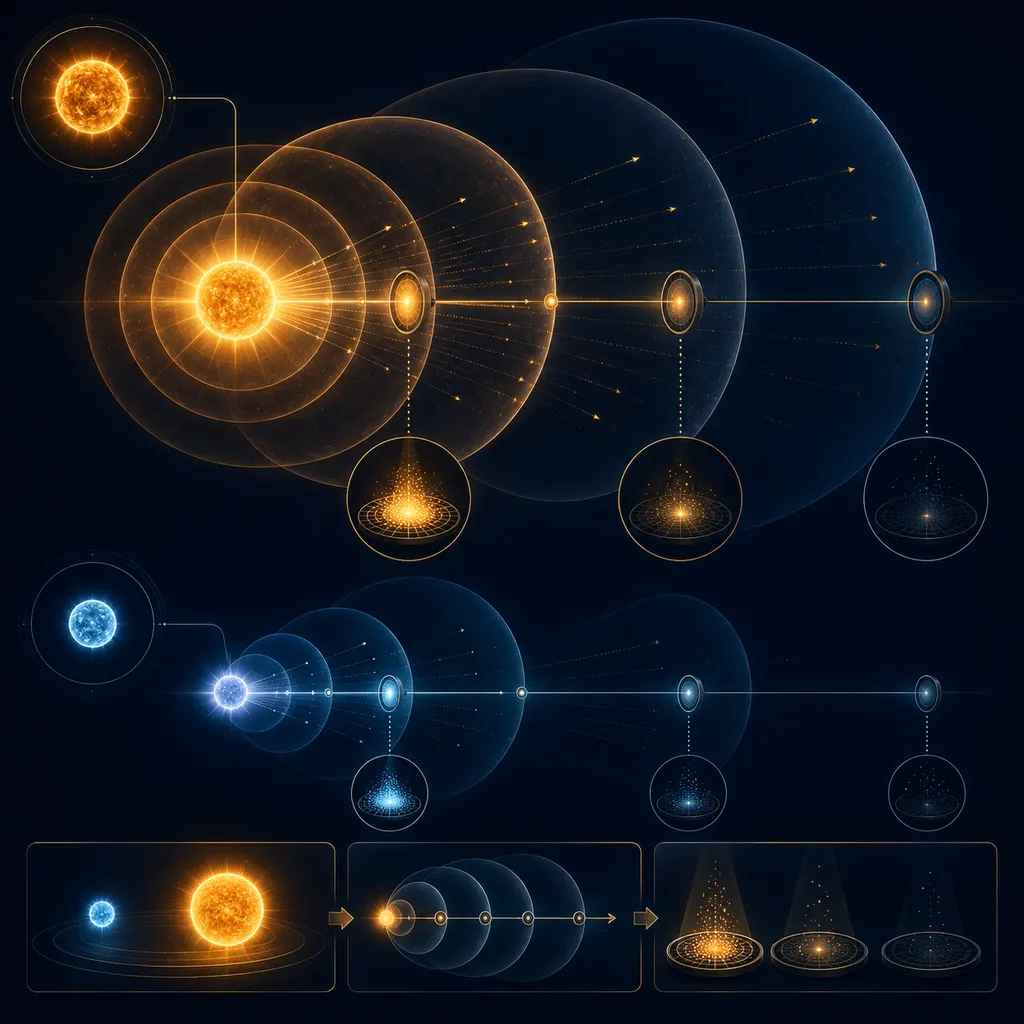
What just happened?
You moved the star twice as far, and its apparent brightness dropped fourfold. The same energy spreads over a sphere of area — twice as far means a four-times-larger sphere, so four times less light reaches each unit of area.
The inverse-square law:
— the observed flux I falls off with the square of the distance. L — the star's luminosity (absolute, intrinsic brightness), d — distance, I — apparent brightness (depends on d).
The invariant:
For a given star the product is constant — all the emitted power passes through every sphere, just spread ever more thinly. So knowing I and d you recover L; knowing L and I you compute the distance d.
Bright, yet faint?
A high-luminosity star L can look faint when it is far away, while a small star right next to us looks bright. That is why astronomers distinguish absolute brightness (L, intrinsic) from apparent brightness (I). Without knowing the distance, apparent brightness alone does not tell you how powerful a star is.
Why this matters for the exam:
The law plus the invariant solve problems about star brightness and distances. The trick: when only d changes, brightness scales as — twice as far means four times fainter.
Remember: apparent brightness falls off with the square of the distance — I = L/(4πd²). Absolute brightness belongs to the star; apparent brightness belongs to the place you look from.
Theory & formulas
The inverse-square law
The light of a star of luminosity spreads over a sphere of area . The observed flux is: Twice as far → 4× fainter ().
Absolute vs apparent brightness
(luminosity) does not depend on distance — it is the absolute brightness. depends on — it is the apparent brightness. Knowing ("standard candles") and measuring , we compute .
Notation: — observed flux, — radiated power (absolute brightness), — distance.
Frequently asked questions
›Why is a distant star faint?
Because its light spreads over the surface of a sphere 4πd² — the farther away, the less energy falls on 1 m² (I ∝ 1/d²).
›What is absolute brightness?
The star's actual radiated power (L), independent of distance — unlike apparent brightness, which depends on d.
›How do you gauge distance from brightness?
Knowing the absolute brightness (e.g. for "standard candles") and measuring the apparent one, from I=L/(4πd²) we compute the distance d.
Teaching? Embed this experiment on your site.
Free widget — paste it on your school site, blog or notes. It links to the full version.