Parallax — distances to the stars
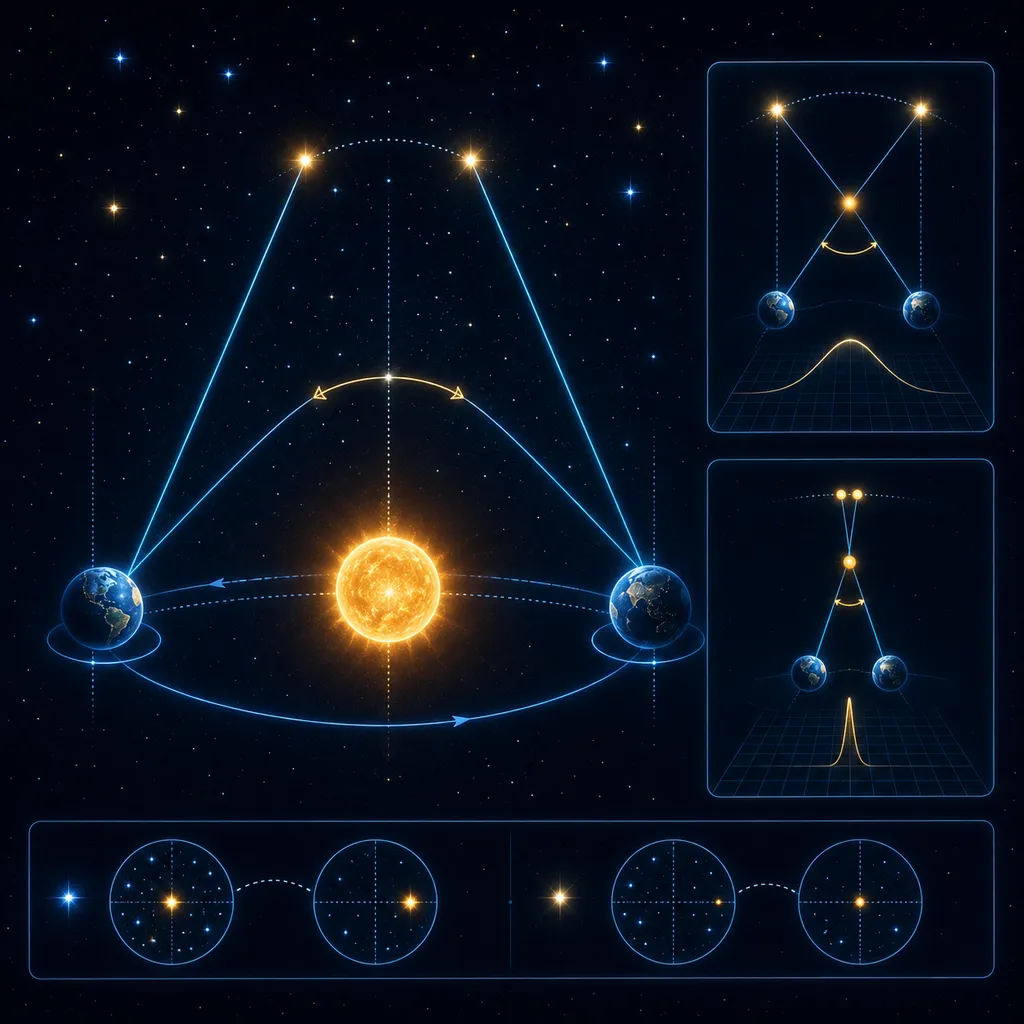
Over the course of a year, as the Earth orbits the Sun, a nearby star appears to shift against very distant stars. The angle of this shift is the parallax p. The distance follows directly: d=1/p (d in parsecs, p in arcseconds). The nearer the star, the larger its parallax. Change the distance to the star.
What just happened?
You moved the star closer, and its apparent shift against the distant background stars grew. Distance and parallax angle are inversely proportional.
The parallax method:
As the Earth orbits the Sun, a nearby star appears to move against the distant background. Half of that annual shift — the angle measured in arcseconds (″) — is called the parallax. The nearer the star, the larger the angle.
Parsec and the invariant:
A parsec (pc) is the distance at which the parallax is exactly . Hence the simple relation:
The product of distance and parallax is constant. 1 pc ≈ 3.26 light-years — the parsec and the light-year are two measures of the same distance.
Where does the method break down?
For very distant stars the angle is so small (hundredths or thousandths of an ″) that it drowns in the measurement uncertainty. That is why parallax works mainly for nearby stars — beyond that, other methods take over (e.g. Cepheids).
Why this matters on your exam:
Given the parallax in arcseconds, you immediately get the distance as in parsecs (and × 3.26 to reach light-years). The trick: a smaller parallax = a more distant star.
Remember: distance and parallax are inversely proportional — d = 1/p, and d·p = 1. Closer means a larger angle.
Theory & formulas
Annual parallax
As the Earth orbits the Sun, a nearby star appears to shift against the distant ones. Half of this shift (an angle) is called the parallax .
Distance in parsecs
where is in parsecs (pc) and is in arcseconds. The nearer the star, the larger the parallax.
Parsec
The distance from which the semi-major axis of the Earth's orbit subtends an angle of ( light-years). For very distant objects is too small to measure.
Notation: — parallax (in arcseconds), — distance (in parsecs).
Frequently asked questions
›What is parallax?
The apparent shift of a nearby star against the distant ones, caused by the Earth's orbital motion. It is measured as an angle (in arcseconds).
›What is a parsec?
The distance from which the semi-major axis of the Earth's orbit subtends an angle of 1 arcsecond (≈ 3.26 light-years). Hence d[pc]=1/p[″].
›Why can't we measure distant galaxies this way?
Because for very large distances the parallax is too small to measure — the method only works for relatively nearby stars.
Teaching? Embed this experiment on your site.
Free widget — paste it on your school site, blog or notes. It links to the full version.