Star colour — the Stefan-Boltzmann and Wien laws
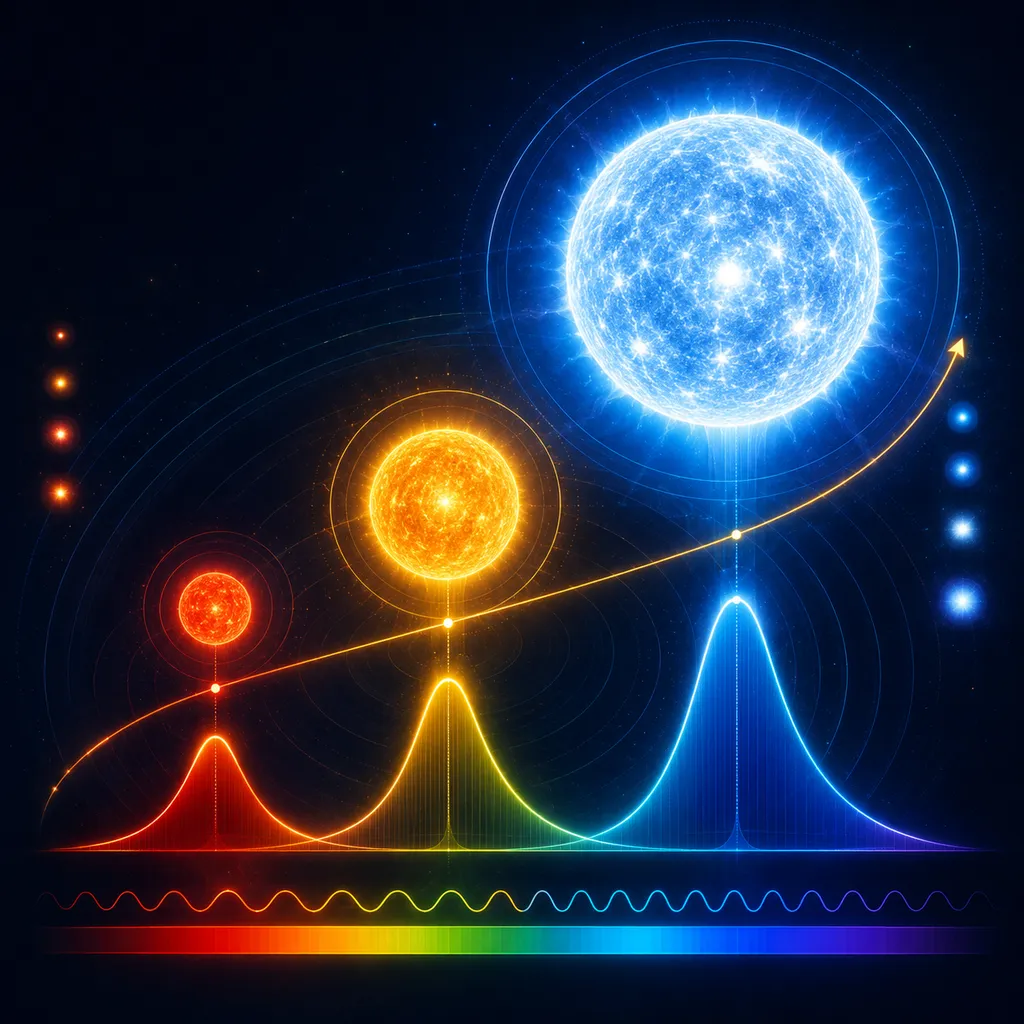
A star's colour depends on its surface temperature: the hotter it is, the shorter the wavelength of peak emission (Wien's law λ_max=b/T) — which is why blue stars are hotter than red ones. The total luminosity grows very fast: L=4πR²σT⁴ (the Stefan-Boltzmann law). Change the star's temperature and radius.
What just happened?
A star’s colour reveals its temperature. Red stars are cool (~3000 K), yellow-white ones like the Sun are ~5800 K, and the hottest shine blue (20000 K and above). It is not a matter of “paint colour” — it is the physics of thermal radiation.
Wien’s law:
— the radiation peak falls at a wavelength inversely proportional to temperature. The hotter the star, the shorter the and the bluer the colour. The Wien constant m·K.
Invariant — constant product:
For every star, the product of the peak wavelength and the temperature gives the same constant. The panel shows that as rises, falls exactly so that their product does not change.
Stefan-Boltzmann law:
Luminosity (radiated power) grows with the square of the radius and with the fourth power of the temperature. Doubling gives a 4× larger , but doubling — a full 16×. That is why hot, large stars are so blindingly bright. W/(m²·K⁴).
Why you need this for the exam:
Colour → temperature (Wien), temperature and size → luminosity (Stefan-Boltzmann). The trick: from the colour read , substitute into or . Remember the fourth power on — that is the most common trap.
Remember: a hotter star = shorter = bluer (λ_max·T = b), and luminosity jumps with T⁴ and R².
Theory & formulas
Wien's law
The hotter the star, the shorter the wavelength of peak emission: This is why blue stars are hotter than red ones.
Stefan-Boltzmann law
The total luminosity (power) of a glowing sphere: Luminosity grows with the square of the radius and the fourth power of the temperature.
Symbols: — wavelength of peak emission, — the Wien constant, — temperature, — radius, — the Stefan-Boltzmann constant, — luminosity.
Frequently asked questions
›Why are blue stars hotter?
Because, by Wien's law, a higher temperature shifts the emission peak towards shorter (bluer) wavelengths; cooler stars radiate most strongly in the red.
›What does Wien's law state?
The wavelength of peak emission is inversely proportional to temperature: λ_max = b/T, where b is the Wien constant.
›What does a star's luminosity depend on?
On the radius and the temperature: L=4πR²σT⁴. Luminosity grows with the square of the radius and the fourth power of the temperature.
Teaching? Embed this experiment on your site.
Free widget — paste it on your school site, blog or notes. It links to the full version.