Tidal force and the Roche limit
Gravity acts more strongly on the near side of a moon than on the far side — that difference is the tidal force, and it grows very fast as the moon approaches: ∝ 1/r³. Below the Roche limit the tidal force overcomes the moon's own gravity and tears it apart — this is how planetary rings form. Change the moon's distance from the planet.
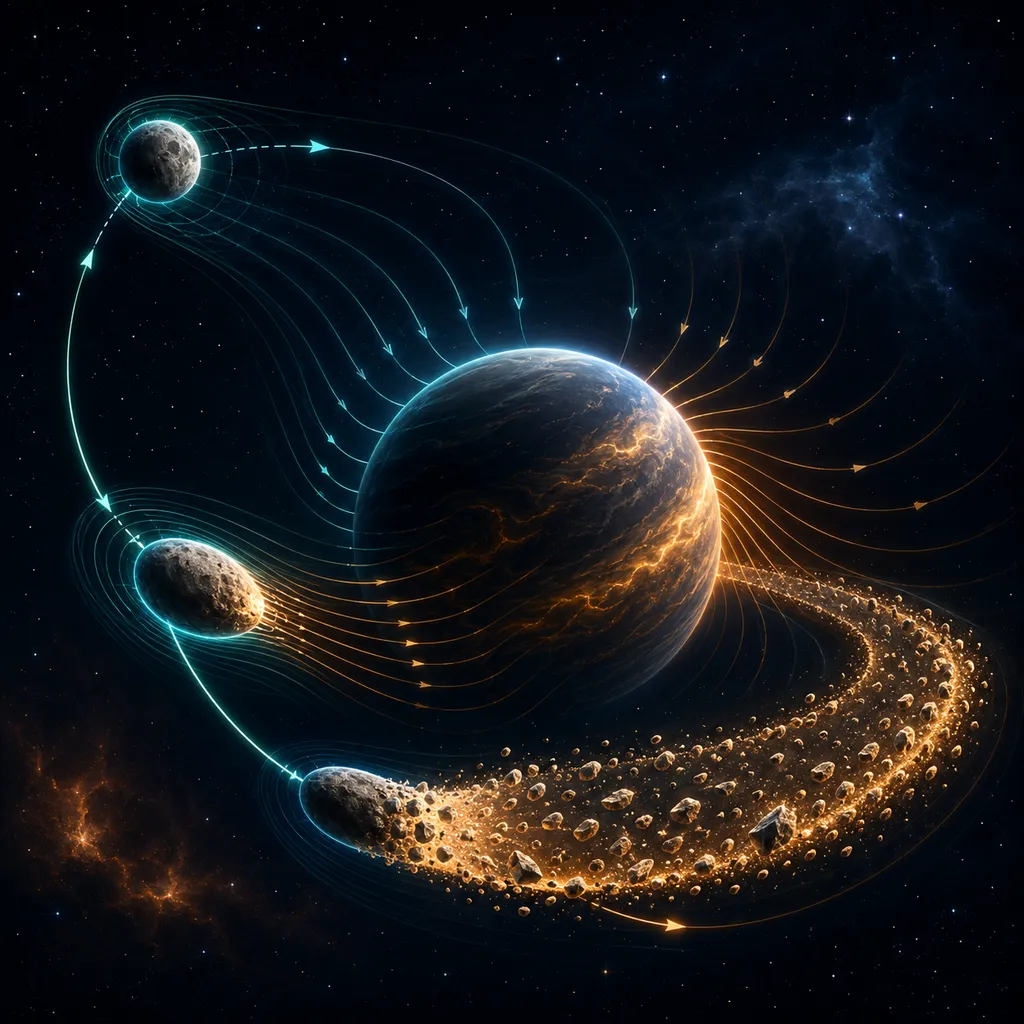
What just happened?
The moon slipped below the Roche limit. The side of the moon nearer the planet is pulled harder than the far side — this difference in forces is the tidal force. The distance shrank, so the tides surged and overcame the gravity that holds the moon together. The result: disruption and a ring of debris.
Where tides come from:
Gravity weakens with distance, so the near and far sides of the moon feel different pulls. This difference stretches the moon along the axis toward the planet. It grows as :
— twice as close means eight times stronger disruption. That is why close-in moons and comets are so vulnerable to tides.
The Roche limit and planetary rings:
Below the Roche limit the tidal force overcomes an object’s own gravity and tears it into debris that spreads into a ring — this is how Saturn’s rings formed, among others. The limit depends on the densities of the planet and the moon:
— planet radius, — densities of the planet and the moon. In the chart on the right the curve crosses the self-gravity level exactly at — to the left of it the moon cannot survive.
Why this matters for the exam:
The relation explains tides, the disruption of moons and the origin of rings — and the exponent 3 (not 2 as in the law of gravity) is a classic trap in problems. The trick: compare r with and check whether the tides beat its own gravity.
Remember: the tidal force is the difference in gravity between an object’s sides and grows as 1/r³; below the Roche limit it tears a moon into a ring.
Theory & formulas
Tidal force
This is the difference in pull between the near and far sides of a body. It grows very fast as the distance shrinks: that is, — much faster than the pull itself ().
The Roche limit
Below a certain distance the tidal force overcomes the moon's own gravity and tears it apart. This is how planetary rings form (e.g. Saturn's).
Notation: — tidal force, — mass of the planet, — distance between centers, — size of the moon, — gravitational constant.
Frequently asked questions
›What is the tidal force?
The difference in gravitational pull between the near and far sides of a body. It stretches the object and grows ∝ 1/r³ as the distance shrinks.
›Where do Saturn's rings come from?
They are the remnants of moons or material that dropped below the Roche limit and were torn apart by tidal forces.
›What is the Roche limit?
The distance below which a planet's tidal force overcomes a moon's own gravity, leading to the moon being torn apart.
Teaching? Embed this experiment on your site.
Free widget — paste it on your school site, blog or notes. It links to the full version.