Pulsars — cosmic lighthouses
An extension of the topic of astrophysics and rotational motion. A neutron star emits a narrow beam of radio waves that "sweeps" across space with every rotation like the light of a lighthouse — hence the remarkably regular radio pulses, whose period equals the star's rotation period. The first observation was made in 1967 by Jocelyn Bell (then a doctoral student), yet the 1974 Nobel Prize went to her supervisor Antony Hewish together with Martin Ryle — an omission still considered controversial today.
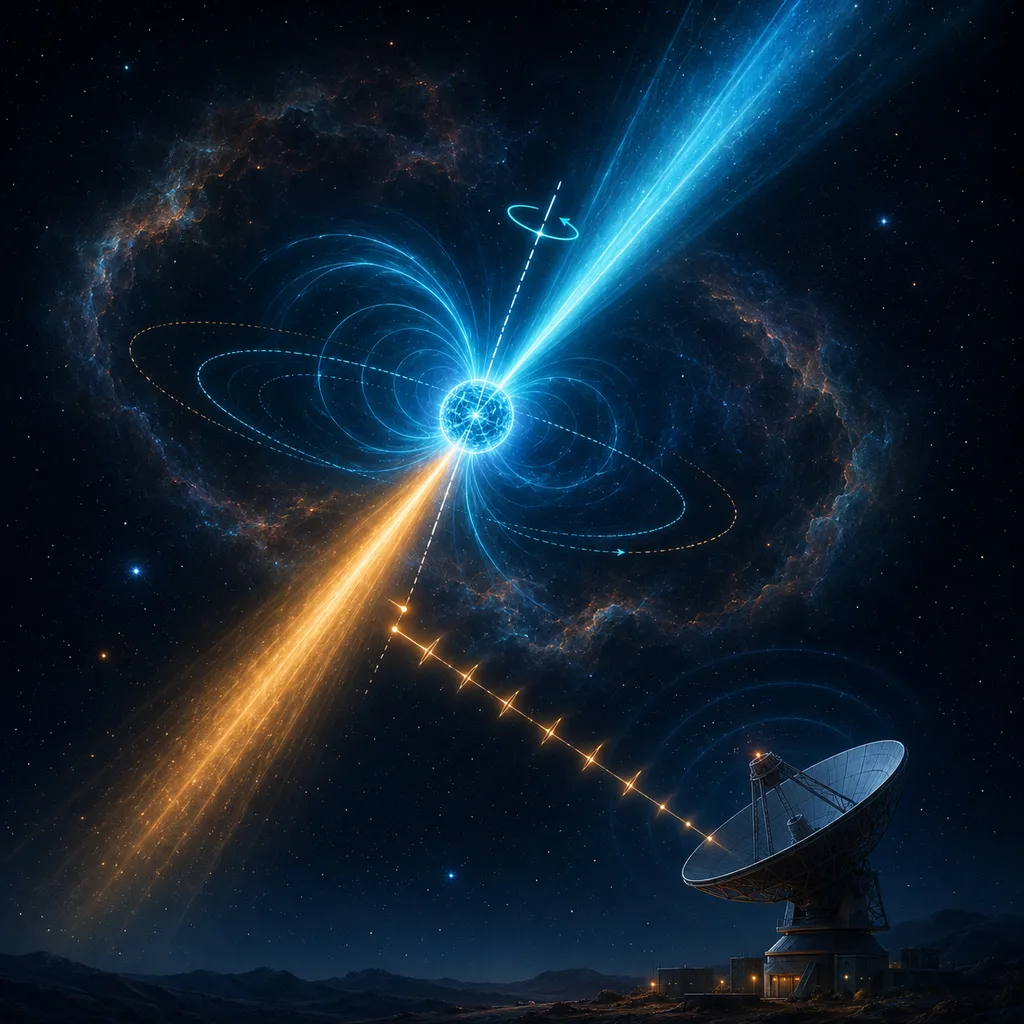
What just happened?
A pulsar is a neutron star — a very small (~20 km), extraordinarily dense core left behind after a supernova explosion. It has an immense magnetic field that emits a narrow beam of radio waves along the magnetic axis, which is tilted relative to the star's rotation axis. As the star spins, the beam "sweeps" across space like the light of a lighthouse. If at some moment it points at Earth, we record a short radio pulse — exactly once per rotation.
How the pulse period depends on rotation:
— the period at which we see the pulses is the reciprocal of the star's rotation frequency. Because a neutron star has enormous inertia (the mass of the Sun packed into a dozen or so kilometres), its rotation is extraordinarily stable — pulsars "tick" with a regularity comparable to atomic clocks.
A bit of history — and controversy:
The first observation of a pulsar was made in 1967 by Jocelyn Bell (then a doctoral student of Antony Hewish), analysing a strange, regular radio signal jokingly named "LGM-1" (Little Green Men). Although it was she who spotted the phenomenon, the 1974 Nobel Prize in Physics went to her supervisor Antony Hewish together with Martin Ryle — the omission of Bell by the Nobel Committee is still regarded as one of the more controversial decisions in the history of the prize.
Why were they not "little green men"?
The signal was too regular and too fast (periods on the order of milliseconds to seconds) for random noise, yet also too stable for a star's natural pulsation (as in Cepheids) — the only mechanism capable of producing such a precise, repeatable "clock" turned out to be a rotating, strongly magnetised, compact object: a neutron star.
Why this matters for your exam:
Remember the simple relation T = 1/f between period and frequency — it is a universal tool for problems on rotational motion and waves, not just in astrophysics. Pulsars are also a good example of how observing and interpreting data are separate stages of a scientific discovery.
Remember: a pulsar = a spinning neutron star with a radio beam like a lighthouse; the pulse period = the star's rotation period, T = 1/f — and it is one of the most stable "clocks" in the Universe.
Theory & formulas
Rotating neutron star
A pulsar is a rapidly spinning neutron star with a strong magnetic field. A narrow beam of radio waves "sweeps" across space like a lighthouse — with every rotation we record a pulse.
Pulse period
The pulse period equals the rotation period of the star. It is remarkably stable, because a compact, massive star has an enormous angular momentum that is hard to perturb.
Historical note
The first observation (1967) was made by Jocelyn Bell; the 1974 Nobel Prize went to her supervisor Hewish and Ryle.
Symbols: — rotation/pulse period, — angular velocity, — angular momentum, — moment of inertia.
Frequently asked questions
›Where do a pulsar's radio pulses come from?
From a beam of radio waves "sweeping" across space with every rotation of a strongly magnetised neutron star.
›Why is the pulse period so stable?
Because it corresponds to the rotation period of a very compact, massive neutron star — an extraordinarily regular process.
›Who first observed a pulsar?
Jocelyn Bell in 1967, although the 1974 Nobel Prize went to her supervisor Antony Hewish together with Martin Ryle.
Teaching? Embed this experiment on your site.
Free widget — paste it on your school site, blog or notes. It links to the full version.