The atomic model — energy levels and spectrum
What we will do: We will supply energy to the atom, excite the electron to higher levels, and watch how, on returning, it emits light, building up the element's spectrum.
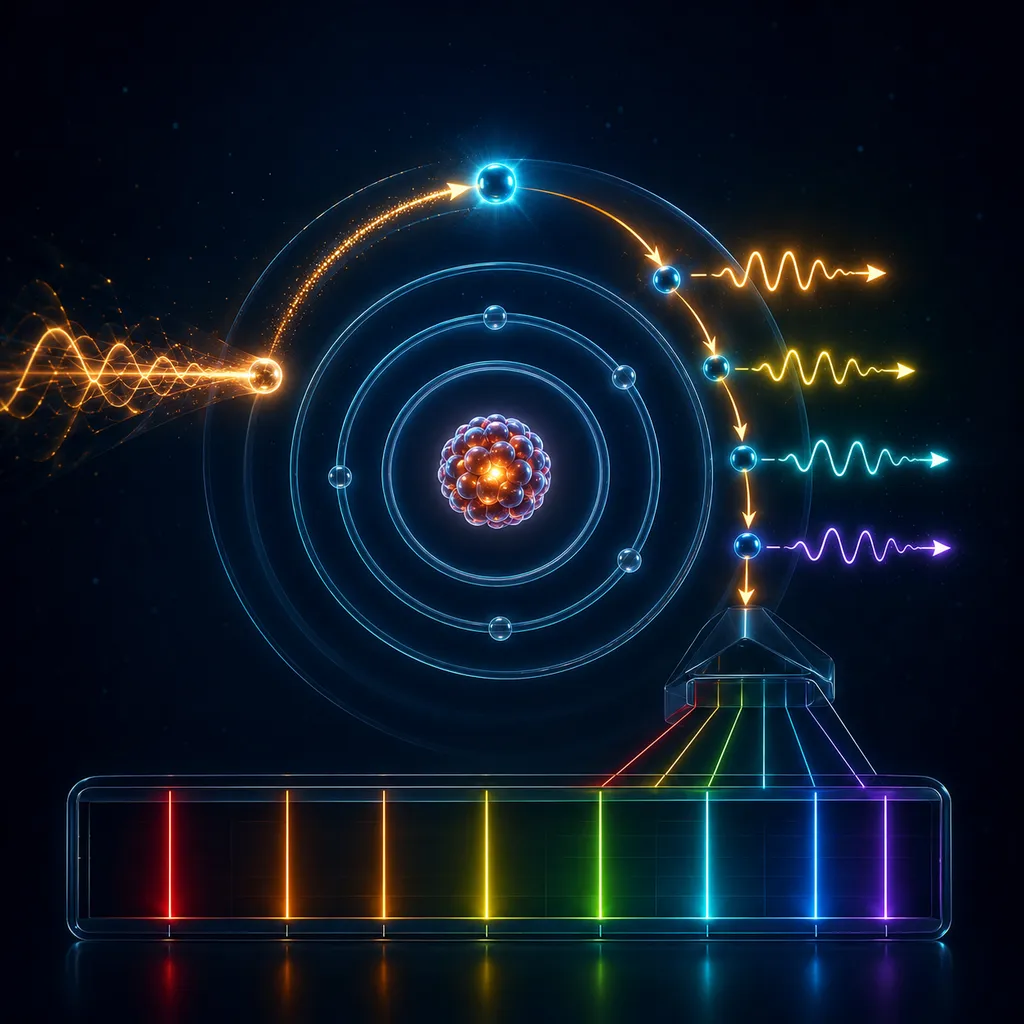
What you see on screen: An atom with energy levels and an electron, a button to supply energy, and an emission-spectrum bar to which successive lines are added; supplying energy kicks the electron upward, and its return emits a photon whose color depends on the jump. Readouts: element, electron level, transition, and the energy and color of the emitted photon.
I will give you an energy packet — guess which level it excites the electron to from the ground state, or whether it matches none. Excitation requires an exact match.
What just happened?
The excited electron returned to a lower level and radiated a photon — a flash of light of a precisely defined color. This is exactly how atoms “glow”.
The Bohr model of the atom:
electrons orbit the nucleus only on ALLOWED levels (orbits) of a definite energy. They cannot sit “in between” them. On a level the electron does not radiate energy.
Excitation and emission:
when an atom absorbs energy (e.g. in a flame or a discharge), the electron jumps to a HIGHER level — this is the excited state (short-lived); returning to a lower level, the electron gives back the energy difference as a PHOTON (a quantum of light):
The color of the light depends on the size of the jump: a large drop in energy → a more blue/violet photon, a small one → red.
Line spectrum:
because the energy levels are DIFFERENT for every element, each one emits its own, unique set of lines — like a “barcode”. That is why neon glows red, sodium yellow, and from a star’s spectrum we learn its composition.
Why you need this for the exam:
the Bohr postulates, the formula , excitation and emission, and the formation of line spectra are the core of atomic physics. The trick: photon energy = difference between levels.
Remember: the electron emits a photon only when it transitions to a lower level, and the photon energy equals the difference between levels (ΔE = hf); hence every element has its own line spectrum.
Theory & formulas
Quantized levels
An electron in an atom can only have specific energies . Supplying energy excites it to a higher level.
Photon emission
On returning to a lower level, the atom emits a photon with an energy equal to the difference between the levels: A larger jump → a more blue photon. Because the levels are unique to each element, each one has its own line spectrum.
Notation: — level energy, — difference between levels, — Planck constant, — frequency, — speed of light, — wavelength.
Frequently asked questions
›When does an atom emit light?
When an excited electron returns to a lower energy level — it then emits a photon with an energy equal to the difference between the levels.
›Where do an element's spectral lines come from?
From transitions of electrons between specific energy levels; because the levels are unique, each element has its own line spectrum.
›What determines the color of the emitted light?
On the size of the energy jump — a larger energy difference gives a more blue photon, a smaller one — more red (ΔE = hf).
Teaching? Embed this experiment on your site.
Free widget — paste it on your school site, blog or notes. It links to the full version.
Related experiments