Rutherford scattering — the discovery of the nucleus
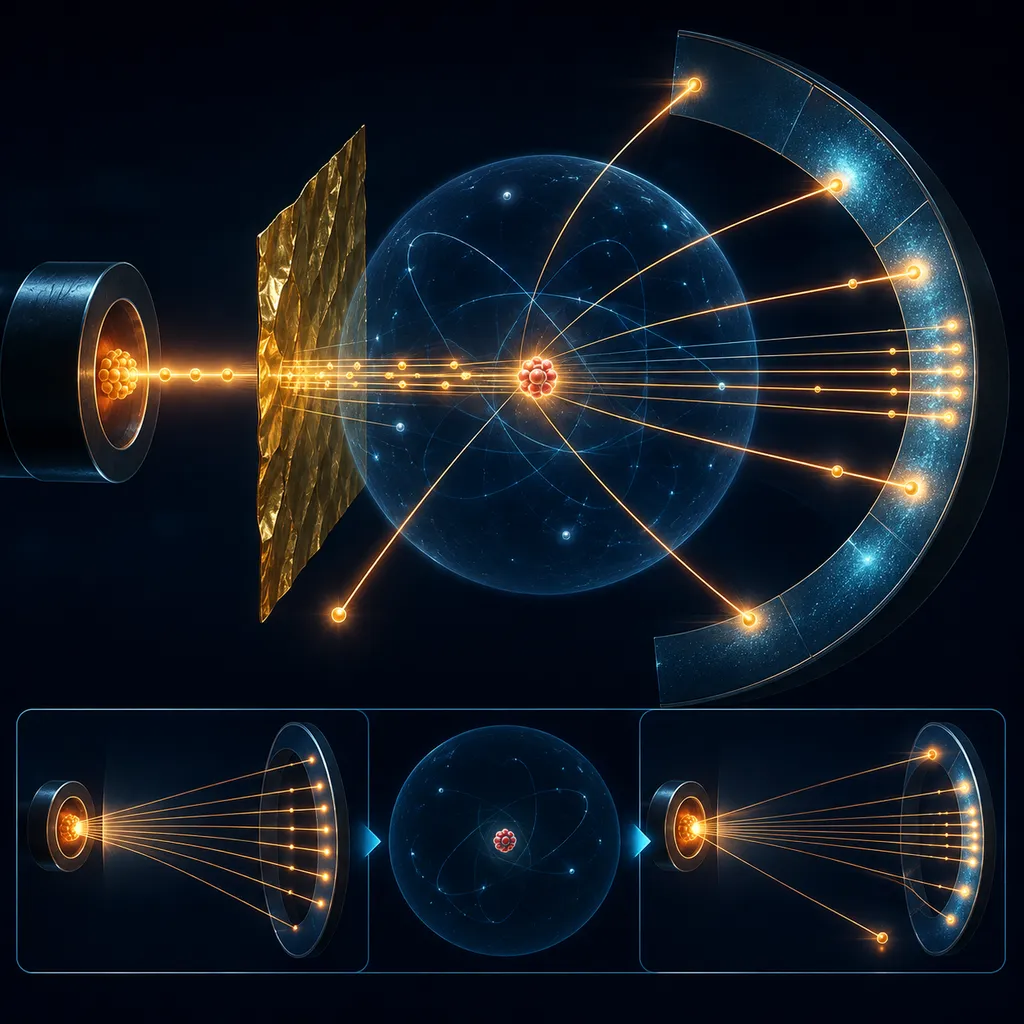
An extension of the atomic-structure topic. Alpha particles bombard a gold foil: most pass almost straight through, but a few are deflected at large angles. This is evidence that the positive charge and mass of the atom are concentrated in a small, dense nucleus (Rutherford's discovery, Nobel 1908).
I will give you a target deflection angle θ — tune the impact parameter b so the alpha particle scatters at that angle.
What just happened?
You reduced the impact parameter — the alpha particle flew closer to the nucleus, so the Coulomb repulsion was stronger and the scattering angle rose sharply, up to an almost backward deflection.
Rutherford's condition:
— the scattering angle grows as the impact parameter decreases. is the approach scale, set by the charges of the nucleus and the particle and by its energy; — the perpendicular distance of the path from the nucleus.
What does this mean in practice?
Most particles have a large and fly almost straight through (small angle). Only a few, hitting almost head-on, are deflected at a large angle — because they meet the concentrated, positive charge of the nucleus:
Why did this overturn the "plum pudding" model?
If the mass and charge were smeared across the whole atom, the forces would average out and all particles would fly almost straight through. Backward deflections are only possible when the positive charge and mass are concentrated in a small, dense nucleus.
Why you need this for the exam:
The Rutherford experiment is a classic of descriptive exam questions: be able to link rare large-angle deflections to the existence of a small, massive, positive nucleus and to the dependence of on . Trick: small ⇒ large angle.
Remember: the scattering angle grows as the impact parameter b decreases (closer to the nucleus, stronger repulsion); all the mass and positive charge are concentrated in a small, dense nucleus.
Theory & formulas
The essence of the experiment
Alpha particles () bombard a thin gold foil. Most pass almost straight through, but a few are deflected at large angles — which proves that the positive charge and nearly all the mass of the atom are concentrated in a tiny, dense nucleus.
Interaction with the nucleus
The positive alpha particle is repelled from the positive nucleus by the Coulomb force: The smaller the impact parameter (the closer to the nucleus), the larger the scattering angle.
Model conclusion
The result overturned Thomson's "plum pudding" model (uniform charge) and introduced the nuclear model of the atom.
Symbols: — repulsive force, — electrostatic constant, — charges of the particle and the nucleus, — distance from the nucleus.
Frequently asked questions
›What did Rutherford scattering discover?
The existence of a small, massive, positive atomic nucleus.
›Why are only a few particles deflected?
Because the nucleus is tiny — only particles with a very small impact parameter are deflected.
›Which model of the atom did it overturn?
Thomson's "plum pudding" model with a uniformly distributed charge.
Teaching? Embed this experiment on your site.
Free widget — paste it on your school site, blog or notes. It links to the full version.