The Compton effect — the photon has momentum
An extension of the wave–particle duality and photon topic. A photon scatters off an electron and gives up part of its momentum, so its wavelength increases: Δλ=(h/m_e·c)(1−cosθ). This is proof of the corpuscular nature of light — the photon has momentum (Compton, Nobel 1927).
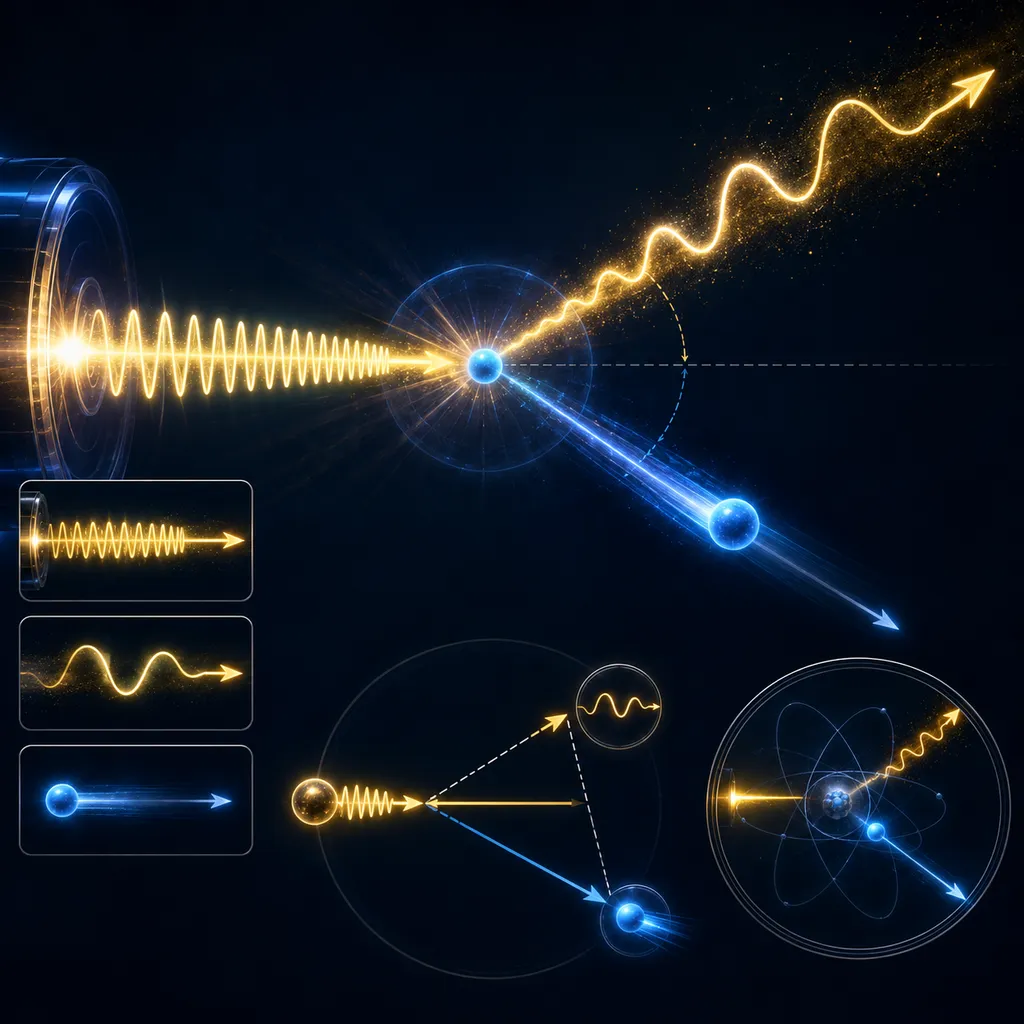
I’ll give you a target Compton shift — set the angle θ to reach it. Δλ = λ_C(1−cosθ).
What just happened?
An X-ray photon struck a free electron like a billiard ball. It gave up part of its momentum and energy, so it bounced off “weaker” — with lower energy, and therefore a longer wavelength. This is the Compton effect.
The Compton shift:
— the increase in wavelength depends only on the scattering angle , not on the incident wavelength. The constant is the Compton wavelength of the electron. Since , always — the photon never gains energy.
Extreme cases:
For (the photon flies straight on) — no collision. For (back-scattering) the shift is largest: , because the electron receives maximum momentum.
Why does this matter?
A wave cannot “collide” and transfer momentum like a particle. The fact that the collision calculation works out proves the photon has momentum and behaves like a particle. The Compton effect is one of the pillars of wave–particle duality.
Why you need this for the exam:
The formula plus and conservation of momentum solve Compton scattering problems. The trick: the angle gives Δλ, hence and the energy of the scattered photon .
Remember: the scattered photon always has a longer wavelength (lower energy) — Δλ = λ_C(1−cosθ) ≥ 0. That is proof that light has momentum and a corpuscular nature.
Theory & formulas
Scattering off an electron
The photon collides with the electron like a particle, giving up part of its energy and momentum, so its wavelength increases:
What it proves
The photon has momentum — this is proof of the corpuscular nature of light (Compton, Nobel 1927). The shift is largest for back-scattering ().
Symbols: — the Compton shift, — the Planck constant, — the electron mass, — the speed of light, — the scattering angle, — the photon momentum.
Frequently asked questions
›What did the Compton effect prove?
That the photon has momentum (p=h/λ) and behaves like a particle in a collision with an electron.
›Why does the photon's wavelength increase?
Because it gives up part of its energy and momentum to the electron — lower energy means a larger λ.
›What does the Compton shift depend on?
On the scattering angle: Δλ=(h/m_e c)(1−cosθ), largest at 180°.
Teaching? Embed this experiment on your site.
Free widget — paste it on your school site, blog or notes. It links to the full version.