The photoelectric effect
Light can eject electrons from a metal, but only when the frequency exceeds the threshold f₀=W/h. The energy of the ejected electrons E_k=hf−W depends on frequency, not on intensity — intense light of too low an f will not eject a single electron. Intensity changes only the number of electrons. This is evidence for the quantum (photon) nature of light. Change f, the work function and the intensity.
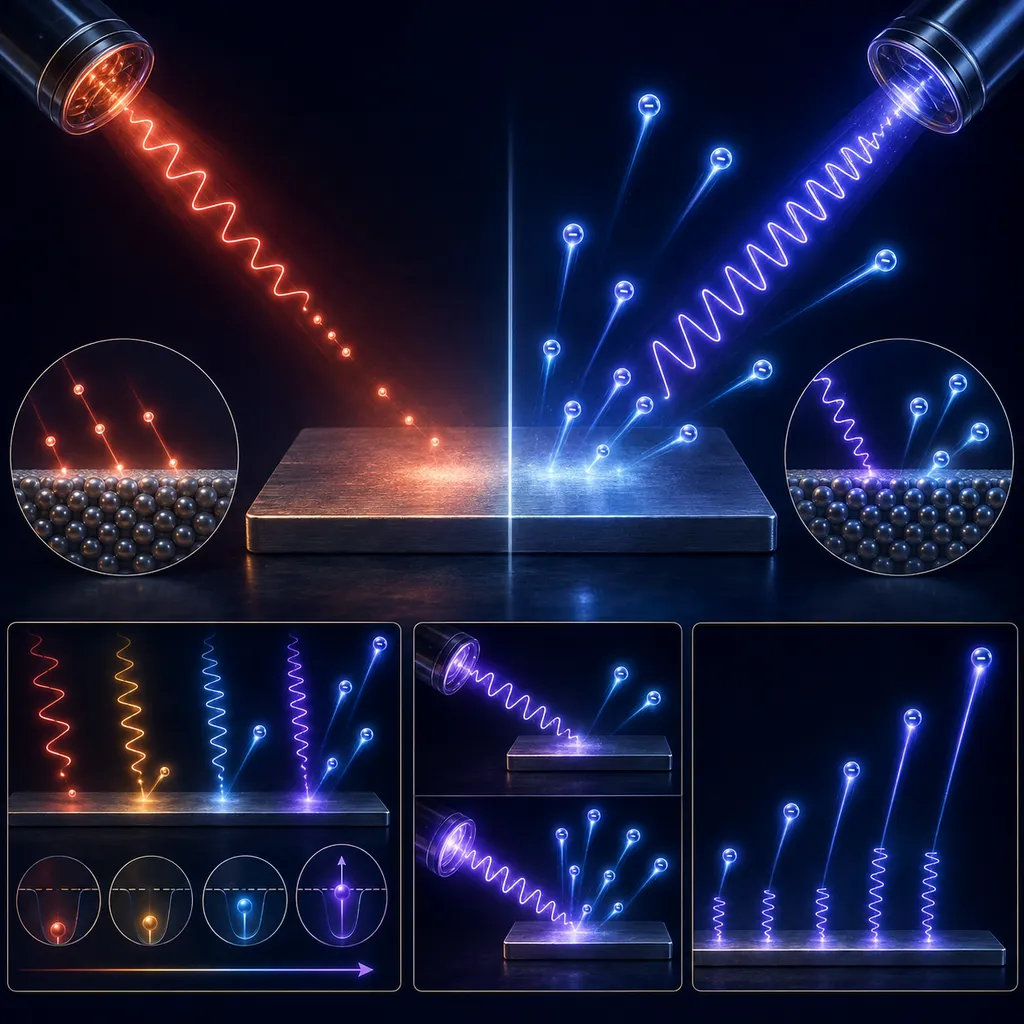
I'll give you a light frequency and a metal's work function — decide whether a photon ejects an electron (no sliders). Threshold: f₀ = W/h.
What just happened?
The photoelectric effect is the ejection of electrons from a metal by incident light. Each photon gives all of its energy to a single electron.
Kinetic energy of the ejected electron:
— the photon energy minus the work function (the minimum energy needed to tear an electron out of the metal). is Planck's constant.
Threshold frequency:
Below the photon has too little energy () and no electron is ejected. Above it — grows linearly with frequency.
Why isn't intensity alone enough?
One photon = one electron. Higher intensity means more photons, so more ejected electrons — but each photon still carries the same energy . If that energy does not exceed , then no matter how blinding the light, no current will flow.
Evidence for light quanta:
The existence of a sharp threshold and the linear dependence were inexplicable for a classical wave. Only the photon — a portion (quantum) of light energy — explains the photoelectric effect. Einstein received the Nobel Prize for this explanation.
Why you need this for the exam:
and solve most photoelectric-effect problems. The trick: first check whether (whether there are any electrons at all), then compute — and remember that intensity changes the number of electrons, not their energy.
Remember: what decides whether an electron is ejected is frequency, not intensity — , and the threshold is .
Theory & formulas
Einstein's equation
An electron absorbs a single photon of energy . If that is enough to overcome the work function , the electron is ejected with kinetic energy:
Threshold frequency
Below no electron is released — even at high intensity. Intensity changes only the number of electrons, not their energy. This is evidence for the quantum (photon) nature of light.
Notation: — kinetic energy of the electron, — Planck's constant, — frequency of the light, — work function, — threshold frequency.
Frequently asked questions
›What is the photoelectric effect?
The ejection of electrons from the surface of a metal by incident light. It occurs only above the threshold frequency.
›Why isn't intensity enough?
Because one electron absorbs one photon of energy hf; if hf<W (the work function), the electron is not released — regardless of the number of photons (intensity).
›What is the work function?
The minimum energy needed to tear an electron out of the metal (W). A photon must have energy hf≥W to eject an electron.
Teaching? Embed this experiment on your site.
Free widget — paste it on your school site, blog or notes. It links to the full version.