Photon energy — color and energy
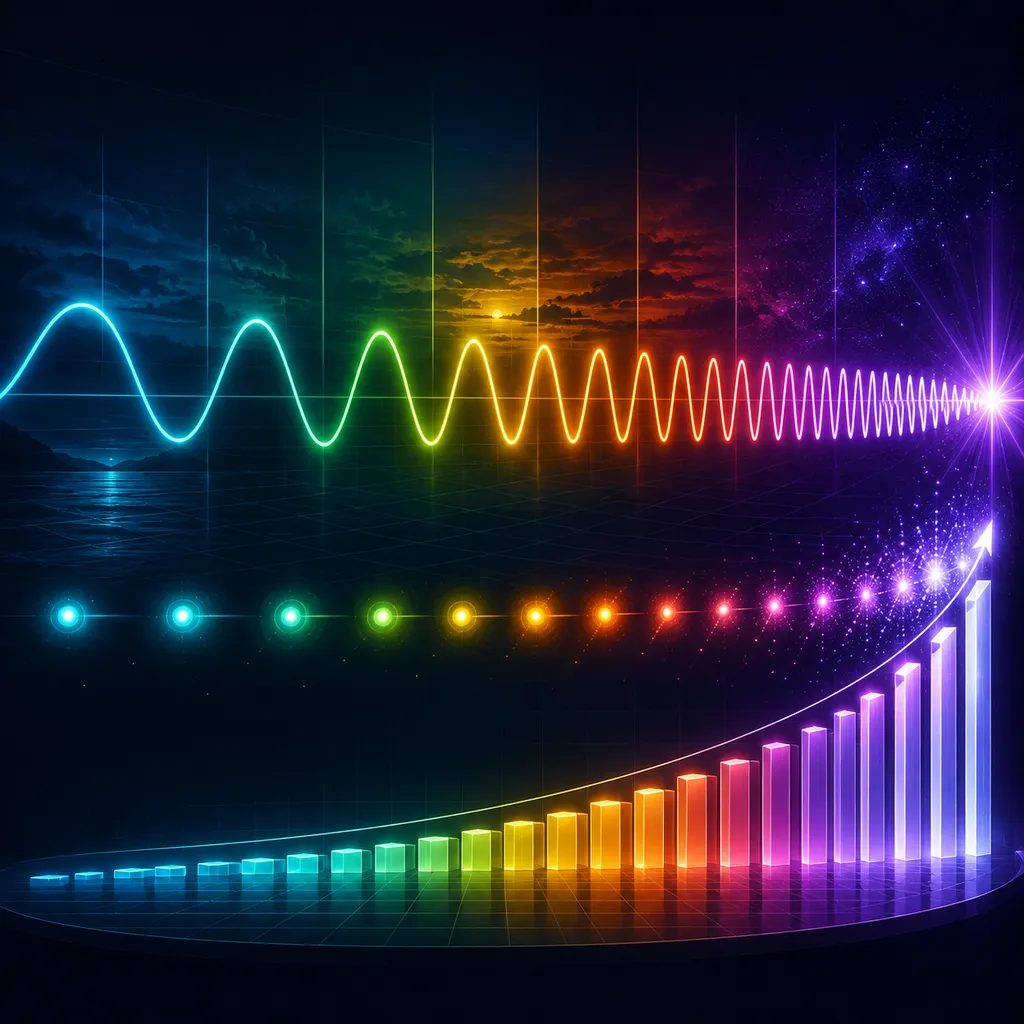
Slide the wavelength from radio waves to ultraviolet. The photon energy E=hc/λ grows as the wave shortens — that is why UV and X-rays are dangerous, while radio waves are harmless. Watch the EM wave and the energy bar.
I will give you a target photon energy — pick the wavelength λ to reach it. E = hc/λ = 1240/λ[nm].
What just happened?
You shortened the wavelength — the wave on screen got denser, and the energy packet (the photon) grew. A shorter wave means a higher frequency, and a higher frequency means greater photon energy.
Photon energy:
— the photon energy is directly proportional to the frequency and inversely proportional to the wavelength. — the Planck constant, — the speed of light, — the wavelength, — the frequency.
What does it mean in practice?
All EM waves travel at the same speed , so a shorter wave "fits" more oscillations per second → higher → greater . A handy formula in electronvolts:
Why are UV and X-rays dangerous, but radio is not?
A UV or X-ray photon carries thousands of times more energy than a photon of visible or radio light — enough to break bonds in molecules (ionization). A radio photon is so "light" that it cannot.
Why you need this for the exam:
is the basis of problems on photons, the photoelectric effect and spectra. Trick: compute the frequency , then the energy — or straight from in eV.
Remember: a shorter wave → higher frequency → greater photon energy. , so .
Theory & formulas
Photon energy
A shorter wave carries greater energy: a violet photon > a red one, and UV and X-rays > visible light.
Why UV is harmful
A UV photon's energy is enough to break chemical bonds in cells; radio-wave photons are too weak.
Symbols: — photon energy, — the Planck constant, — frequency, — the speed of light, — wavelength.
Frequently asked questions
›Which photon has greater energy?
The one with the shorter wavelength (higher frequency): E=hf=hc/λ, so a violet photon carries more energy than a red one.
›Why is UV more dangerous than visible light?
It has a shorter wave, so a greater photon energy — enough to break chemical bonds in cells.
›What is the Planck constant?
The coefficient h in E=hf that links photon energy to frequency (h≈6.63·10⁻³⁴ J·s).
Teaching? Embed this experiment on your site.
Free widget — paste it on your school site, blog or notes. It links to the full version.