X-ray diffraction — Bragg's law
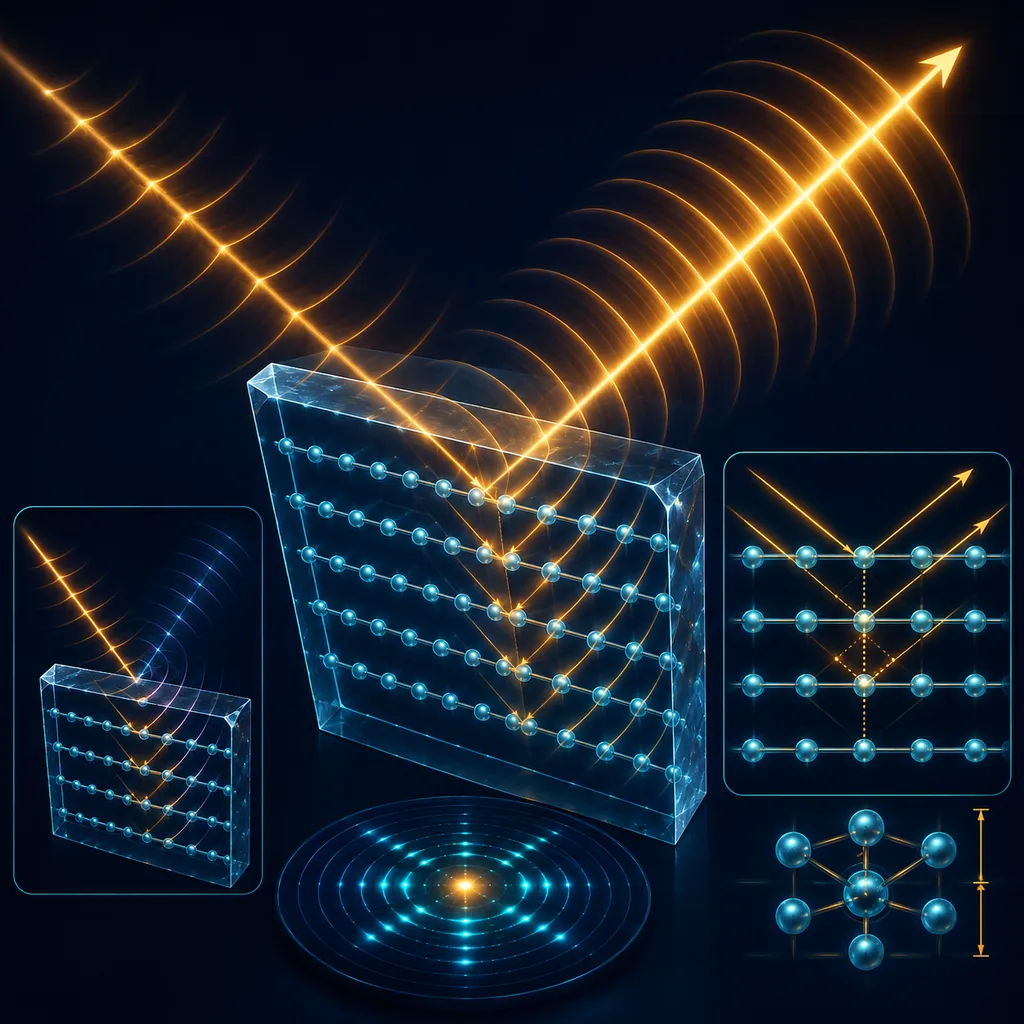
An extension of the topic of wave diffraction and interference. When X-rays strike a crystal, strong (constructive) reflection occurs only at angles satisfying the Bragg condition nλ = 2d sinθ (d — the spacing between atomic planes); at all other angles the waves reflected from adjacent planes cancel out. Father and son, William Henry and William Lawrence Bragg, used this to create a new field — X-ray crystallography (Nobel Prize in Physics, 1915).
I'll give you a reflection order n — set the angle θ to hit that sharp peak (nλ = 2d·sinθ).
What just happened?
X-rays strike a crystal — a regular, repeating lattice of atoms arranged in parallel planes. Each such plane reflects (scatters) part of the wave. Waves reflected from adjacent planes overlap (interfere), and whether they reinforce or cancel depends on the difference in the path length they travel.
Bragg's condition:
— a sharp reflection peak appears only when the path difference of the waves reflected from adjacent planes (2d·sinθ) is an integer multiple of the wavelength λ. n — the order of reflection (an integer), d — the spacing between the crystal's lattice planes, λ — the X-ray wavelength, θ — the angle of incidence (measured from the crystal plane).
Why these particular angles?
When 2d·sinθ falls exactly on a multiple of λ, the crests of the waves reflected from successive planes line up — the waves reinforce (constructive interference) and a strong, bright reflection appears. At all other angles the waves are shifted "out of phase" and cancel one another (destructive interference) — the reflected beam all but vanishes. That is why the graph shows narrow, sharp peaks instead of a smooth, continuous variation.
A bit of history — father and son:
The 1915 Nobel Prize in Physics was shared by William Henry Bragg and his son William Lawrence Bragg — "for their services in the analysis of crystal structure by means of X-rays". Lawrence Bragg was only 25 at the time and to this day remains the youngest Nobel laureate in history. Their discovery launched an entirely new field of science — X-ray crystallography, which lets us determine the structure of molecules from diffraction patterns. Decades later the same method made it possible to establish the structure of DNA and many proteins, among others.
Why you need this for the exam:
The formula nλ = 2d·sinθ is a ready-made tool for X-ray diffraction problems — a problem usually gives two of the three quantities (θ, d, λ or n) and asks for the fourth. The key association: "sharp maxima" and "Bragg's condition" are the signal to plug the data straight into this formula.
Remember: the reflection of X-rays from a crystal is strong only for angles satisfying nλ = 2d·sinθ — for all other angles the waves cancel out. This is the foundation of X-ray crystallography.
Theory & formulas
Reflection from atomic planes
In a crystal the atoms form parallel planes a distance apart. X-rays reflected from adjacent planes interfere with one another.
The Bragg condition
Strong (constructive) reflection occurs only at angles for which the path difference is a multiple of the wavelength: At all other angles the waves cancel out — which is why the maxima are sharp.
Application
By measuring the angles and intensities of the reflections, one determines the positions of the atoms — this is how X-ray crystallography was born, the method that revealed the structure of proteins and DNA, among others (Nobel 1915).
Notation: — the order of the maximum (), — the X-ray wavelength, — the spacing of the atomic planes, — the angle of incidence (measured from the plane).
Frequently asked questions
›When does a sharp reflection peak from a crystal arise?
Only when the angle of incidence satisfies the Bragg condition nλ = 2d sinθ.
›What is X-ray crystallography used for?
For determining molecular structures — the positions of atoms in crystals, and later also in proteins and DNA.
›Who was the youngest Nobel laureate in history?
William Lawrence Bragg — he was 25 when he received the Nobel Prize in Physics in 1915.
Teaching? Embed this experiment on your site.
Free widget — paste it on your school site, blog or notes. It links to the full version.