The blue LED — photon energy from the band gap
An extension of the photon and light-spectrum topic. In an LED, the recombination of an electron and a hole emits a photon whose energy equals the band gap of the semiconductor: E_g=hf=hc/λ. A larger gap gives a higher-energy photon — a color closer to blue. Blue LEDs (made of GaN) were technologically very hard and made white LED light possible (2014 Nobel Prize).
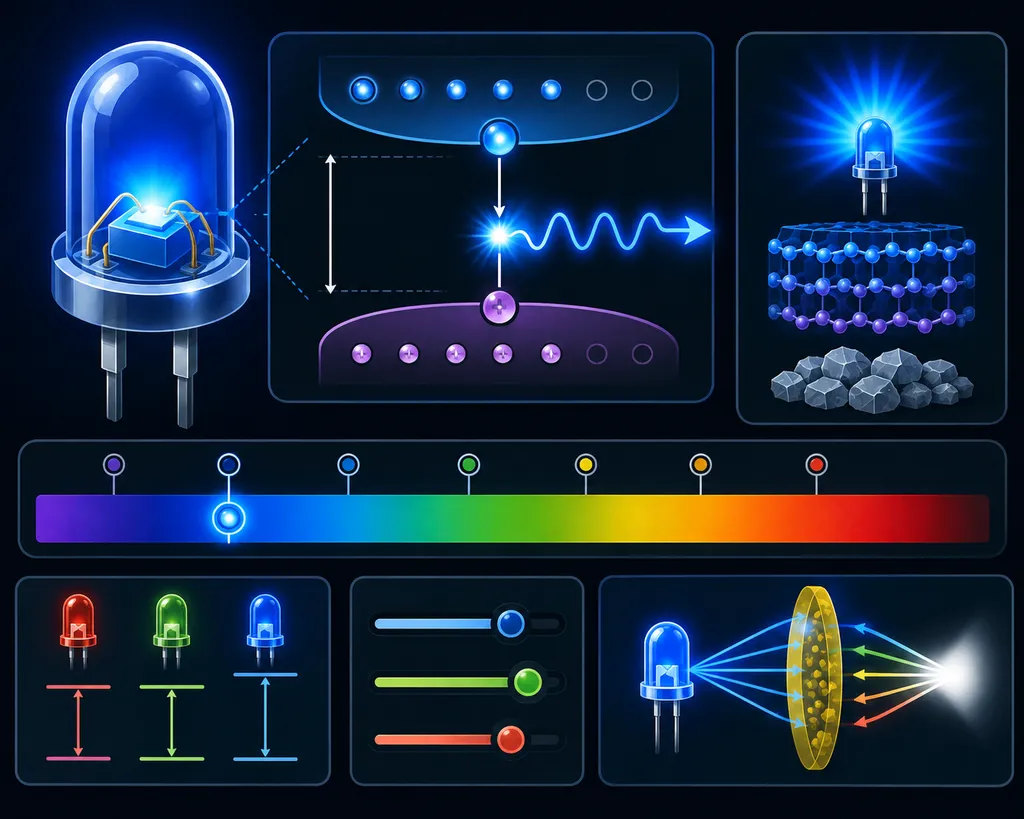
I will give you an LED emission color — tune the material band gap E_g so it produces that color (E_g = hc/λ).
What just happened?
You increased the semiconductor band gap. The photon created when an electron and a hole recombine carries energy exactly equal to that gap — a larger gap means a higher-energy photon, i.e. a shorter wavelength.
Photon energy in an LED:
— the energy of the photon emitted during recombination equals the band gap of the material. E_g — band gap (eV), h — Planck constant, f — photon frequency, λ — wavelength, c — speed of light.
Why is the blue LED a Nobel Prize?
Red and green LEDs (small E_g) were built back in the 1960s and 70s. The blue one needed a material with a large band gap and a high-quality crystal — gallium nitride (GaN). Only in the 1990s did Akasaki, Amano and Nakamura master the growth of pure GaN crystals, which earned them the 2014 Nobel Prize in Physics.
The blue LED completed the RGB triad and — coated with phosphor — made it possible to build energy-efficient white LED light and the screens you carry in your phone today.
Why you need this for the exam:
E_g = hf = hc/λ is the same relation as the photon energy in the photoelectric effect and in atomic spectra. The trick: a higher-energy photon always means a shorter wavelength — remember the inverse proportionality of E and λ (Optics, Atomic physics).
Remember: a larger band gap → a higher-energy photon → a shorter wavelength → a color closer to blue/violet. E_g = hf = hc/λ.
Theory & formulas
Photon from the band gap
In an LED an electron recombines with a hole and emits a photon whose energy equals the band gap of the semiconductor:
Color versus band gap
The larger the gap , the higher the photon energy and the shorter the wavelength — a color closer to blue:
Why blue LEDs were hard
They required a semiconductor with a large gap (gallium nitride, GaN) of high quality. Without blue it was impossible to assemble efficient white LED light (2014 Nobel Prize).
Notation: — band gap, — Planck constant, — frequency, — wavelength, — speed of light.
Frequently asked questions
›Where does the color of LED light come from?
From the energy of the photon emitted during electron-hole recombination, which equals the band gap of the material: E_g=hf.
›Why were blue LEDs harder than red ones?
They required a semiconductor with a large band gap (gallium nitride, GaN) — hard to grow in high quality.
›What were blue LEDs needed for?
To produce white light (red+green+blue) — without blue there were no efficient white LED lamps.
Teaching? Embed this experiment on your site.
Free widget — paste it on your school site, blog or notes. It links to the full version.