The transistor — a small signal controls a large current
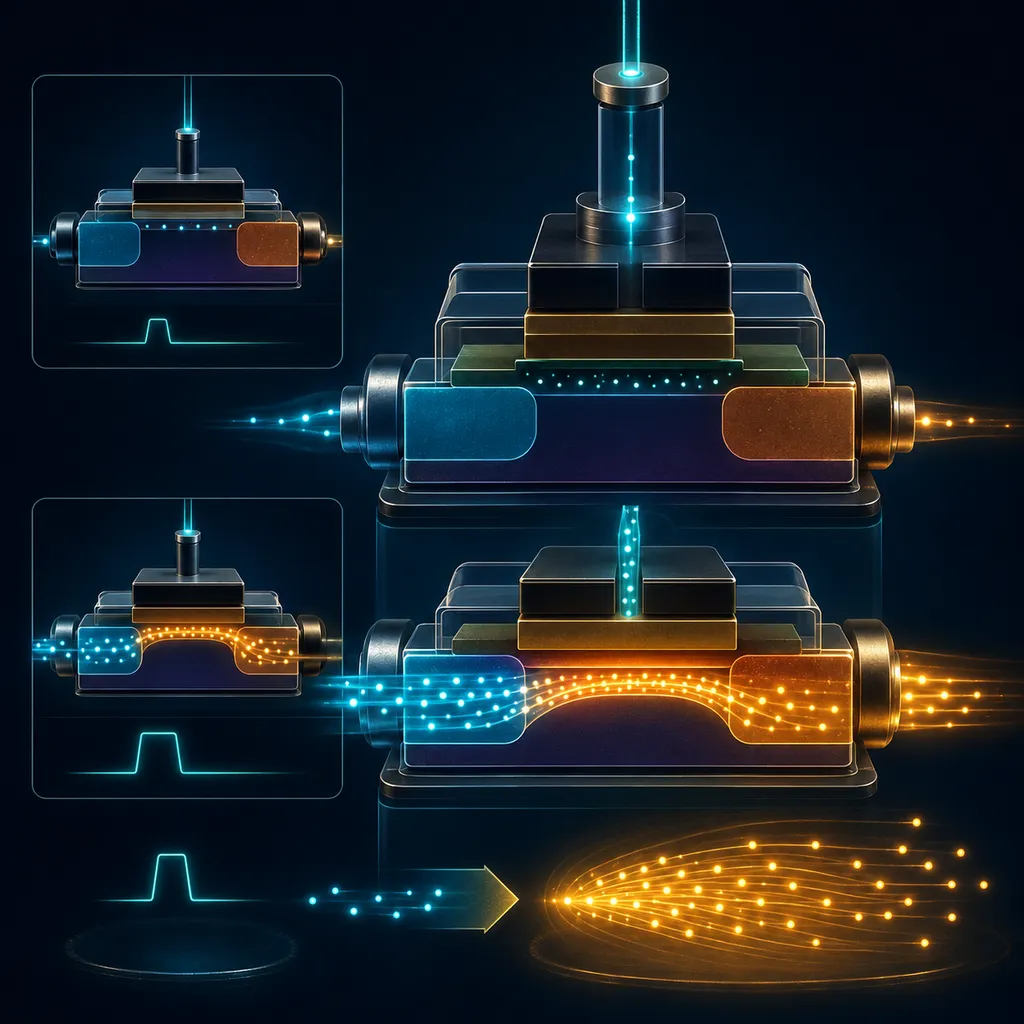
An extension of the topic of electric current and semiconductors. A small voltage on the transistor's gate/base controls a large current flowing through the channel — below the threshold the transistor is closed, above it the channel opens and conducts. This is the basis of signal amplification and switching (0/1) across all of modern electronics (Nobel 1956).
I'll give you a gate voltage U_g — guess the channel state (no slider). Threshold U_th = 1.8 V.
What just happened?
Below the threshold voltage the channel between source and drain is closed — the current I_D is zero, regardless of what voltage is waiting at the drain. Once the gate voltage crossed the threshold U_th, the channel opened and a current started to flow, growing as U_g rises further.
Simplified conduction model:
— U_g is the control voltage at the gate (or base in a bipolar transistor), U_th is the threshold voltage, and I_D is the current flowing between drain and source (respectively: collector and emitter). Below the threshold the channel is closed; above it — the larger the excess U_g − U_th, the more current the channel conducts.
What does this mean in practice?
A tiny change in the gate voltage (on the order of single volts, microwatts of power) can switch a much larger current through the channel on or off. It is exactly this "lever" — a small signal controls a large current — that lets the transistor amplify signals and act as a 0/1 switch, i.e. a logic gate in a computer.
Why the 1956 Nobel Prize in Physics?
John Bardeen, Walter Brattain and William Shockley built the first transistor at Bell Labs in 1947, replacing the much larger, power-hungry and failure-prone vacuum tubes. That single invention launched all of semiconductor electronics — from the transistor radio to today's integrated circuits with billions of transistors acting as 0/1 switches.
Why you need this for the exam:
Remember the direction of the relationship: below the threshold — no current, above the threshold — the current grows with the control voltage. That is enough to describe how the transistor works as an amplifier and as a switch in problems about electricity and electronics.
Remember: the "on/off" state and the magnitude of the current I_D depend on the control voltage U_g relative to the threshold voltage U_th — a small signal at the gate controls a large current in the channel.
Theory & formulas
Controlling current
A transistor has three terminals. A small control voltage (at the base or gate) governs the large main channel current.
Conduction threshold
- below the threshold → transistor closed (current ~0),
- above the threshold → open, conducting.
Two uses
- amplification: a small change in produces a large change in the output current,
- switch (0/1): the basis of digital electronics (Nobel 1956).
Notation: — control voltage (base–emitter or gate), threshold — the turn-on threshold voltage.
Frequently asked questions
›How does a transistor amplify a signal?
Small changes in the control voltage cause large changes in the current flowing through the transistor's channel.
›What is the threshold voltage?
The value of the control voltage above which the transistor starts to conduct current.
›Why did the transistor revolutionize electronics?
It replaced the much larger and less durable vacuum tubes, enabling the miniaturization of circuits.
Teaching? Embed this experiment on your site.
Free widget — paste it on your school site, blog or notes. It links to the full version.