Superconductivity and the Meissner effect
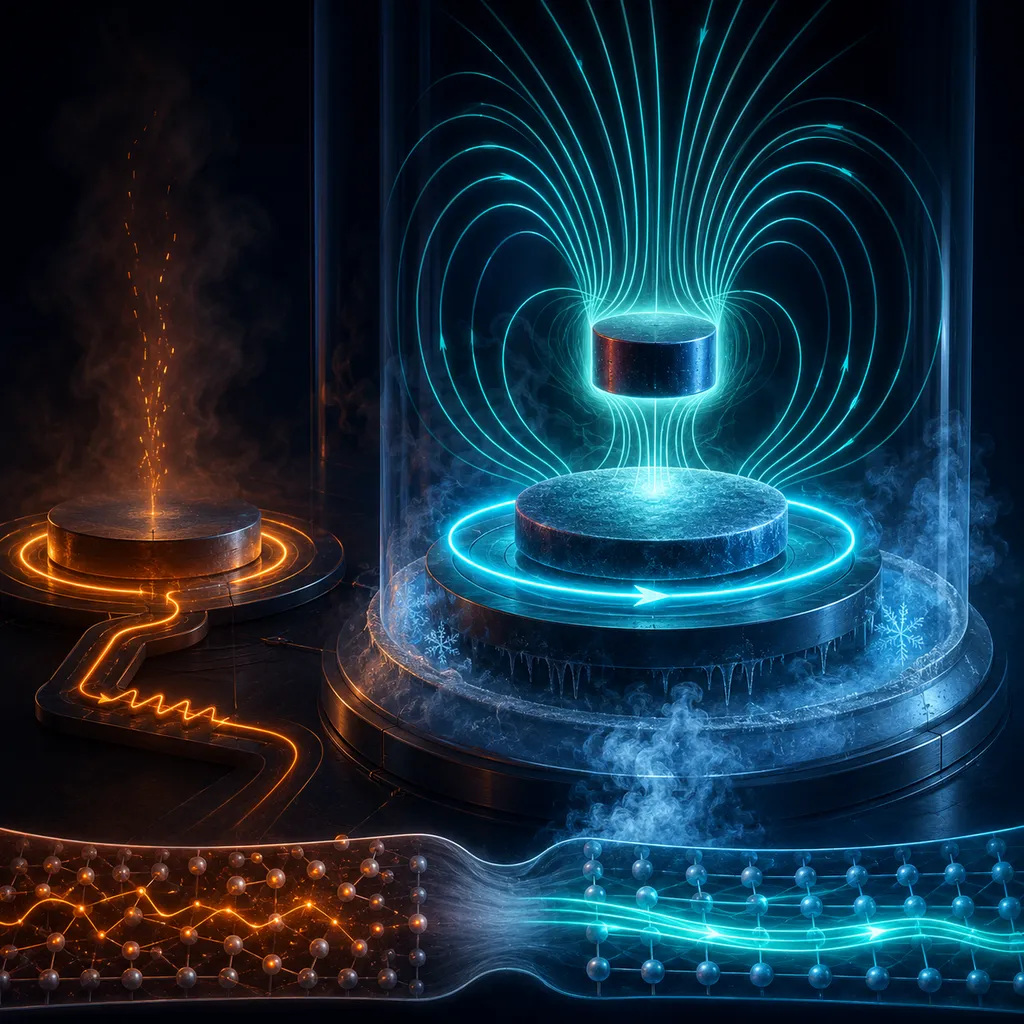
This extends the school topic of electrical resistance and its dependence on temperature and magnetic field — beyond the core curriculum. Cool the sample: below the critical temperature the resistance drops abruptly to zero (current without losses), and the expelled magnetic field lifts the magnet (the Meissner effect).
I'll give you the sample temperature — guess its state (no slider). Critical temperature T_c = 92 K.
What just happened?
Above the critical temperature the sample is an ordinary metal — its resistance rises linearly with temperature. Once cooled below the resistance drops abruptly to zero: the material enters the superconducting state.
Resistance vs. temperature:
— for a metal the resistance is directly proportional to temperature, but at the critical temperature a sudden jump appears: . For YBCO .
Current without losses:
When , current flows through the sample, but no Joule heat is released:
Charges flow without resistance — once started, a current can circulate in a superconducting loop practically forever.
Meissner effect:
Below the superconductor expels the magnetic field from its interior ( inside). Screening currents on the surface create a field opposing the external one — that is why the magnet rises and levitates above the sample. Maglev trains exploit this phenomenon.
Where does this work?
Superconductors carry enormous currents without losses — hence the strong electromagnets in MRI scanners, particle accelerators, and levitating maglev trains.
Why this matters for the exam:
This extends the topic of electrical resistance and its dependence on temperature and magnetic field. Trick: check whether is above or below — that decides whether the resistance rises with temperature or is exactly zero (and then ).
Remember: below the critical temperature a superconductor's resistance is exactly zero — the current flows without losses, and the magnetic field is expelled (Meissner effect → levitation).
Theory & formulas
Zero resistance
Above the critical temperature the resistance of a metal rises with temperature. Below the resistance of a superconductor drops abruptly to zero: The current then flows without any energy loss (no release of Joule heat ).
The Meissner effect
A superconductor completely expels the magnetic field from its interior. The expelled field lines create a lifting force — the magnet levitates above the sample.
Applications
Strong electromagnets (MRI scanners), maglev trains, particle accelerators — everywhere large currents are needed without losses.
Symbols: — electrical resistance, — temperature, — critical temperature, — electric current.
Frequently asked questions
›What is a superconductor?
A material that has zero resistance below the critical temperature — current flows through it without any energy loss.
›Why does the magnet levitate?
A superconductor expels the magnetic field (the Meissner effect), creating a force that lifts the magnet.
›Where is it used?
In strong magnets (MRI scanners), maglev trains and particle accelerators.
Teaching? Embed this experiment on your site.
Free widget — paste it on your school site, blog or notes. It links to the full version.
Related experiments