LC oscillating circuit — wave emission
In an LC oscillating circuit energy sloshes between a capacitor (electric field) and an inductor (magnetic field) at frequency f=1/(2π√(LC)) (Thomson's formula). A connected antenna radiates an electromagnetic wave. To raise the frequency, you must reduce the product L·C. Change L and C.
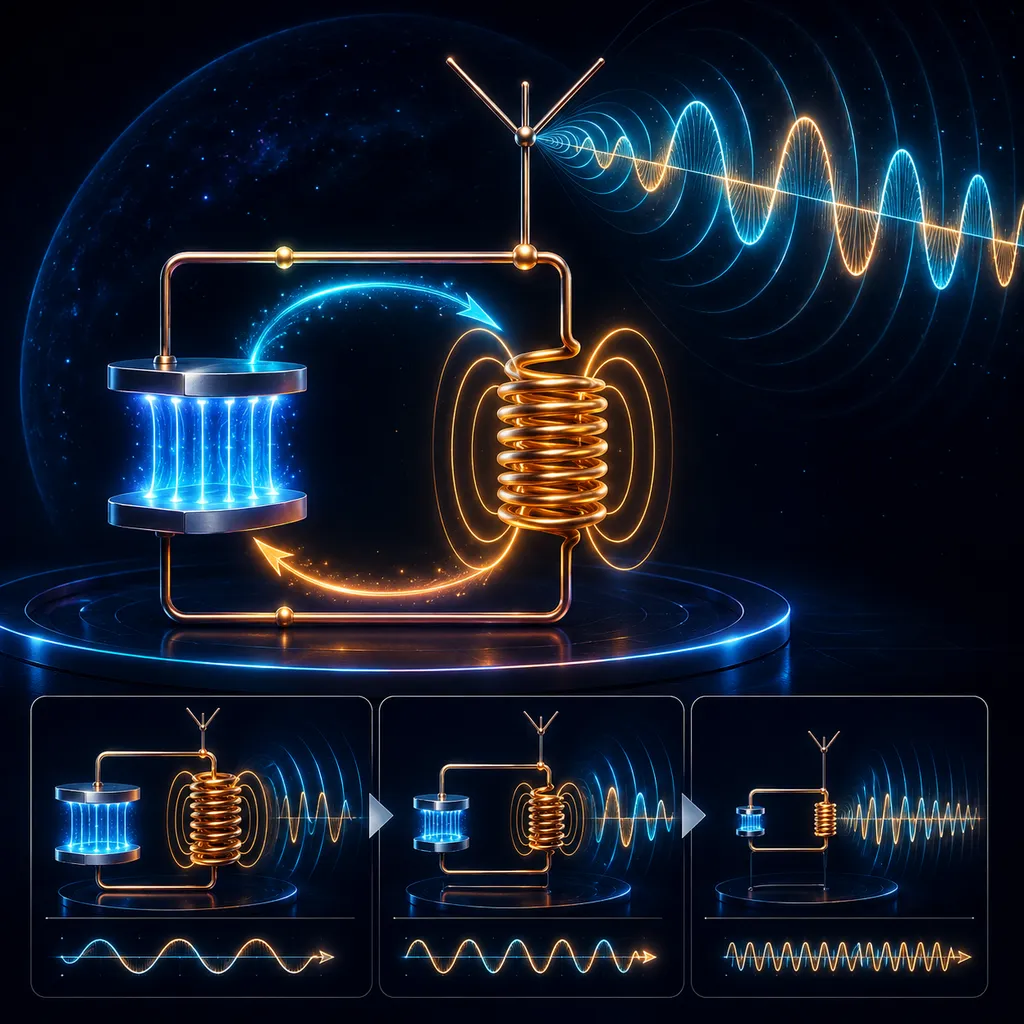
I’ll give you a target oscillation frequency for the antenna — tune L and C to reach it. f = 1/(2π√(LC)).
What just happened?
In an LC circuit the charge sloshes round and round: the capacitor discharges through the inductor, and the inductor — thanks to induction — charges the capacitor back up, but with the opposite sign. Electrical oscillations arise. A connected antenna turns them into an electromagnetic wave sent out into space — this is how a radio wave is born.
Oscillation frequency (Thomson’s formula):
— the smaller the product , the higher the frequency , and so the shorter the wave (). L — inductance of the coil (H), C — capacitance of the capacitor (F), f — frequency (Hz).
Conservation of energy:
In an ideal circuit (no resistance) the total energy is constant — it only sloshes between the electric field of the capacitor and the magnetic field of the inductor:
Analogy with a pendulum:
The LC circuit oscillates like a pendulum. The capacitor plays the role of the spring (it stores potential energy — field E), and the inductor the role of the mass (it stores energy of motion — field B). The energy is now "in the spring", now "in the motion", and its total does not change — exactly as in mechanical oscillations.
Why you need this for the exam:
The formula plus solve most problems about oscillating circuits and radio waves. The trick: compute f from Thomson’s formula, then the wavelength from the speed of light.
Remember: an LC circuit oscillates faster the smaller the product L·C, and the total energy circulates between field E and field B and never disappears — f = 1/(2π√(LC)).
Theory & formulas
The LC oscillating circuit
Energy sloshes between a capacitor (electric field) and an inductor (magnetic field) — an analogy with mechanical oscillations (C like a spring, L like a mass).
Frequency (Thomson's formula)
To raise the frequency, reduce the product . A connected antenna radiates an EM wave.
Symbols: — oscillation frequency, — inductance of the coil, — capacitance of the capacitor.
Frequently asked questions
›How does a radio wave form?
Current oscillations in an LC circuit connected to an antenna produce changing E and B fields, which detach and travel out as an EM wave.
›What does the circuit's frequency depend on?
On the inductance L and the capacitance C: f=1/(2π√(LC)). Smaller L·C → higher frequency.
›Analogy with a pendulum?
The capacitor is like a spring (a store of potential energy), and the inductor like a mass (inertia) — energy oscillates between them as in mechanical oscillations.
Teaching? Embed this experiment on your site.
Free widget — paste it on your school site, blog or notes. It links to the full version.