Gravitational field — strength vs. distance
Move away from the mass and watch the gravitational field strength g=GM/r² weaken. Doubling the distance weakens the field fourfold — that is the inverse-square law. Watch the field lines and the shrinking g vector.
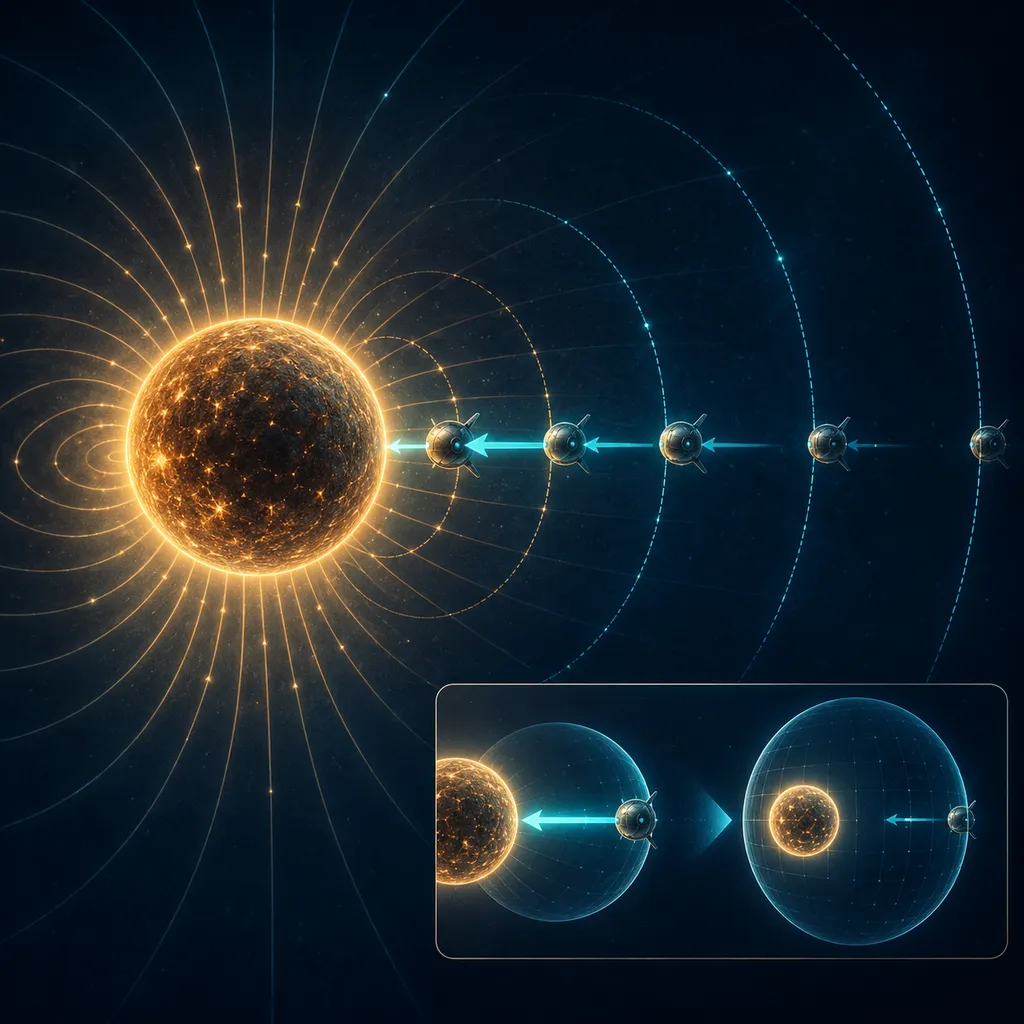
I will give you a target field strength g — set the distance r that produces it. g = GM/r² (here GM = 1).
What just happened?
You moved twice as far, and the field strength dropped fourfold. The gravitational field weakens with the square of the distance — twice as far means four times weaker.
Gravitational field strength:
— the field strength at a given point is directly proportional to the source mass M and inversely proportional to the square of the distance r. G — gravitational constant, M — mass (kg), r — distance from the centre of mass (m), g — field strength (N/kg).
What does it mean in practice?
Close to the mass the field is strong, farther away it weakens sharply. This is the same relationship as for the gravitational force acting on a test mass m:
Why “inverse square”?
Field lines spread out over an ever larger sphere with area . The same “number” of lines spreads over an area growing as , so their density — and with it the field strength — decreases as .
Why you need it for the exam:
The inverse-square law is the key to problems on gravitation, orbits and weight at different altitudes. Trick: count how many times r changes, and square it — that is how many times (inversely) g changes.
Remember: the gravitational field strength decreases with the square of the distance — g = GM/r², i.e. g ∝ 1/r². Twice as far ⇒ four times weaker.
Theory & formulas
Field strength
The gravitational field strength is the force acting on a unit mass at a given point: Its value is numerically equal to the gravitational acceleration .
Inverse-square law
The field strength decreases with the square of the distance: doubling weakens the field fourfold ().
Field vs. force
The field strength is a property of the field itself (it does not depend on the test mass). The force on a test body is only then .
Notation: — gravitational field strength, , — mass of the field source, — distance, — test mass, — force.
Frequently asked questions
›What is gravitational field strength?
The force acting on a unit mass, g=GM/r²; its value is the gravitational acceleration at a given point.
›Why is twice as far four times weaker?
Because g depends on 1/r²; at r→2r the denominator grows 4× (2²), so the field strength drops 4×.
›How does field strength differ from the gravitational force?
The force F=mg depends on the test mass, while the field strength g=GM/r² is a property of the field itself, independent of the test mass.
Teaching? Embed this experiment on your site.
Free widget — paste it on your school site, blog or notes. It links to the full version.