Gravitational lensing — the bending of light
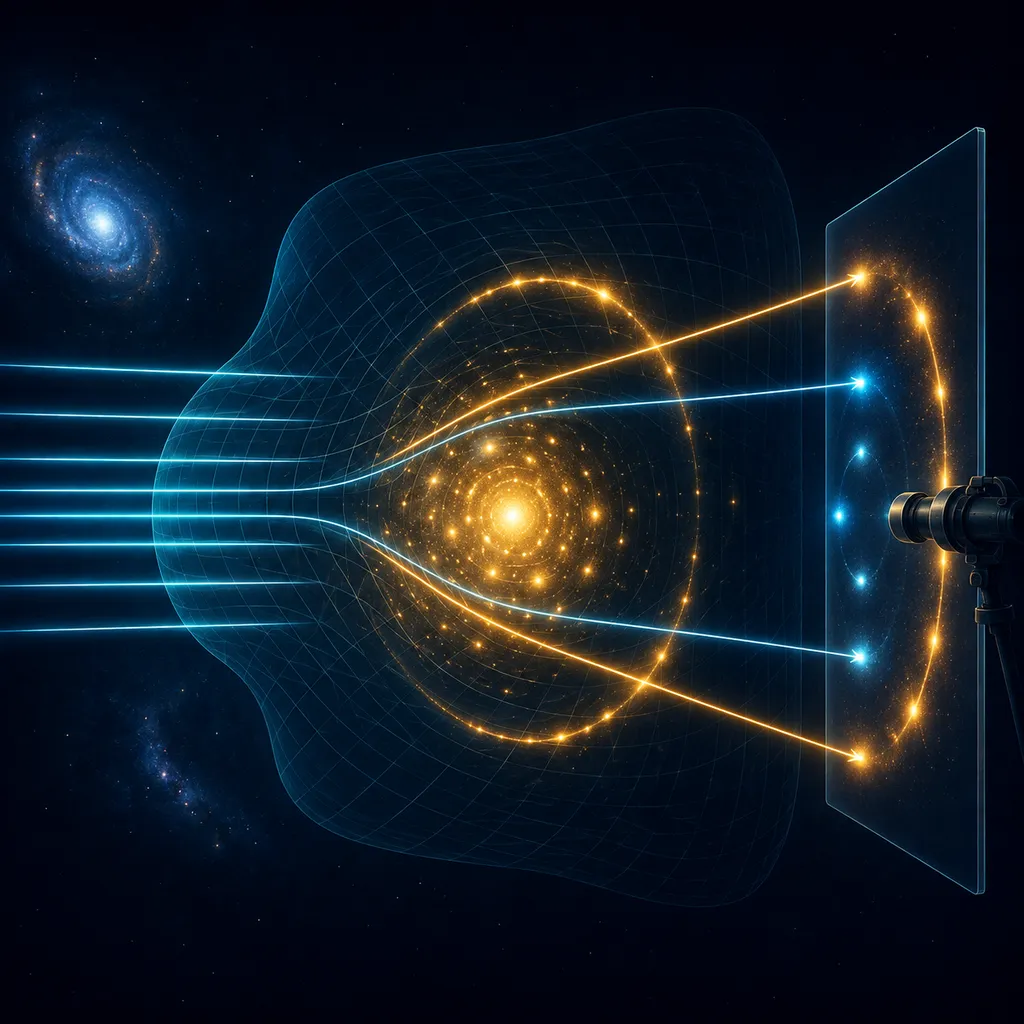
Mass curves spacetime, so light passing nearby “turns”. Set the lens mass and the impact parameter, and compare the deflection angle according to Einstein (4GM/c²b) and according to Newton (2× smaller). Eddington's measurement during the 1919 eclipse settled the dispute in Einstein's favour.
I’ll give you a target deflection angle α — tune the mass M and impact parameter b to reach it. α = 4GM/c²b.
What just happened?
Mass curves spacetime, and light passing nearby “turns”. A ray from a distant star, grazing the Sun, bends — the star’s image shifts on the sky. The angle of this deflection can be predicted and measured.
Deflection angle (GR):
That is twice as much as the naive “Newtonian” analogy gave (treating light as an ordinary particle). A perfect source–mass–observer alignment produces an Einstein ring of angular radius .
Invariant — scaling:
(more mass → stronger deflection) and (closer to the mass → stronger). For the Sun’s limb the famous comes out.
Why this matters for your exams:
This is an academic extension of gravitation and relativity. The 1919 eclipse and Eddington’s measurement made Einstein famous; today gravitational lenses serve as “telescopes” and dark-matter detectors.
Remember: — gravity bends light 2× more strongly than Newton would. Confirmed: Eddington 1919.
Theory & formulas
Bending of light
Mass curves spacetime, so light passing nearby “turns”. The deflection angle according to general relativity:
Twice as much as Newton
Treating light naively as a particle (Newton) gives — half. The dispute was settled by Eddington's measurement during the eclipse (1919) in Einstein's favour.
Einstein ring
With a perfect source–mass–observer alignment, the image of the source smears into a luminous ring.
Notation: — deflection angle, — gravitational constant, — lens mass, — speed of light, — impact parameter (the ray's closest approach to the mass).
Frequently asked questions
›Why does gravity bend light?
In general relativity mass curves spacetime, and light travels “along the straightest path” in this curved geometry — which near a mass is curved. The effect is independent of the fact that a photon has no rest mass.
›Why 2× more than Newton?
Treating light naively as a particle in a gravitational field (Newton) gives half. Full general relativity accounts for the curvature of both space and time — these two contributions add up, giving α = 4GM/c²b, twice as much.
›What is an Einstein ring?
When the source, the lensing mass and the observer line up perfectly, the image of the source smears into a luminous ring of angular radius θ_E. Such rings are really observed around massive galaxies and clusters.
Teaching? Embed this experiment on your site.
Free widget — paste it on your school site, blog or notes. It links to the full version.