Newton's law of universal gravitation — the formula F = G·m₁m₂/r²
What we'll do: We'll change the masses of two bodies and the distance between them, watching how the gravitational force changes — and in satellite mode, how gravity keeps a body in orbit.
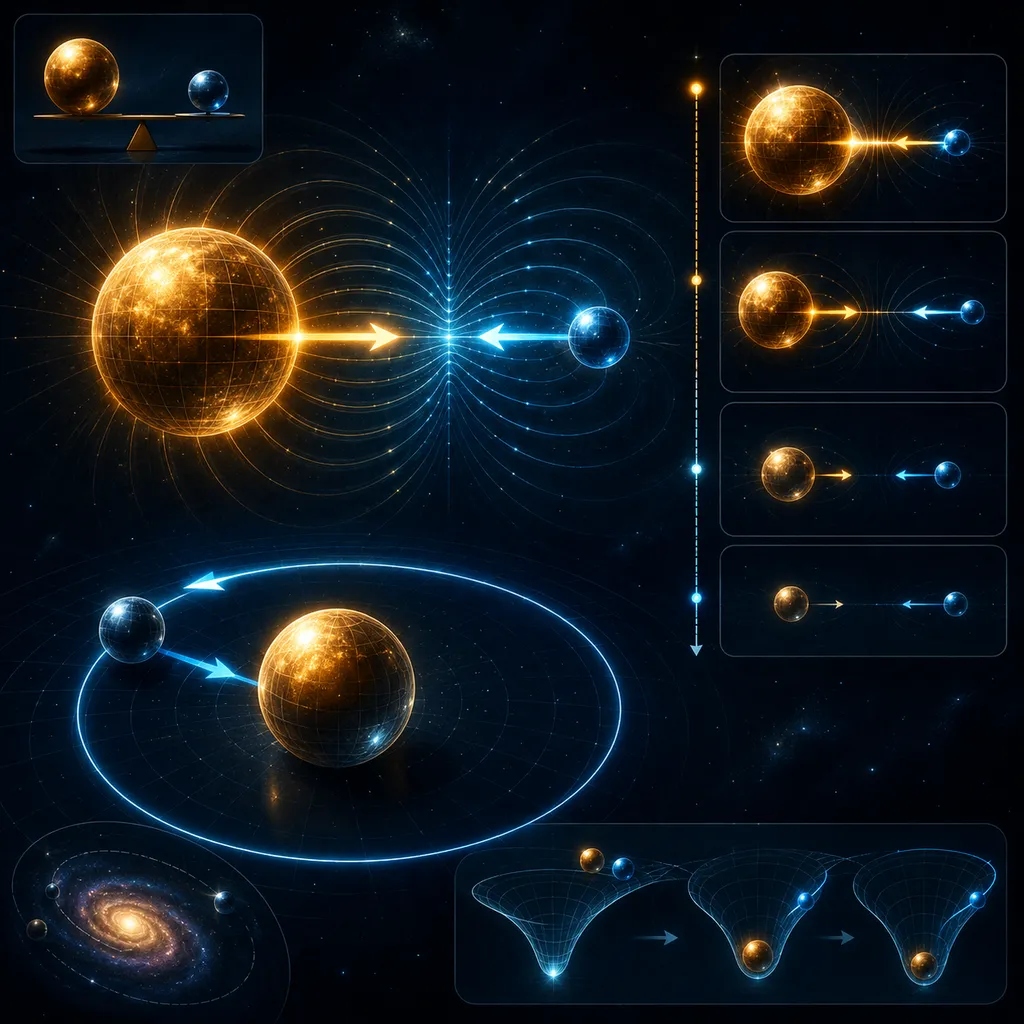
What you see on screen: Two bodies with arrows of mutual attraction, sliders for the masses and the distance, and a force bar that decreases with the square of the distance. In satellite mode the smaller body orbits the larger one. Readouts: masses, distance, gravitational force and orbital speed.
I'll give you a target gravitational force — tune the masses and the distance to reach it. F = G·m₁m₂/r².
What just happened?
You doubled the distance, and the gravitational force dropped not two but FOUR times. This is the inverse-square law.
Newton's law of universal gravitation:
every two bodies attract each other with a force directly proportional to the product of their masses and inversely proportional to the square of the distance between them:
G is the gravitational constant. The force grows with the masses but decreases very quickly with distance (squared!).
Why "universal"?
Because it applies to ALL bodies — from an apple and the Earth to the Earth and the Sun. The same force holds us on the surface and keeps the planets in their orbits.
Gravity as a centripetal force:
in orbit it is gravity that "curves" the satellite, acting as the centripetal force — hence the orbital speed
Why you need this for the exam:
F = Gm₁m₂/r², computing the force, the gravitational field strength and orbital speeds is the core of the gravitation unit. Trick: remember the square in the denominator.
Remember: the gravitational force grows with the product of the masses and decreases with the square of the distance (F = Gm₁m₂/r²). Doubling the distance = a fourfold drop in force.
Theory & formulas
Newton's law of universal gravitation
Two bodies attract each other with a force directly proportional to the product of their masses and inversely proportional to the square of the distance:
The inverse-square law
Doubling the distance weakens the force fourfold (), tripling it — ninefold.
A satellite's orbit
In a circular orbit gravity acts as the centripetal force (), hence the orbital speed:
Symbols: — gravitational force, — the gravitational constant, — the masses of the bodies, — the mass of the central body, — the distance, — the orbital speed.
Frequently asked questions
›What does Newton's law of universal gravitation state?
Two bodies attract each other with a force F = G·m₁m₂/r² — proportional to the product of the masses and inversely proportional to the square of the distance.
›How does the gravitational force change when the distance doubles?
It decreases fourfold (the inverse-square law).
›What keeps a satellite in orbit?
The gravitational force — it acts as the centripetal force that curves the path of motion.
Teaching? Embed this experiment on your site.
Free widget — paste it on your school site, blog or notes. It links to the full version.