Satellite orbit — altitude, speed, period
A satellite on a circular orbit stays up thanks to the balance between gravity and the centripetal force: v=√(GM/r), and the period T=2π√(r³/GM) (r = R+h). The higher it is, the slower it goes and the longer the period. At an altitude of ~35,800 km the period equals one day — this is the geostationary orbit. Change the orbital altitude.
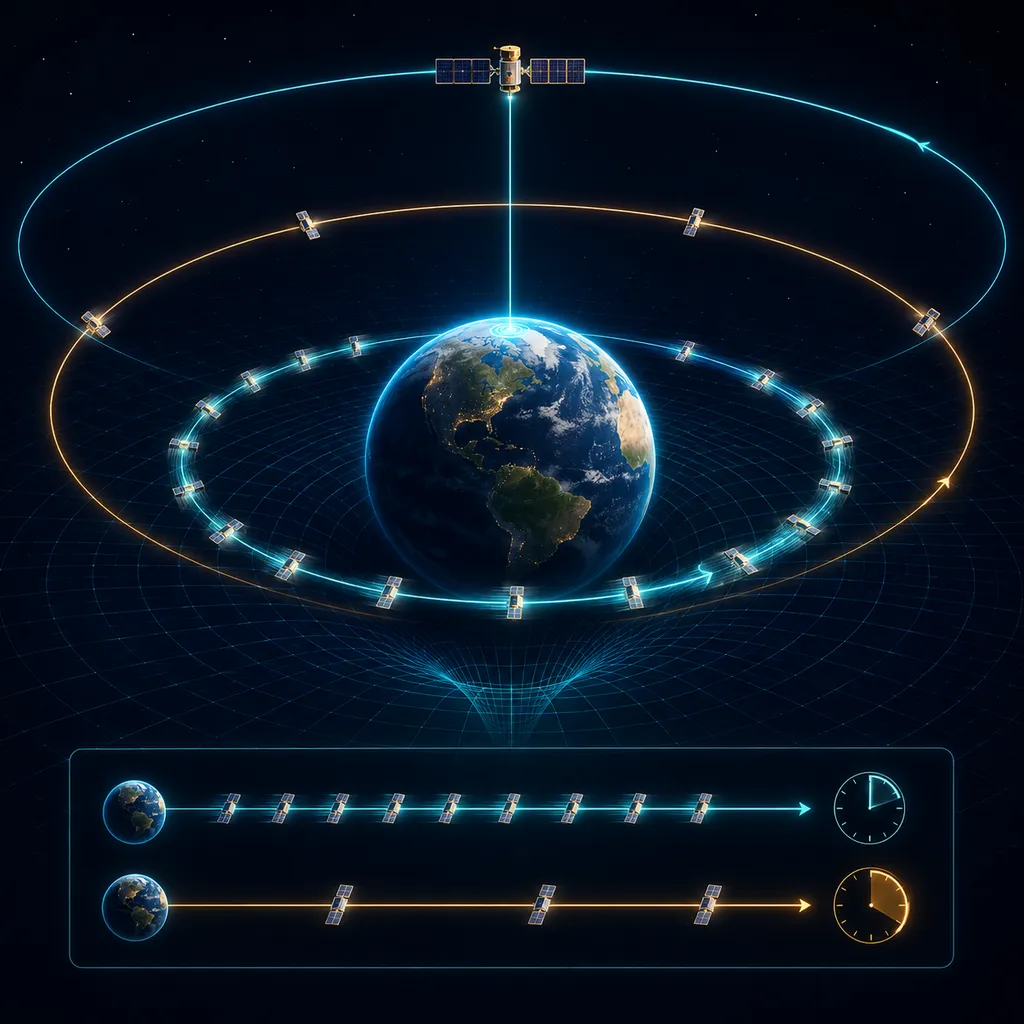
What just happened?
You raised the orbit, and the satellite slowed down and needs more time for one revolution. The farther from Earth, the lower the speed and the longer the period.
Where does this come from?
On a circular orbit, gravity acts as the centripetal force — it keeps the satellite moving in a circle:
The satellite's mass cancels out. What remains is the dependence of speed and period on the orbital radius alone:
— the larger , the smaller and the larger . This is exactly Kepler's third law: .
Geostationary orbit
When ( above the equator), the satellite orbits Earth at the same rate as the planet rotates — from the ground it looks as if it hangs motionless. This is how TV and weather satellites work.
Why doesn't the satellite fall?
It is falling the whole time — gravity constantly curves its path toward Earth. But its horizontal speed is so large that Earth's surface "falls away" beneath it just as fast. This continuous falling "past" the planet is precisely the orbit.
Why this matters for the exam:
Three formulas — , , — solve most satellite problems. The trick: first compute the orbital radius (add Earth's radius to the altitude!), then substitute into or .
Remember: a higher orbit means lower speed and a longer period — , . Gravity plays the role of the centripetal force here.
Theory & formulas
Circular orbit
Gravity = centripetal force: , hence the orbital speed:
Orbital period
This is Kepler's third law: the higher you go (the larger ), the lower the speed and the longer the period. Remember .
Geostationary orbit
When , the satellite "hangs" over a single point on the equator ().
Symbols: — mass of the planet, — its radius, — orbital altitude, , — orbital speed, — period.
Frequently asked questions
›What is a geostationary orbit?
An orbit above the equator with a 24 h period (h≈35,800 km) — the satellite "hangs" over the same point on Earth, which is why it is used for telecommunications.
›Why does higher mean slower?
Because at a larger r gravity is weaker, so a smaller orbital speed is enough for balance (v=√(GM/r)); the period grows in line with Kepler's third law.
›Why doesn't the satellite fall?
Because it is falling all the time — but its horizontal speed makes it "miss" Earth, moving along the orbit (continuous free fall).
Teaching? Embed this experiment on your site.
Free widget — paste it on your school site, blog or notes. It links to the full version.