Horizontal projectile
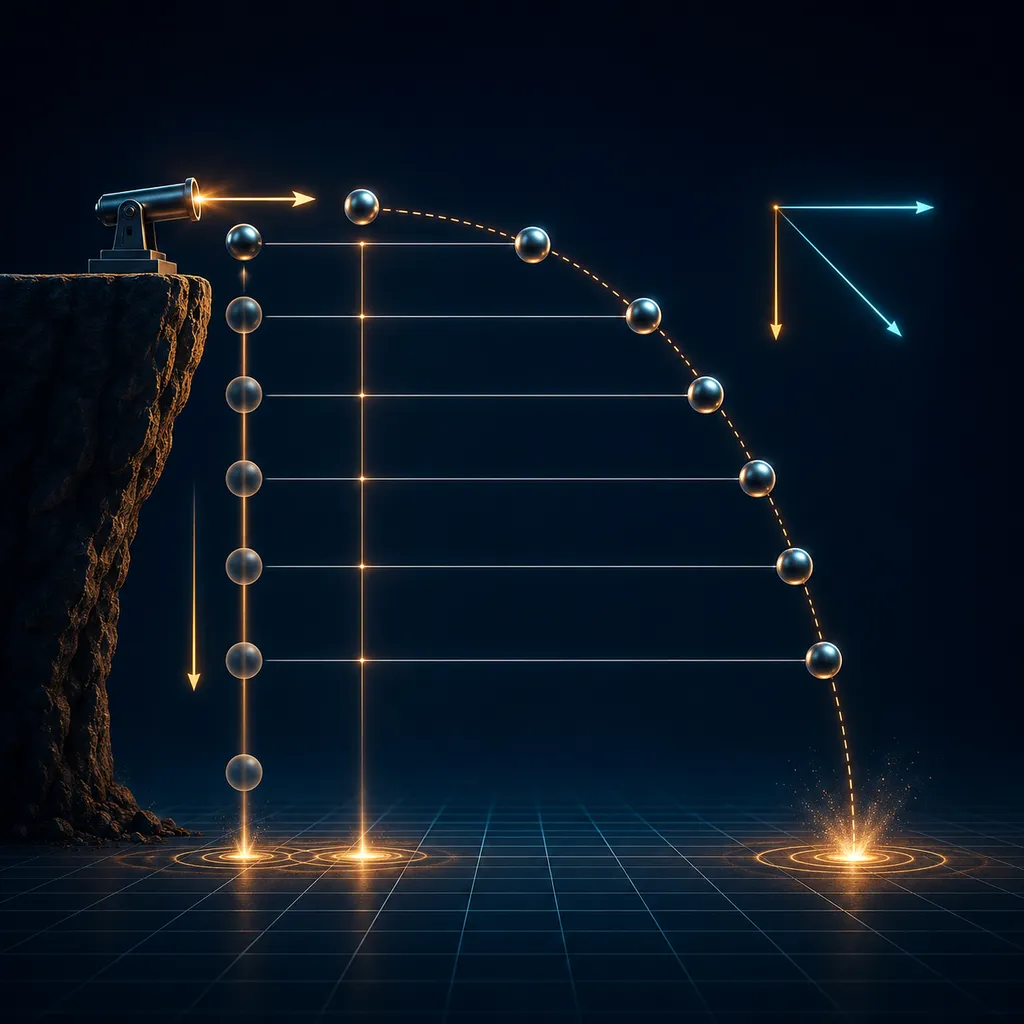
What we'll do: We fire a ball horizontally from a certain height and, at the same instant, drop a second one straight down. We check which one hits the ground first — and whether the horizontal speed affects the fall time at all.
What you see on screen: On the left, a launcher at height H, the flight path traced as a parabola, and strobe time markers every fraction of a second. The sliders set the initial speed and the height; the white line shows that both balls are at the same level at the same instant. Below: readouts for fall time, range and velocity components.
Why do they fall together?
Motion splits into two independent parts: horizontal and vertical — and they do not mix.
Vertically: gravity pulls both balls down the same way. Sideways speed has no vertical component, so it can neither speed up nor slow down the fall. The launched ball falls exactly as fast as the dropped one — second by second at the same height (that is why the white line connects them the whole time).
Horizontally: the launched ball travels at a constant speed sideways — hence the larger range. But this happens alongside the fall, not instead of it.
That is why the fall time depends only on the height , not on . Increase → the ball flies farther sideways, but lands at the same instant.
Remember: gravity does not care about sideways motion — it only handles up and down.
Mental model: picture the shadow of both balls on the wall behind — it moves identically, because it shows only the vertical motion.
Theory & formulas
Two independent motions
Horizontal projectile motion is a combination of uniform horizontal motion and free fall in the vertical direction. Gravity acts only vertically, so the fall time does not depend on the horizontal speed.
Velocity components
- horizontal (constant):
- vertical (grows with time):
- resultant:
Fall time
Depends only on the height (not on ):
Range
How far the ball travels horizontally:
Trajectory equation (parabola)
Substitute into :
Notation: — initial (horizontal) speed, — launch height, , — fall time, — range, — height above the ground.
Frequently asked questions
›Why do objects in horizontal projectile motion fall in the same time?
Vertical and horizontal motion are independent — only gravity acts vertically, so the fall time depends only on the height: t = √(2h/g).
›What determines the range of a horizontal projectile?
The initial speed and the fall time: x = v₀·t, where t = √(2h/g).
›What path does a body follow in horizontal projectile motion?
A parabola — the combination of uniform horizontal motion and uniformly accelerated vertical motion.
Teaching? Embed this experiment on your site.
Free widget — paste it on your school site, blog or notes. It links to the full version.