Antimatter — the discovery of the positron
An extension of the topic of mass–energy equivalence and elementary particles. Every particle has an antiparticle with identical mass and opposite charge — the electron has the positron (the antielectron). When they meet, they annihilate: all their mass turns into pure energy (gamma photons), in line with E=mc². Antimatter really exists — positrons are used in medical PET imaging (Nobel Prize in Physics 1936, Carl Anderson).
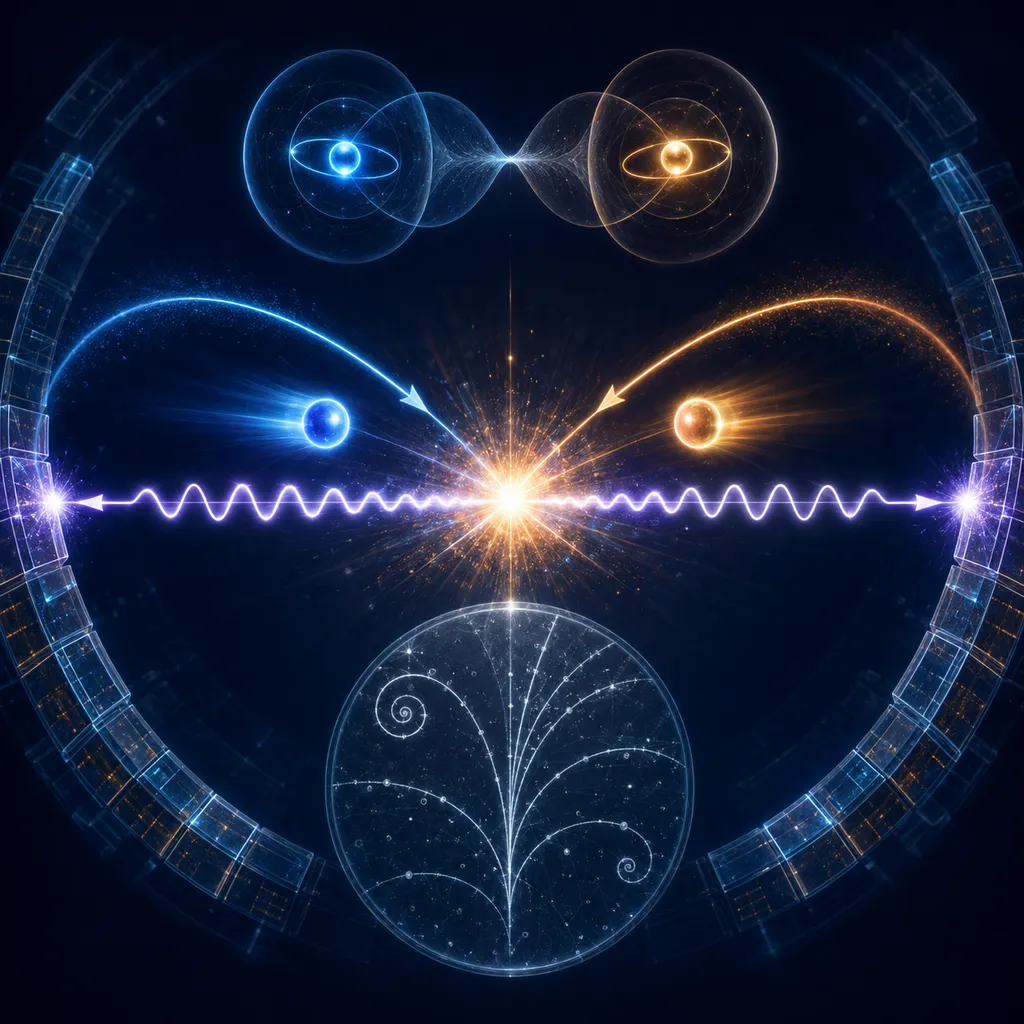
I’ll give you a particle and its rest energy mc² — pick the total photon energy from annihilating the pair. E = 2mc².
What just happened?
The electron and positron are a particle–antiparticle pair: they have exactly the same mass but opposite electric charge. When they meet, they do not form a “bigger” particle, nor do they repel — both vanish, and all their rest mass turns into pure gamma-radiation energy.
Pair annihilation:
— the energy of the two resulting gamma photons equals the sum of the rest energies of both particles (the electron and the positron), because both vanish. For the electron , so each of the two photons carries about 0.511 MeV — 1.022 MeV together.
What is antimatter and how do we know it exists?
In 1928 Paul Dirac, combining quantum mechanics with special relativity, theoretically predicted the existence of a “mirror image” of ordinary matter — particles with identical mass but opposite charge. In 1932 Carl Anderson, analysing the tracks of cosmic-ray particles in a cloud chamber placed in a magnetic field, observed the trace of a positively charged particle with the mass of an electron. He named it the positron — it was the first experimentally confirmed example of antimatter. For this discovery Anderson received the Nobel Prize in Physics in 1936.
Where is antimatter used? PET imaging
Positrons save lives every day in medical diagnostics. In PET (positron emission tomography) the patient is given a radioactive tracer that emits positrons. Each positron almost immediately meets an electron of the body’s ordinary matter and annihilates with it, emitting two 0.511 MeV gamma photons travelling in nearly opposite directions. Detectors surrounding the patient record these photon pairs, and from them a computer reconstructs an image — e.g. of regions of raised metabolism, characteristic of tumours.
Why is there so little antimatter in the Universe?
According to theory, the Big Bang should have produced equal amounts of matter and antimatter, which would have annihilated each other, leaving almost nothing. Yet the observed Universe consists almost entirely of ordinary matter. This “matter–antimatter asymmetry” is one of the great unexplained puzzles of modern physics — physicists look for answers in, among other things, subtle differences between the properties of particles and antiparticles.
Why you need this for the exam:
E = mc² (here in the pair version: E = 2mc²) is a basic tool for problems on nuclear transformations and annihilation — converting mass into energy (and back) is one of the pillars of modern physics at the advanced exam level.
Remember: an antiparticle has the same mass and opposite charge; on meeting its particle both vanish, and their mass turns into energy: E = 2mc². That is conservation of energy in action.
Theory & formulas
Particle and antiparticle
Every particle has an antiparticle with identical mass and opposite charge. The electron () has the positron ().
Annihilation
When an electron meets a positron, their mass turns entirely into the energy of two photons: Each photon carries an energy of .
Application
PET imaging is based on the annihilation of positrons with electrons in tissue.
Symbols: — total photon energy, — the electron mass, — the speed of light.
Frequently asked questions
›What is antimatter?
Matter made of antiparticles — identical in mass but with the opposite charge to ordinary matter particles.
›Where is antimatter used?
In medical PET imaging, where the annihilation of positrons with electrons in the body makes it possible to image tissues.
›Why is there so little antimatter in the Universe?
This is still an open problem in physics — the asymmetry between matter and antimatter that arose after the Big Bang.
Teaching? Embed this experiment on your site.
Free widget — paste it on your school site, blog or notes. It links to the full version.