Mass–energy equivalence
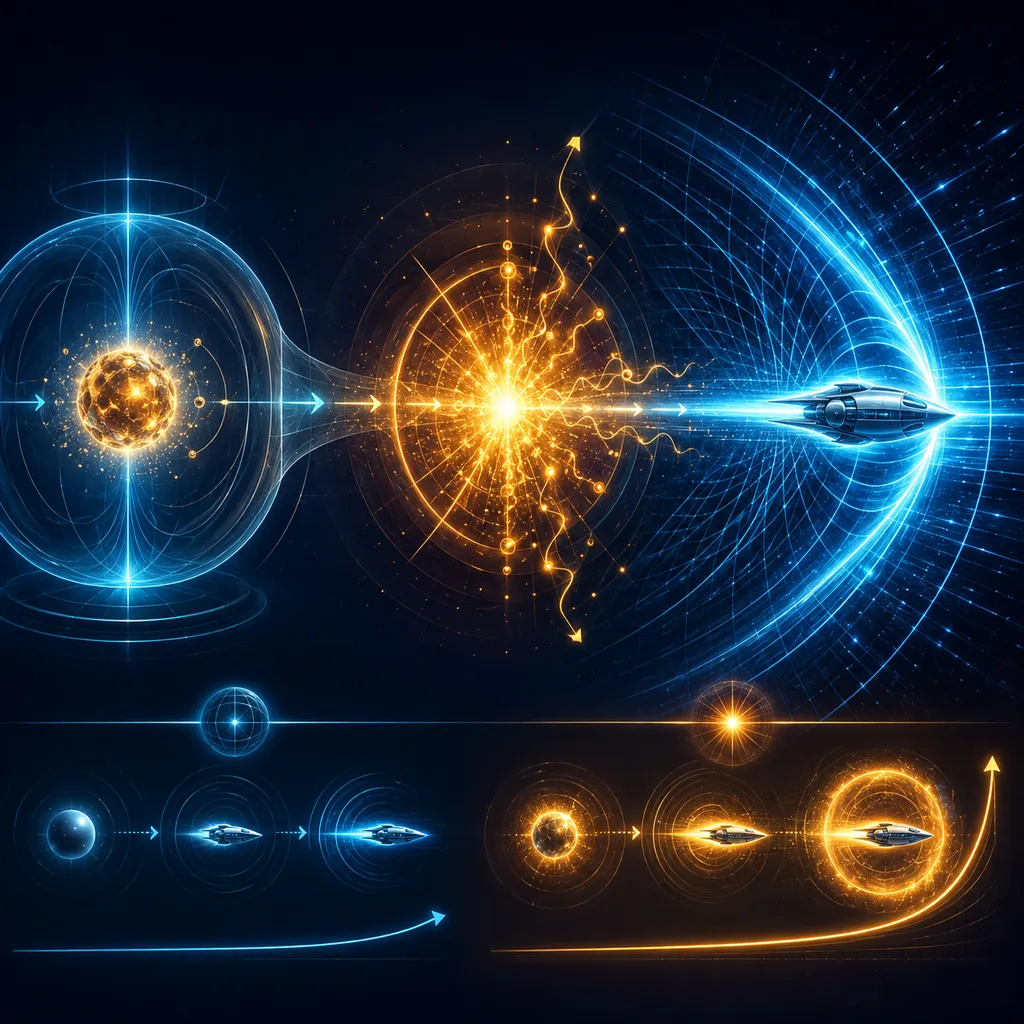
Mass and energy are equivalent: a body at rest has rest energy E₀=mc², and a moving one has total energy E=γmc². As the speed approaches c, γ (and so the energy) grows to infinity — that is why no massive body can reach the speed of light. Change the speed.
I will give you a target total energy E/E₀ — tune the speed to reach it. E/E₀ = γ.
What just happened?
The closer to the speed of light, the larger the Lorentz factor , and with it the total energy. As the energy grows without bound — the curve reaches the vertical asymptote.
Mass–energy equivalence:
— is the total energy, is the rest energy, and depends only on the speed. Hence .
What does E = mc² mean?
Mass is condensed energy: even a body at rest has rest energy . It is released in nuclear reactions and in the Sun — a tiny loss of mass yields enormous energy, because is a huge number.
Why can you not exceed c?
Accelerating a mass to would require , i.e. infinite energy. No finite source can supply it — the speed of light is a barrier for massive bodies.
What is the invariant?
The rest energy does not depend on the reference frame — it is the same for every observer. The energy grows (it depends on speed), but stays constant.
Why you need this for the exam:
and are the core of special-relativity problems. Trick: compute from the speed, then the energy — and remember that is unreachable for massive bodies.
Remember: mass is frozen energy (E₀ = mc²), and accelerating to the speed of light devours infinite energy, because E = γmc² and γ → ∞.
Theory & formulas
Rest energy
Even a body at rest has energy tied to its mass alone:
Total energy
A body moving with speed has energy:
The speed-of-light barrier
As , the factor , so the energy grows to infinity. Infinite energy cannot be supplied — that is why no massive body will reach the speed of light. The mass defect in nuclear reactions converts into energy according to .
Notation: — rest energy, — total energy, — (rest) mass, , — Lorentz factor, — speed.
Frequently asked questions
›What does E=mc² mean?
That mass is a form of energy — even a body at rest has energy E₀=mc². The mass defect in nuclear reactions converts into energy.
›Why can you not exceed c?
Because the energy needed to accelerate a body grows to infinity as v→c (E=γmc², γ→∞). Infinite energy cannot be supplied.
›What is rest energy?
The energy E₀=mc² tied to the body's mass alone, independent of the reference frame and of motion.
Teaching? Embed this experiment on your site.
Free widget — paste it on your school site, blog or notes. It links to the full version.