Mass defect and binding energy
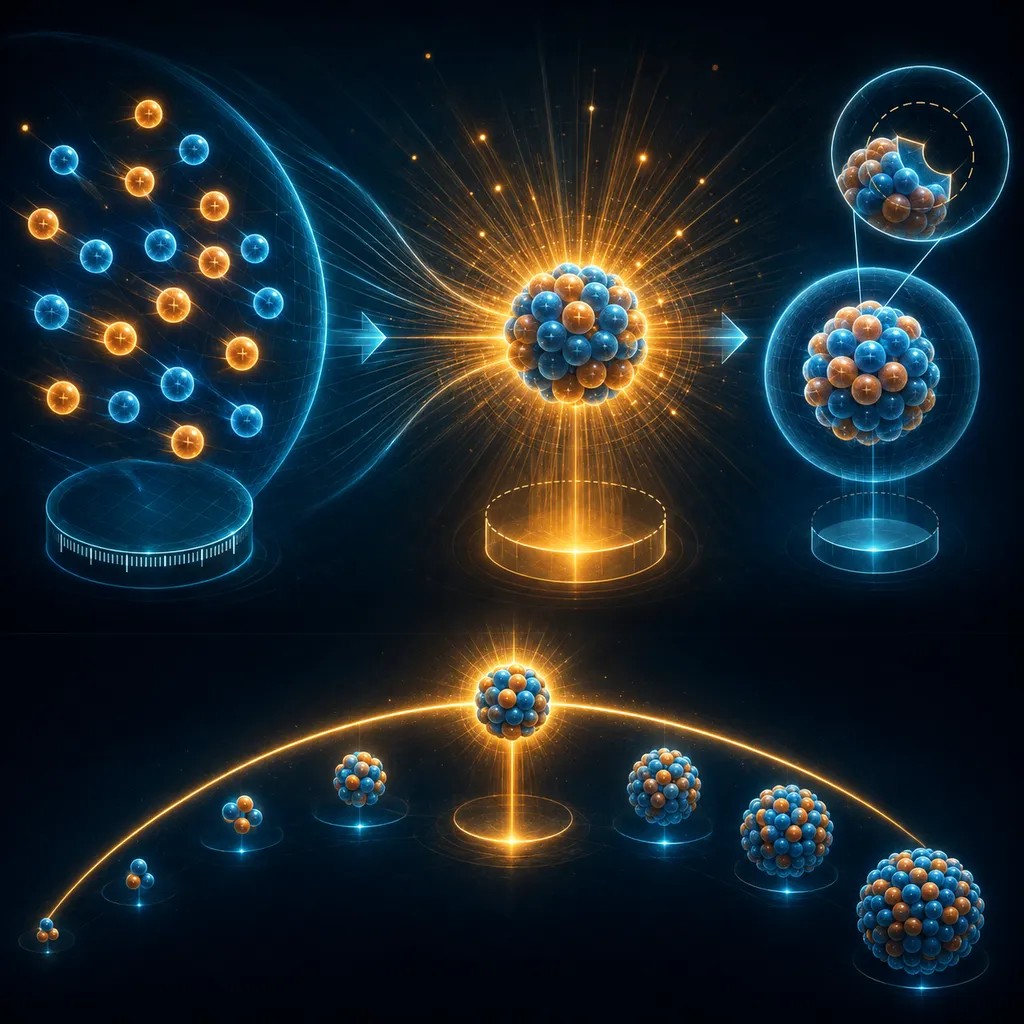
A nucleus's mass is smaller than the sum of the masses of the nucleons that make it up — this shortfall is the mass defect Δm, and the corresponding binding energy is E=Δm·c². Binding energy per nucleon peaks for nuclei with a mass near iron's (Fe-56), which is why they are the most stable. Change the mass number A and watch the curve.
I'll give you a target binding energy per nucleon — pick the mass number A so the point on the curve reaches it.
What is mass defect?
A nucleus's mass is smaller than the sum of the masses of the free protons and neutrons that make it up. This missing piece of mass is the mass defect . It vanished because energy was released when the nucleons were bound together — and energy has mass.
Invariant — binding energy:
Binding energy is the energy you must supply to pull a nucleus apart into separate nucleons — and it equals exactly the mass defect times . Dividing by the number of nucleons gives — a measure of how tightly a single nucleon is held.
Why is Fe-56 the most stable?
The curve climbs steeply for light nuclei, reaches a peak at A ≈ 56 (iron, ~8.8 MeV per nucleon), then slowly falls. The top = the largest binding energy per nucleon = the most tightly bound, most stable nucleus. All other nuclei "want" to move toward this peak.
Where does nuclear energy come from?
From the binding-energy difference. Fusion of light nuclei (the Sun) and fission of heavy ones (a reactor) — both shift nuclei toward Fe-56, into a region of higher . The surplus binding energy is released as the reaction's energy.
Why you need this for the exam:
Nuclear problems almost always come down to : compute the mass defect (sum of nucleon masses minus the nuclear mass), multiply by . And the shape of the curve, with its maximum at iron, explains why the Sun shines and a reactor works.
Remember: a nucleus's mass < the sum of nucleon masses, and that difference is the binding energy: . The peak of the curve at Fe-56 is the most stable nucleus in the Universe.
Theory & formulas
Mass defect
A nucleus's mass is smaller than the sum of the masses of the nucleons that make it up. This missing piece is the mass defect:
Binding energy
The mass defect corresponds to the binding energy (Einstein's formula): This is the energy you must supply to pull the nucleus apart into free nucleons.
Energy per nucleon
Stability is governed by the binding energy per single nucleon: It reaches a maximum for nuclei with a mass close to iron (-56) — which is why they are the most stable.
Symbols: — mass defect, — number of protons, — number of neutrons, — masses of the proton and the neutron, — mass of the nucleus, — mass number, — binding energy, .
Frequently asked questions
›What is the mass defect?
The difference between the sum of the nucleon masses and the actual (smaller) mass of the nucleus. It corresponds to the binding energy: E=Δm·c².
›Why is Fe the most stable?
Because it has the largest binding energy per nucleon — its nucleons are bound most tightly, so splitting or fusing such a nucleus no longer releases energy.
›Where does nuclear energy come from?
From the difference in binding energy: when the reaction products are closer to the peak of the curve than the reactants, the excess energy is released (E=Δm·c²).
Teaching? Embed this experiment on your site.
Free widget — paste it on your school site, blog or notes. It links to the full version.