Discovery of the neutron — isotopes of the same element
An extension of the topic of atomic nucleus structure and isotopes. The atomic nucleus is made of protons (positive) and neutrons (electrically neutral). The number of protons (Z) determines the element, but the number of neutrons (N) can differ for the same number of protons — giving isotopes of the same element with different masses (A = Z + N). James Chadwick discovered the neutron in 1932, completing the picture of the nucleus (Nobel Prize in Physics 1935).
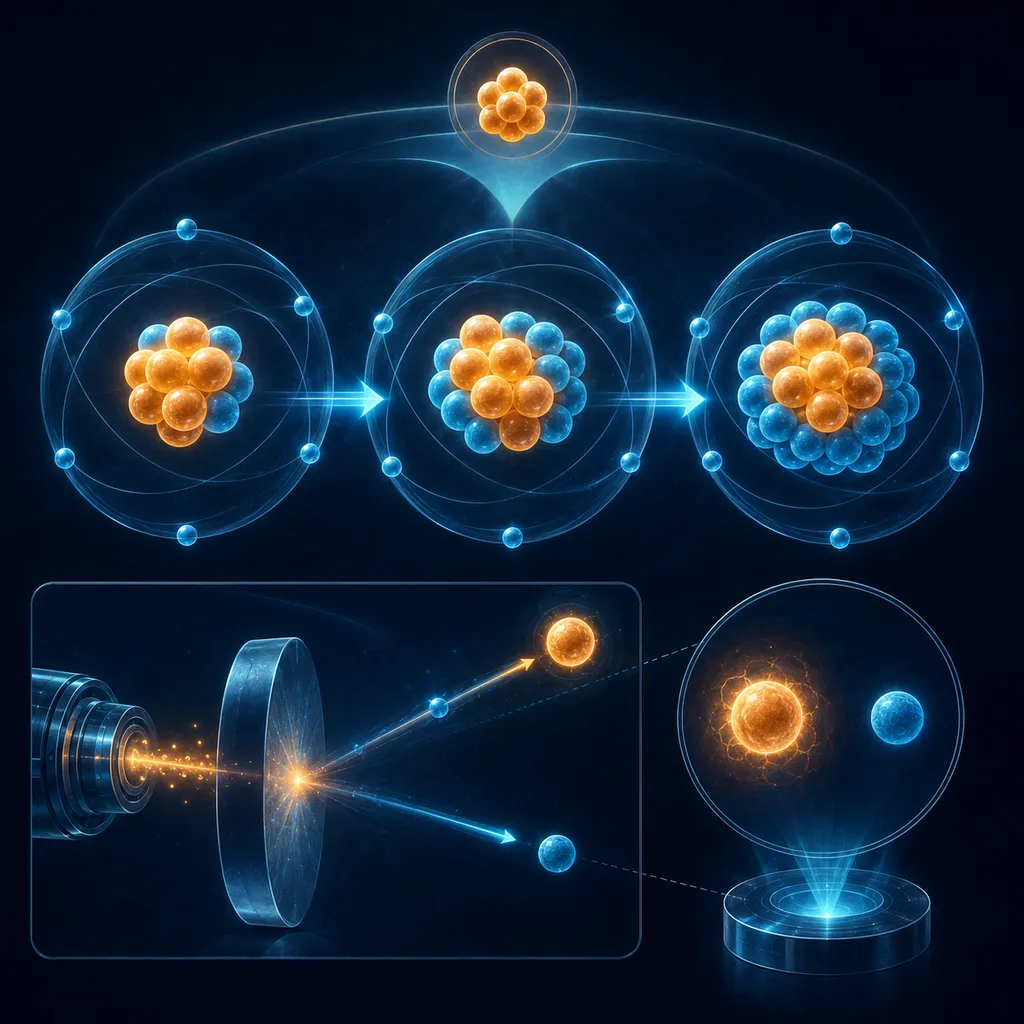
I'll give you a number of neutrons N in a carbon nucleus (Z = 6) — identify the isotope. A = Z + N.
What just happened?
The nucleus of a carbon atom always has exactly 6 protons — they are what make the element carbon. The number of neutrons, however, can differ: 6, 7 or 8 neutrons give carbon-12, carbon-13 and carbon-14 respectively. Chemically it is still the same element (the same electrons, the same chemical reactions), but with a different mass.
Mass number:
— the mass number A is the sum of protons (Z) and neutrons (N). Z determines the element and never changes between isotopes; N and A rise or fall together.
How did Chadwick discover the neutron (1932)?
Earlier, Walther Bothe and Herbert Becker had observed a strange, highly penetrating radiation produced when beryllium was bombarded with alpha particles — they thought it was gamma radiation. In 1932 James Chadwick showed experimentally that this radiation was in fact a stream of electrically neutral particles with a mass close to that of the proton — he called them neutrons. The existence of such a particle in the nucleus had earlier been predicted theoretically by Ernest Rutherford, but it was Chadwick who first confirmed it experimentally.
Why was this so important?
The discovery of the neutron completed the picture of the atomic nucleus — protons and neutrons (nucleons) together form the nucleus, while electrons orbit around it. It also opened the way to nuclear physics, including an understanding of the fission of the atomic nucleus. For this discovery Chadwick received the Nobel Prize in Physics in 1935.
Why you need this for the exam:
Isotope problems almost always ask you to compute A = Z + N or to tell whether two atoms are isotopes (same Z, different N and A) or ions (same Z and N, different number of electrons). Carbon-14 is also the classic example of a radioactive isotope used in radiocarbon dating.
Remember: Z (the number of protons) determines the element and does not change; N (the number of neutrons) can vary — that gives isotopes; A = Z + N is the mass number.
Theory & formulas
Structure of the nucleus
The nucleus is made of protons (positive) and neutrons (electrically neutral). The identity of the element is decided by the number of protons ; the number of neutrons can vary.
Mass number
The total number of nucleons is the mass number:
Isotopes
Atoms of the same element (the same ) with a different number of neutrons are isotopes — they share the same chemistry but have different masses. Chadwick's discovery of the neutron (1932) completed the picture of the nucleus.
Notation: — mass number, — atomic number (protons), — number of neutrons.
Frequently asked questions
›What distinguishes isotopes of the same element?
The number of neutrons in the nucleus — the number of protons (and therefore the chemical identity) stays the same.
›What is a neutron?
An electrically neutral nuclear particle with a mass close to that of the proton, discovered by Chadwick in 1932.
›Why was the discovery of the neutron a breakthrough?
It completed the picture of the atomic nucleus and opened the way to nuclear physics, including fission reactions.
Teaching? Embed this experiment on your site.
Free widget — paste it on your school site, blog or notes. It links to the full version.