Isotope dating — the half-life
Move the time in units of the half-life. After each T½ half of the nuclei remain: after two — ¼, after three — ⅛. Carbon-14 dating rests on this. Watch the shrinking population of nuclei and the decay curve.
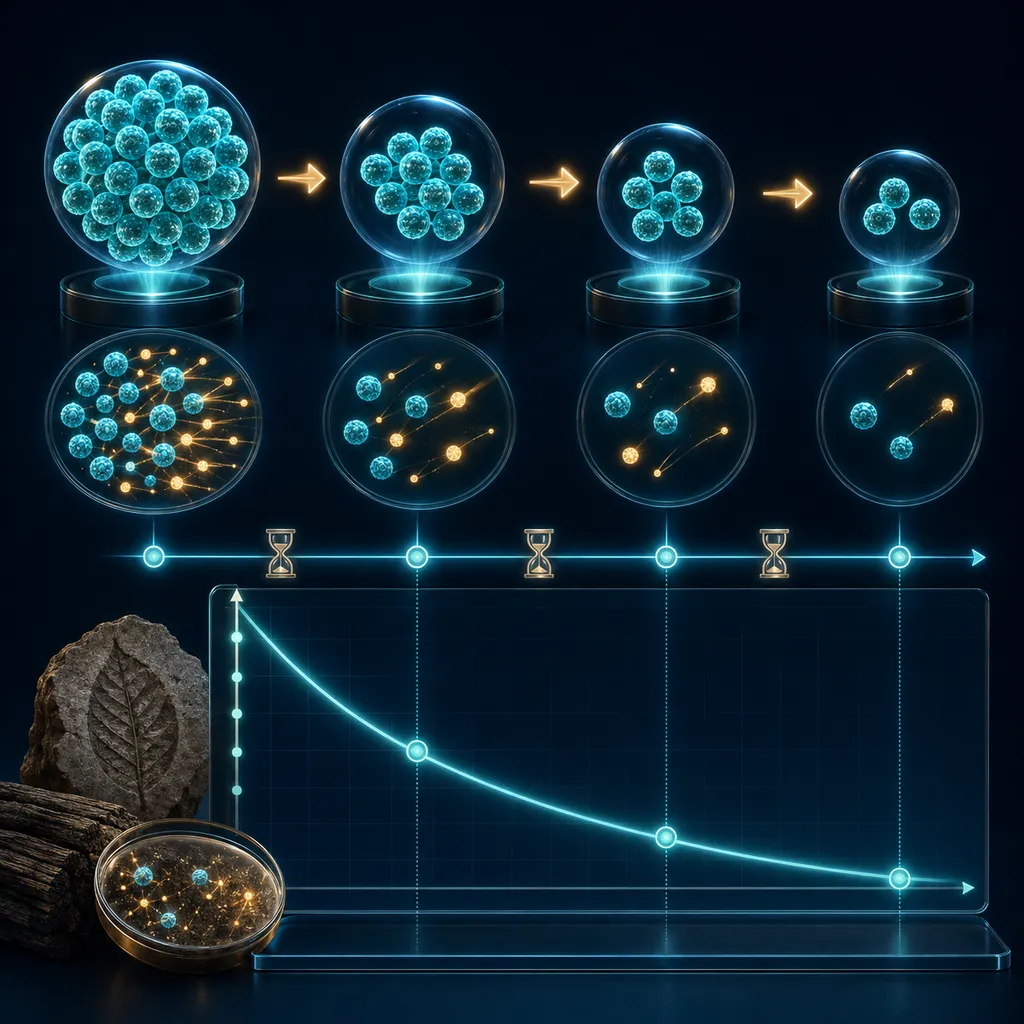
I will give you a target share of nuclei that have not yet decayed — adjust the number of half-lives t/T½.
What just happened?
You set 2 half-lives — of the C-14 nuclei are left. Every half-life removes half of what is still left, so the population falls like a power of two, not linearly.
Decay law:
— the number of nuclei that have not yet decayed falls exponentially. — the initial number, — the half-life (for C-14 ≈ 5730 years), — time.
What does it mean in practice?
After each successive one half drops away: in turn Inverting the formula, the remaining fraction gives you the age of the sample:
Why does this date artefacts?
A living organism keeps a constant share of C-14. After death the intake stops and the isotope decays. By measuring how much C-14 is left relative to , we work out how many have passed — that is the age of the remains.
Why you need this for the exam:
Decay problems come down to counting half-lives: divide the time by , and compute the fraction as . Trick: count how many times “half of a half”, instead of integrating.
Remember: after each half-life half of the previous amount remains — N = N₀(½)^(t/T½). This is the essence of radioactive decay and isotope dating.
Theory & formulas
Decay law
After each half-life the number of nuclei drops by half. After a time what remains is:
Exponential form
Equivalently, through the decay constant :
Dating
By measuring what fraction of the isotope is left (), you determine the age of the sample. For carbon the half-life is years. After 2 half-lives remains, after 3 — .
Notation: — the number of nuclei after a time , — the initial number, — the half-life, — the decay constant, — time.
Frequently asked questions
›How much remains after 2 half-lives?
One quarter (¼) — after the first T½ a half remains, after the second a half of a half, i.e. ¼.
›What is a half-life?
The time after which half of the nuclei of a given isotope decay; for C-14 it is about 5700 years.
›How does C-14 dating work?
You measure what fraction of carbon-14 is left in the sample and compute the age from N=N₀(½)^(t/T½).
Teaching? Embed this experiment on your site.
Free widget — paste it on your school site, blog or notes. It links to the full version.