Decay chain and secular equilibrium
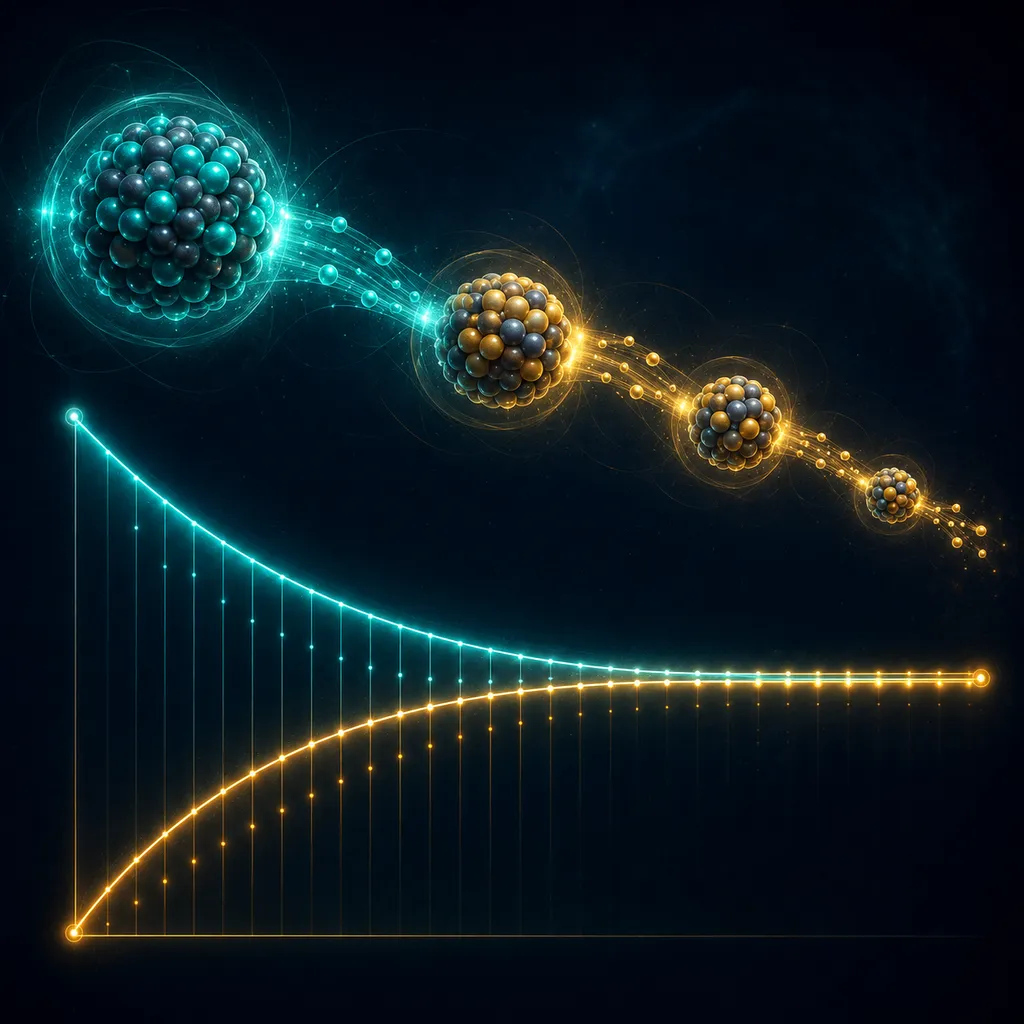
In a decay chain the parent decays into a daughter, which itself decays. The daughter's activity rises until it reaches secular equilibrium: λ_D·N_D = λ_P·N_P. Set the ratio of half-lives and the observation time, and watch the daughter curve "stick" to the parent.
I'll give you a half-life ratio T_P/T_D — guess the type of equilibrium: secular (A_D ≈ A_P) or transient (A_D exceeds A_P).
What just happened?
In a decay chain the parent decays into a daughter , which itself decays. At first there is no daughter — its number and activity rise. But the more daughter there is, the faster it decays, until the rate of production equals the rate of decay: this is secular equilibrium.
Bateman equations:
When the parent is much longer-lived (), the daughter's activity tends toward the parent's activity: .
Invariant — constant despite decay:
At equilibrium the number of daughter nuclei does not change, though each of them still decays — exactly as many are produced from the parent as decay away. It is like a tank with inflow equal to outflow.
Why this matters for your exam:
This is an academic extension of the decay law . Uranium–thorium series, radon from radium, mineral dating — secular equilibrium is at work in all of them.
Remember: the daughter builds up to secular equilibrium ; then its amount is constant despite continuous decay.
Theory & formulas
Parent → daughter decay
In a decay chain the parent (P) decays into a daughter (D), which itself decays. The activity of each isotope: .
Secular equilibrium
When the parent is much longer-lived, the daughter's activity rises until inflow equals outflow: Despite continuous decay, the number of daughter nuclei no longer changes. Disturbing this equilibrium is used to date rocks (uranium–thorium methods).
Notation: — decay constant, — number of nuclei, — activity, with indices (parent) and (daughter).
Frequently asked questions
›How can something decay yet its amount stay constant?
In secular equilibrium the daughter is still decaying, but the parent supplies it with exactly as many new nuclei as are lost in the same time. Inflow equals outflow — like a tank with equal inflow and outflow of water. The number of daughter nuclei does not change despite continuous decay.
›What is secular equilibrium?
A state in which the daughter's activity (decays per second) equals the parent's activity: λ_D·N_D = λ_P·N_P. It is reached when the parent is much longer-lived than the daughter, after a time of order a few half-lives of the daughter.
›Why does this matter for dating?
In minerals the uranium–thorium series reach secular equilibrium. Disturbing this equilibrium (e.g. radon escape or dissolution of some isotopes) lets us measure the age of rocks and sediments — uranium–thorium methods reach back hundreds of thousands of years.
Teaching? Embed this experiment on your site.
Free widget — paste it on your school site, blog or notes. It links to the full version.