Attosecond pulses — the world's fastest camera
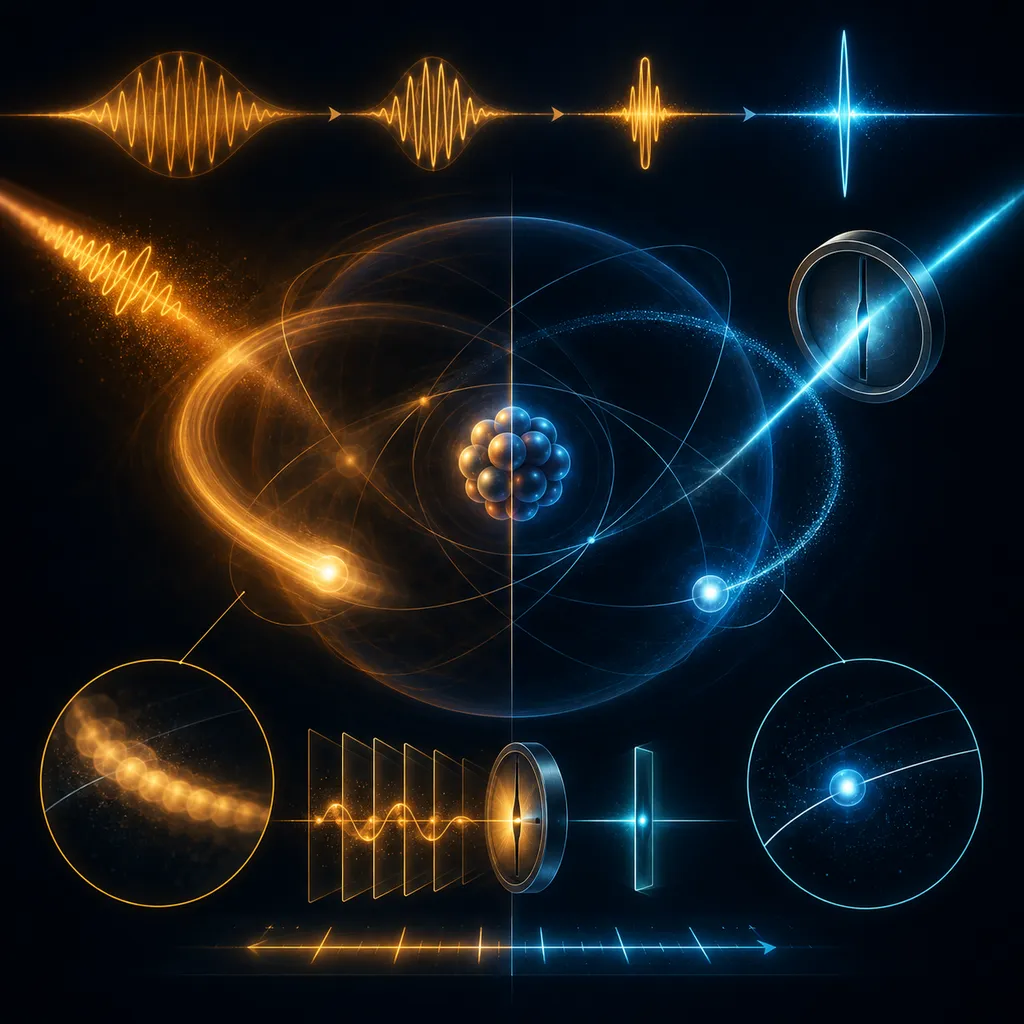
An extension of the topic of light, the photon and time scales. An attosecond is 10⁻¹⁸ of a second — an electron in an atom moves on exactly this time scale, too fast to capture with a longer pulse (the image comes out blurred). A sufficiently short, attosecond pulse acts like a shutter with an ultrashort opening time, "freezing" the electron's motion at a given instant (Nobel Prize in Physics 2023, Agostini, Krausz, L’Huillier).
I'll give you a pulse duration — guess (without the slider) whether it "freezes" the electron or comes out blurred. Threshold: Tₑ₋ ≈ 150 as = 1.5·10⁻¹⁶ s.
What just happened?
You shortened the light pulse duration down to the attosecond scale — and the electron's "snapshot" changed from a blurred streak into a sharp, single point. This is exactly the same effect as photographing a running sprinter: with too long an exposure the image comes out blurry, because the sprinter moved during the exposure. Shorten the shutter time below the duration of the motion — and the frame comes out sharp.
What is an attosecond?
It is an unimaginably short time — about as many attoseconds fit into one second as there have been seconds since the Big Bang (about 13.8 billion years ≈ 4·10¹⁷ s). An electron in an atom moves and changes energy on a scale of tens to hundreds of attoseconds — too fast to "photograph" with a longer, femtosecond (10⁻¹⁵ s) light pulse.
The condition for "freezing" motion:
— to capture a phenomenon without blur, the shutter time (τ) must be shorter than the duration of the phenomenon itself (Tₑ₋). A sufficiently short, attosecond pulse acts like a shutter with an ultrashort opening time — it "freezes" the electron at a specific place and moment.
Where did such short pulses come from? (Nobel 2023)
In 1987 Anne L’Huillier discovered that passing infrared laser light through a noble gas generates many higher harmonics of light — a phenomenon that became the basis for producing very short pulses. In 2001 Pierre Agostini produced a series of consecutive light pulses, each lasting 250 attoseconds, while Ferenc Krausz (in parallel) isolated a single pulse lasting 650 attoseconds. Such ultrashort pulses act like the world’s fastest shutter — they let us observe (and even, in a sense, "film") the motion of electrons inside atoms, molecules and solids — processes previously too fast to record. This opens the way to understanding and controlling chemical and electronic processes in real time.
Frequently asked questions
How long is one attosecond? 10⁻¹⁸ s — a billionth of a billionth of a second. As many attoseconds fit into one second as there have been seconds since the Big Bang.
Why "photograph" individual electrons? The motion of electrons determines how chemical reactions proceed, how semiconductors work and how matter absorbs light. Seeing this motion "frame by frame" lets us understand it — and in the future control it, e.g. in faster electronics or medical diagnostics.
How is such a short pulse physically generated? A strong, infrared laser pulse is passed through a noble gas (e.g. neon, argon). The laser’s electric field tears electrons out of the gas atoms and "throws" them back — on colliding with the nucleus, higher harmonics of light are emitted (at a much higher frequency). Superimposing many such harmonics results in an ultrashort, attosecond light pulse.
Why this matters for your exams:
The association "attosecond = 10⁻¹⁸ s" and the idea that "the shutter time must be shorter than the duration of the phenomenon" is a common theme in problems about time scales and physics Nobel Prizes. It is worth remembering the order of the prefixes: milli (10⁻³) → micro (10⁻⁶) → nano (10⁻⁹) → pico (10⁻¹²) → femto (10⁻¹⁵) → atto (10⁻¹⁸).
Remember: a shorter pulse "freezes" faster motion — attosecond light pulses (Nobel Prize in Physics 2023) are the world’s fastest camera, fast enough to capture the motion of electrons in atoms.
Theory & formulas
The attosecond scale
An attosecond is: An electron in an atom moves on exactly this time scale — too fast to capture with a longer pulse (the image comes out blurred).
A shutter for the electron
To "freeze" motion, the pulse duration must be shorter than the time in which the object moves noticeably. That is why photographing electrons requires attosecond pulses — the world's shortest "shutter".
How they are generated
Strong laser light is passed through a noble gas; higher harmonics are then produced, which combine into an ultrashort, attosecond light pulse (Nobel 2023).
Notation: — attosecond, — second.
Frequently asked questions
›How long is one attosecond?
10⁻¹⁸ of a second — an unimaginably short fraction of time.
›Why "photograph" individual electrons?
To observe and understand the chemical and electronic processes taking place inside atoms in real time.
›How is such a short light pulse generated?
By passing laser light through a noble gas, which generates higher harmonics that form attosecond pulses.
Teaching? Embed this experiment on your site.
Free widget — paste it on your school site, blog or notes. It links to the full version.