Converging lens — where will the image form?
What we will do: We will slide an object in front of a converging lens and check where the image forms and what kind it is — larger or smaller, upright or inverted.
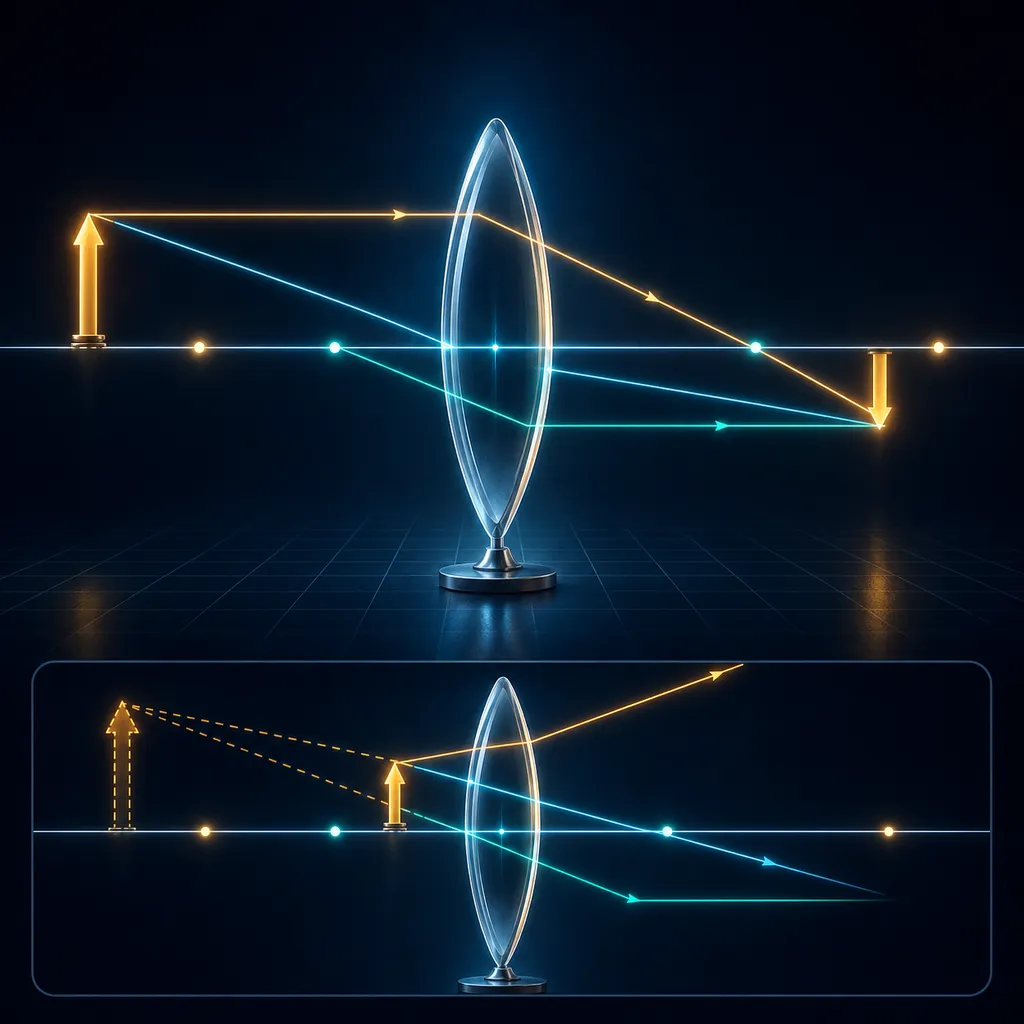
What you see on screen: The optical axis with the lens, the focal points F and 2F, an arrow-object and the three principal rays that intersect at the image; sliders for the focal length and the object distance. For a virtual image the rays are extended backward with dashed lines. Readouts: focal length, the distances x and y, magnification, and the type and orientation of the image.
What just happened?
An object far in front of the lens produced a smaller image, flipped upside down. That is how a camera and your eye work — the image on the retina is inverted too (the brain “flips” it back).
How the lens forms the image — three rays:
• parallel to the axis → refracts through the focal point , • through the center of the lens → straight through, no bending, • through the front focal point → onward parallel to the axis. Where they cross — there is the image.
Lens equation:
— focal length, — object distance, — image distance.
How large is the image? Magnification:
enlarged, reduced.
Everything depends on where you place the object:
farther than 2f → real, inverted, reduced (camera and eye), between f and 2f → real, inverted, enlarged (projector), closer than f → virtual, upright, enlarged, on the same side (magnifier).
The limiting point x = f:
After the lens the rays run parallel and never meet — the image escapes to infinity. That is why a zero appears in the denominator .
Why you need this for the exam:
The equation plus the sign of the result ( real, virtual) solves every lens problem. The rest is the construction of the three rays.
Remember: the same lens is a camera, a projector, or a magnifier — depending only on whether the object stands farther than 2f, between f and 2f, or closer than f.
Theory & formulas
The lens equation
The position of the image is related to the position of the object by the equation:
Magnification
The ratio of the image height to the object height: — the image is enlarged, — reduced.
Type of image
- object farther than the focal point (): a real and inverted image (it can be projected on a screen),
- object closer than the focal point (): a virtual image, upright and enlarged — the lens acts as a magnifier.
Notation: — focal length (positive for a converging lens), — object distance, — image distance, — magnification.
Frequently asked questions
›What is the lens equation?
1/f = 1/x + 1/y, where f is the focal length, x is the object distance and y is the image distance.
›When does a lens give a real image and when a virtual one?
Real when the object is farther than the focal point (x > f); virtual and enlarged when it is closer (x < f) — then it acts as a magnifier.
›How do you calculate the magnification of the image?
p = y/x (or h'/h); p > 1 means enlargement, p < 1 means reduction.
Teaching? Embed this experiment on your site.
Free widget — paste it on your school site, blog or notes. It links to the full version.