Spherical mirrors — concave and convex
What we'll do: We'll move an object in front of a concave and a convex mirror and check what image forms and where.
What you see on screen: A mirror with its axis, focal point and centre of curvature, an object-arrow and the reflected characteristic rays that form the image; a mirror-type toggle and sliders for distance and radius. Readouts: mirror type, focal length, distances x and y, magnification, plus the image type and orientation.
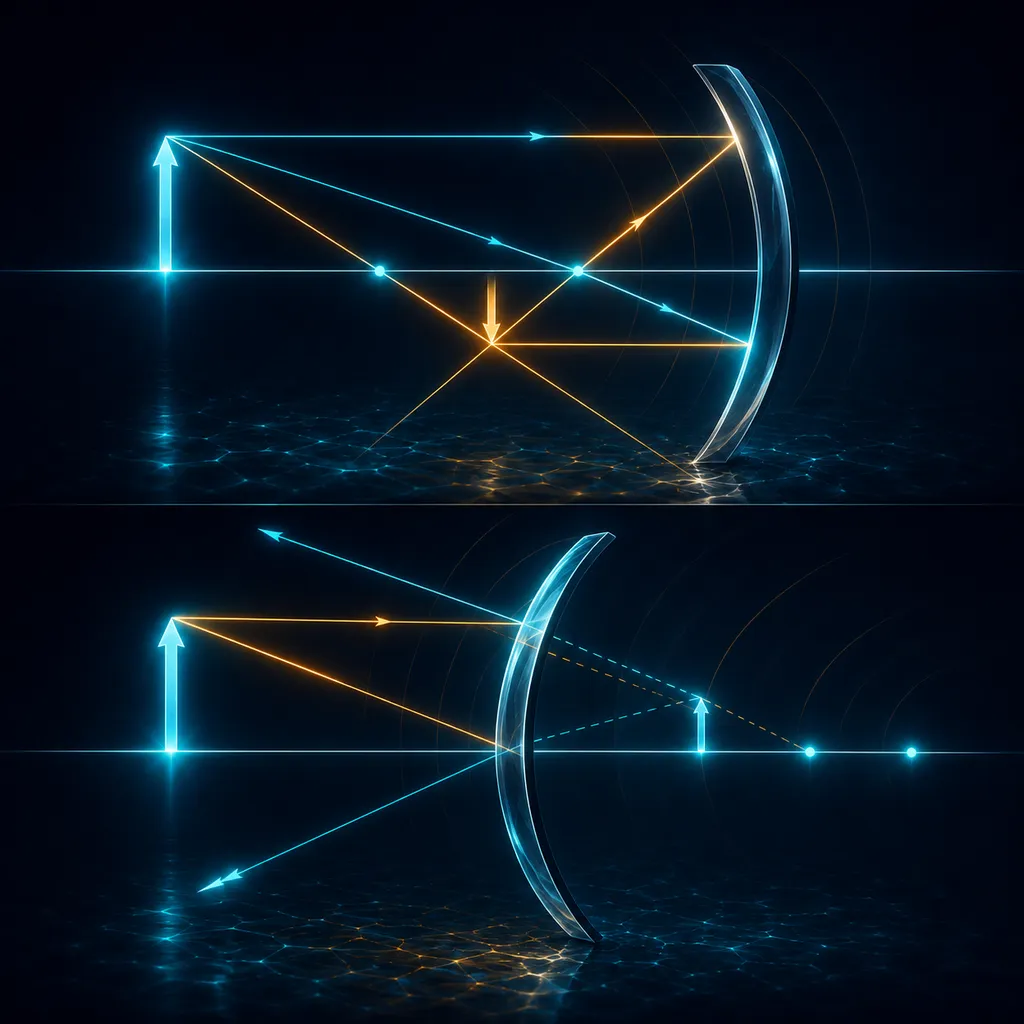
What just happened?
The convex mirror formed a virtual, upright and reduced image — and that is ALWAYS the case, regardless of distance. That is why a rear-view mirror shows a wide area behind the car.
Two kinds of spherical mirrors:
CONCAVE (converging): reflects rays toward the focal point. The image depends on the object position — far away it forms a real, inverted image (as in a headlight), and up close (closer than the focal point) — enlarged and upright (a makeup mirror). CONVEX (diverging): scatters rays. The image is ALWAYS virtual, upright and reduced, but it covers a wider field of view (rear-view and shop mirrors).
The mirror equation:
— focal length (positive for concave, negative for convex), — object distance, — image distance, — radius of curvature. Magnification:
Why you need this for the exam:
constructing images in mirrors and the mirror equation are typical optics problems (twins of lens problems). Trick: treat a concave mirror like a converging lens, a convex one like a diverging lens.
Remember: a concave mirror converges (image depends on position), a convex one diverges (always virtual, upright, reduced). Equation: , .
Theory & formulas
The mirror equation
For a spherical mirror: The focal length is positive for a concave mirror and negative for a convex one.
Convex mirror
It always forms a virtual, upright and reduced image — hence its use in rear-view and shop mirrors (a wide field of view).
Concave mirror
The type of image depends on the object position: for the image is real and inverted, for it is virtual, upright and enlarged (a makeup mirror).
Symbols: — focal length, — radius of curvature, — object distance, — image distance.
Frequently asked questions
›What is the spherical mirror equation?
1/f = 1/x + 1/y, where f = R/2 (f positive for a concave mirror, negative for a convex one).
›What image does a convex mirror form?
Always virtual, upright and reduced — that is why they are used as rear-view and shop mirrors.
›When does a concave mirror form an enlarged, upright image?
When the object is closer than the focal point (x < f) — it then acts as a magnifying mirror.
Teaching? Embed this experiment on your site.
Free widget — paste it on your school site, blog or notes. It links to the full version.