Polarisation of light
What we will do: We will pass light through two polarisers and rotate the second one, checking when the light gets through and when it is extinguished.
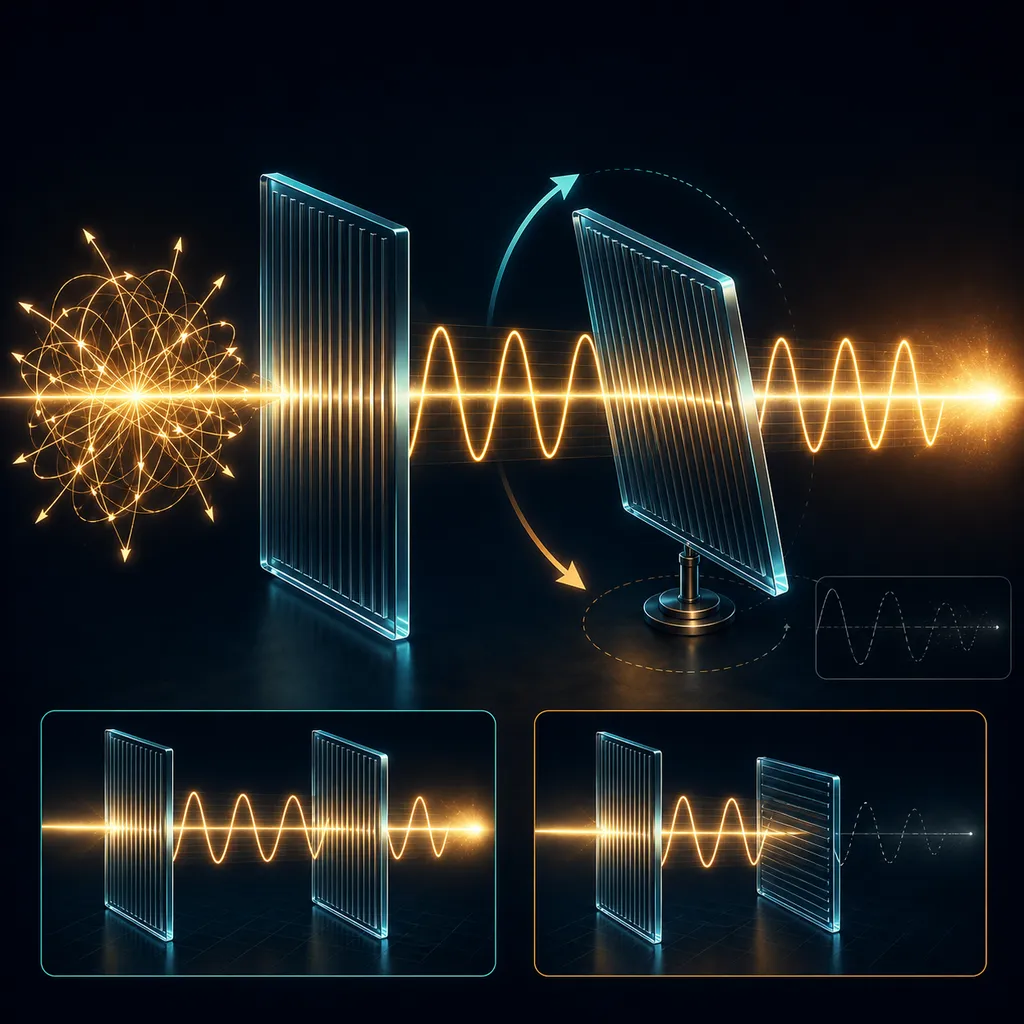
What you see on screen: A light beam, a polariser that orders the oscillations and a rotatable analyser, and the brightness of the outgoing light, which changes from a maximum (parallel polarisers) to zero (crossed). A slider for the analyser angle. Readouts: angle, relative intensity (cos²θ) and state (transmits/blocks).
I'll give you a target intensity behind the analyser — set the angle θ so that I = I₀·cos²θ hits it.
What just happened?
Two crossed polarisers almost completely extinguished the light — (almost) nothing passes through a perpendicular pair.
What is polarisation?
Light is a TRANSVERSE wave — the oscillations are perpendicular to the direction of travel, in many planes. A POLARISER transmits only the oscillations of one plane, "ordering" the light (polarised).
Two polarisers:
the second polariser (the analyser) checks how the polarised light is oriented. When both are PARALLEL (θ=0°) the light passes (maximum); when CROSSED (θ=90°) the light is extinguished (dark).
Malus's law describes this quantitatively:
— the intensity depends on the square of the cosine of the angle between the polarisers.
Where does this apply?
In sunglasses (they cut glare), LCD screens, photography (polarising filters) and stress analysis in materials.
Why this matters for your exam:
polarisation as evidence that light is transverse, together with Malus's law, belongs to wave optics (extended level).
where is the angle between the transmission axes of the polariser and the analyser.
Remember: a polariser transmits the oscillations of one plane; crossed polarisers extinguish the light, and the intensity follows Malus's law I = I₀cos²θ.
Theory & formulas
Polarisation
Light is a transverse wave — the field oscillations are perpendicular to the direction of travel. A polariser transmits only the oscillations of one plane, ordering the light.
Malus's law
The intensity after passing through the analyser depends on the angle between its axis and the plane of polarisation:
Limiting cases
- parallel polarisers (): (maximum),
- crossed polarisers (): (light extinguished).
Notation: — intensity after the analyser, — intensity of the polarised light incident on the analyser, — angle between the polariser axes.
Frequently asked questions
›What is polarisation of light?
Ordering the oscillations of a light wave into a single plane — because light is a transverse wave.
›How much light passes through crossed polarisers?
Almost none — when set perpendicular they extinguish it completely.
›What does Malus's law state?
I = I₀·cos²θ — the intensity after the analyser depends on the square of the cosine of the angle between the polarisers.
Teaching? Embed this experiment on your site.
Free widget — paste it on your school site, blog or notes. It links to the full version.