Why the sky is blue
What we will do: We will trace how sunlight scatters in the atmosphere and find out why the sky is blue while the sunset is red.
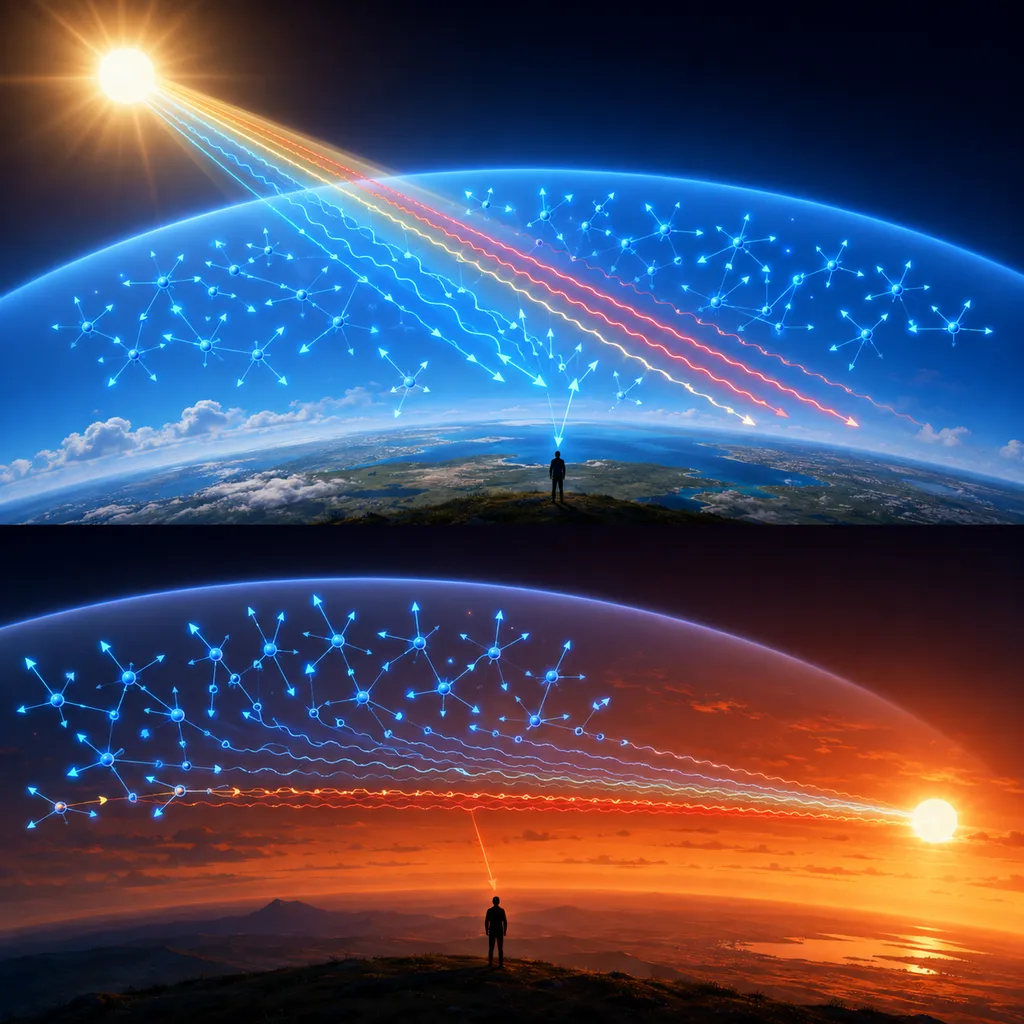
What you see on screen: The atmosphere with the Sun's rays; short wavelengths (blue) scatter in all directions, lighting up the sky, and when the Sun is low over the horizon mostly red reaches the observer. The slider moves the Sun from the zenith toward the horizon. Readouts: Sun position, the path of the light, and the colour of the sky/sunset.
I will give you a sky colour to reach — your task is to set the Sun position with the slider.
What just happened?
During the day the sky was blue, and when you moved the Sun toward the horizon it turned red. Light scattering is responsible for this.
What is scattering?
Sunlight (white) meets air molecules in the atmosphere, which "throw" it in different directions. The key point: SHORTER wavelengths (blue, violet) scatter MUCH more strongly than longer ones (red).
Why is the sky blue?
During the day, looking at the sky, you see light scattered by the whole atmosphere — and it is mainly BLUE that scatters. That is why the sky glows blue from every direction.
Why is the sunset red?
When the Sun is low, its light passes through a THICKER layer of atmosphere. Blue scatters "along the way" and escapes sideways, so mostly what remains reaches our eyes — red and orange.
Why you need this for the exam:
light scattering and its dependence on wavelength explains the colour of the sky and sunset — a common example of optical phenomena in the atmosphere.
Trick: shorter wavelength → stronger scattering (factor ).
Remember: short wavelengths (blue) scatter most strongly — hence the blue sky by day and the red sunset when light travels a long path.
Theory & formulas
Rayleigh scattering
Air molecules scatter light more strongly the shorter its wavelength. The intensity of the scattered light:
Blue sky
Short wavelengths (blue) scatter far more strongly than long ones (red) — about times as much. This scattered blue light reaches us from all over the sky.
Red sunset
When the Sun is low, its light passes through a thicker layer of atmosphere. Blue scatters away “along the way”, and mostly red reaches the observer.
Notation: — intensity of the scattered light, — wavelength (shorter = stronger scattering).
Frequently asked questions
›Why is the sky blue?
Because air molecules scatter shorter wavelengths (blue) far more strongly than longer ones — and this scattered blue light fills the sky.
›Why is the sunset red?
Because sunlight low over the horizon passes through a thicker layer of atmosphere — blue scatters away along the way, and red reaches us.
›What does the strength of light scattering depend on?
On the wavelength — shorter wavelengths (blue, violet) scatter far more strongly than longer ones (red).
Teaching? Embed this experiment on your site.
Free widget — paste it on your school site, blog or notes. It links to the full version.