Structure of an EM wave — the E and B fields
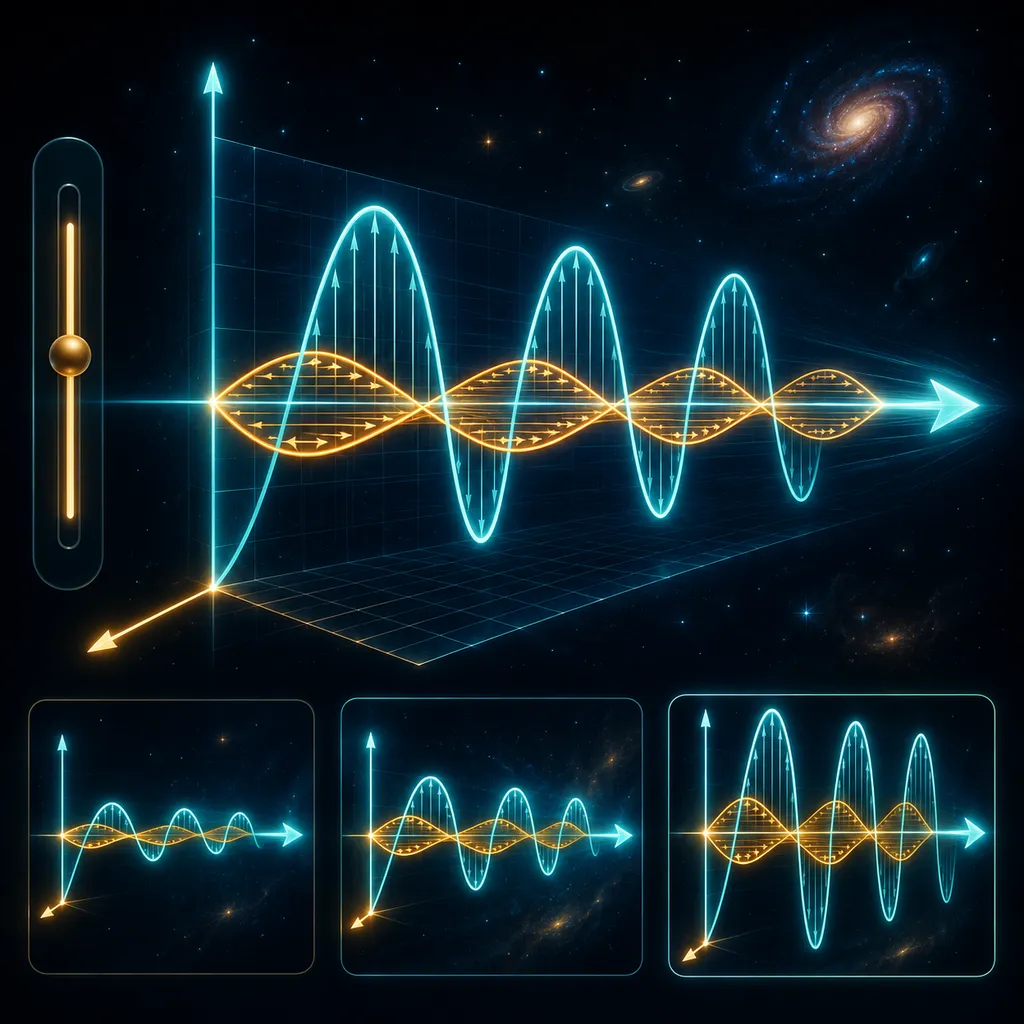
An electromagnetic wave is coupled oscillations of the electric field E and the magnetic field B. Both are mutually perpendicular and perpendicular to the direction in which the wave travels (it is a transverse wave), oscillate in phase, and their ratio E/B = c. An EM wave does not need a medium. Change the field amplitude.
I’ll give you a target magnetic field — tune the amplitude E₀ to reach it. B₀ = E₀/c.
What just happened?
An EM wave is coupled oscillations of the electric field and the magnetic field . The E field oscillates in one plane (here: vertically), the B field in a plane perpendicular to it (into the screen), and both are perpendicular to the wave’s direction of motion.
Field orientation:
The E and B vectors and the direction of motion form a mutually perpendicular triad. That is why an EM wave is a transverse wave — the fields oscillate across the direction in which the wave travels.
In phase and a constant ratio:
The E and B fields reach their maxima and zeros at the same moments — they oscillate in phase. Their ratio is constant and equal to the speed of light , so when E grows, B grows in the same proportion.
Does an EM wave need a medium?
No. Unlike sound, an electromagnetic wave does not need a medium — a changing E field creates a B field and vice versa, so the wave “drives itself” and travels even through a vacuum (e.g. sunlight from the Sun).
Why you need this for the exam:
Classic questions: how E and B are oriented (perpendicular, in phase), whether the wave is transverse (yes), whether it needs a medium (no), and the relation . Trick: draw the triad and remember the in-phase oscillation.
Remember: in an EM wave E ⊥ B ⊥ direction of motion, both fields oscillate in phase, and E/B = c. It is a transverse wave that travels even through a vacuum.
Theory & formulas
Structure of an EM wave
The electric field and magnetic field oscillate perpendicular to each other and both perpendicular to the direction of motion — it is a transverse wave. They oscillate in phase.
Key relations
An EM wave does not need a medium — it travels even through a vacuum.
Notation: — electric field strength, — magnetic flux density, — speed of light, — vacuum permittivity, — vacuum permeability.
Frequently asked questions
›Does an EM wave need a medium?
No — it travels even through a vacuum. That distinguishes it from mechanical waves (sound), which require a medium.
›How are the fields oriented?
The E field and the B field are perpendicular to each other and both perpendicular to the direction of the wave's motion. They oscillate in phase.
›Why is it a transverse wave?
Because the fields oscillate in directions perpendicular to the direction in which the wave propagates (not along it).
Teaching? Embed this experiment on your site.
Free widget — paste it on your school site, blog or notes. It links to the full version.