The chain reaction and critical mass
Each fission releases neutrons that trigger further ones. The multiplication factor k decides it: k<1 dies out (subcritical), k=1 sustains the reaction (reactor), k>1 produces an avalanche (supercritical). Set k and the number of generations, and you will see how a small excess multiplication grows exponentially.
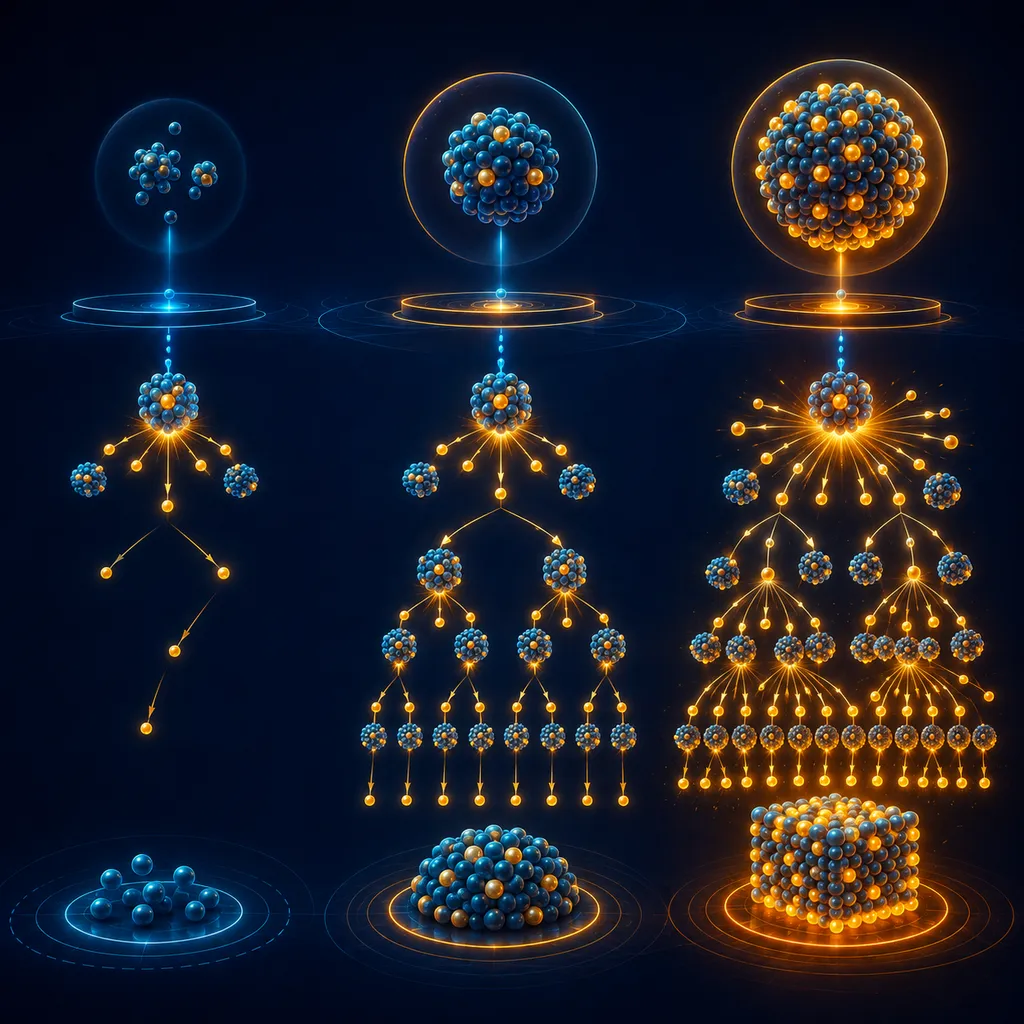
I will give you a multiplication factor k — guess the regime (no slider). The critical boundary lies at k = 1.
What just happened?
Each fission releases neutrons that can trigger further ones. The multiplication factor k tells how many offspring one fission has on average. The neutron count in a generation grows (or decays) like a power — which is why small changes in k have huge effects.
Geometric growth:
— subcritical (dies out); — critical (reactor, steady level); — supercritical (avalanche). The reactor holds with control rods that absorb neutrons.
Invariant — a sharp boundary:
At the reaction dies out always, even if you start from a huge number of neutrons — it is only a matter of how many generations. is the boundary: critical mass is the amount and geometry of material at which just reaches 1.
Why this matters for your exam:
This is an academic extension of the topic of nuclear reactions and fission. It links nuclear physics with the mathematics of geometric sequences — the same formula describes compound interest and population growth.
Remember: . k<1 dies out, k=1 reactor, k>1 avalanche. Critical mass = the threshold at which k=1.
Theory & formulas
Multiplication factor
is the average number of fissions triggered by one preceding fission:
- — the reaction dies out (subcritical),
- — stable (reactor),
- — avalanche (supercritical).
Exponential growth
The number of fissions grows with generation . Even after 100 generations gives ~7×. Critical mass is the amount and geometry of fuel at which (fewer neutrons escape). The reactor holds with rods that absorb neutrons.
Symbols: — neutron multiplication factor, — initial number, — number after generations, — generation index.
Frequently asked questions
›What is critical mass?
It is the amount and geometry of fissile material at which the multiplication factor k reaches 1 — that is, each fission triggers on average exactly one more. Below the critical mass too many neutrons escape outward and the reaction dies out.
›How does a reactor hold k = 1?
With control rods made of a neutron-absorbing material (e.g. boron, cadmium). Inserting them lowers k (more neutrons absorbed); withdrawing them raises it. Feedback keeps k very close to 1, i.e. a steady power level.
›Why is a small excess in k so dangerous?
Because the neutron count grows like kⁿ — exponentially with the number of generations. Even k=1.02 after 100 generations gives ~7× growth, and a neutron generation lasts fractions of a second. That is why reactor control requires continuous, precise regulation.
Teaching? Embed this experiment on your site.
Free widget — paste it on your school site, blog or notes. It links to the full version.