Nuclear fission and fusion
Nuclear energy is released when the reaction product lies closer to the peak of the binding-energy curve (Fe-56). For light nuclei, fusion pays off (joining — as in stars); for heavy nuclei, fission does (splitting — as in reactors). Change the nucleus mass and see which process releases energy.
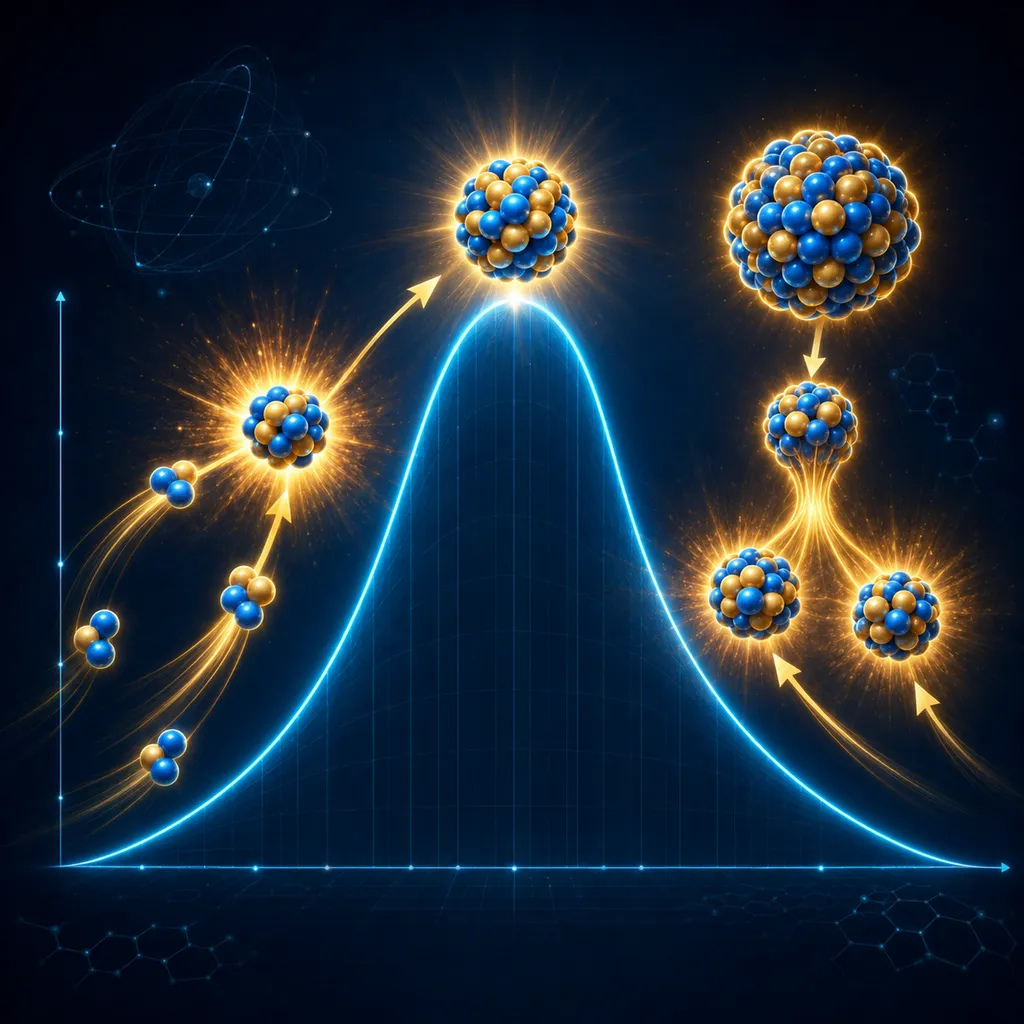
I will give you a nucleus mass number A — guess which process releases its energy. Peak of the curve: A ≈ 56.
What just happened?
The curve shows binding energy per nucleon — the higher, the more tightly bound the nucleus. The peak is at iron (A≈56). Energy is always released when the product nuclei lie closer to the peak than the reactants.
Two ways, one principle:
Fusion — merging light nuclei (A < 56): the product moves right, toward the peak. Fission — splitting heavy nuclei (A > 56): the fragments move left, also toward the peak.
The difference in binding energy shows up as a mass defect — this "missing" mass turns into energy. The number of nucleons is always conserved; only how tightly they are bound changes.
What powers stars, and what powers reactors?
In the Sun, fusion takes place: hydrogen merges into helium, releasing enormous energy per nucleon. In nuclear power stations we use fission of heavy uranium — it is easier to initiate and control than fusion, which requires millions of degrees.
Why this matters for the exam:
Look at the curve and ask: is the product closer to iron? If so — energy is released. Light → fusion, heavy → fission. You compute the gain from the difference in binding energy and .
Remember: both processes push nuclei toward the peak of the curve (Fe, A≈56). Light ones merge, heavy ones split — and the released energy is the mass defect times .
Theory & formulas
Where the energy comes from
Energy is released when the reaction products have a higher binding energy per nucleon than the reactants — that is, they lie closer to the peak of the curve (Fe-56). The surplus binding energy is the energy released.
Mass and energy balance
The energy released corresponds to a mass defect: where is the difference between the masses of the reactants and the products.
Two paths to the peak
- Fusion (light nuclei) — joining into heavier ones, e.g. hydrogen into helium in stars.
- Fission (heavy nuclei) — splitting, e.g. uranium in reactors.
Both processes move the product closer to the maximum of the binding-energy curve.
Notation: — energy released, — mass defect (reactants minus products), — the speed of light.
Frequently asked questions
›How does fusion differ from fission?
Fusion joins light nuclei into heavier ones; fission splits heavy nuclei into lighter ones. Both release energy when the product lies closer to the peak of the binding-energy curve.
›Why fission in a power plant?
Because the fission of heavy nuclei (uranium) is easy to initiate and control; fusion requires extreme temperatures and pressures.
›What powers the stars?
Thermonuclear fusion — the joining of hydrogen nuclei into helium in the core of a star, releasing enormous amounts of energy.
Teaching? Embed this experiment on your site.
Free widget — paste it on your school site, blog or notes. It links to the full version.