Binding energy curve (Weizsäcker formula)
Binding energy per nucleon B/A tells you how stable a nucleus is. Set the mass number and proton count, and you will see the semi-empirical mass formula (Weizsäcker) in action: the curve rises, reaches a maximum of ~8.8 MeV at iron and falls. This explains why the Sun (fusion) and reactors (fission) produce energy at all.
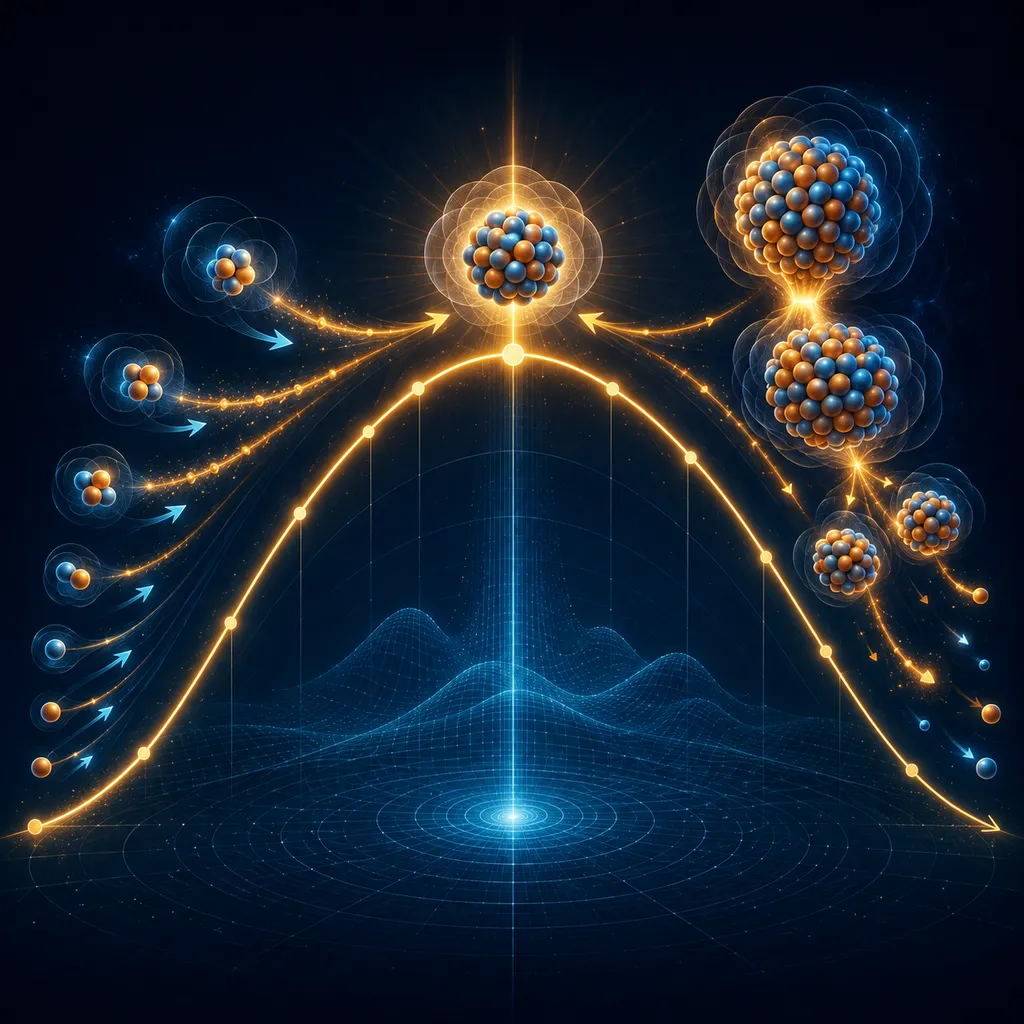
I will give you a mass number A — guess how this nucleus moves down toward iron (B/A peak ≈ 56): through fusion or fission.
What just happened?
Binding energy is the “glue” holding nucleons together — its mass deficit converts into energy per . Divided by the number of nucleons () it tells you how stable the nucleus is. The curve rises, peaks at iron and falls — which is why iron is the energy “floor”.
The semi-empirical mass formula (Weizsäcker):
The successive terms: volume (glue), surface (nucleons at the edge), Coulomb (proton repulsion), asymmetry (neutron excess) and pairing. The “liquid-drop” model reproduces the data surprisingly well.
The invariant — everything descends toward iron:
Both fusion of light nuclei and fission of heavy ones shift the system toward the B/A maximum. Because the products are more tightly bound, the energy difference is released. Stars synthesize elements only up to iron — heavier ones form only in supernovae.
Why this matters for your exam:
This is an academic extension of the topic of nuclear reactions and . In school you compute energy from the mass deficit; here you see why reactors (fission of U) and the Sun (fusion of H) work at all — because both move “downhill” along the same curve.
Remember: B/A peaks at iron (~8.8 MeV). Fusion of light nuclei and fission of heavy ones both move toward iron — which is why both release energy.
Theory & formulas
Binding energy per nucleon
tells you how stable a nucleus is. It arises from the mass deficit (the nucleus's mass is less than the sum of the nucleon masses):
The B/A curve
It rises for light nuclei, reaches a maximum of ~8.8 MeV at iron, then falls. It is described by the semi-empirical mass formula (Weizsäcker) (terms: volume, surface, Coulomb, asymmetry, pairing).
Where the energy comes from
- fusion of light nuclei — climbing up the curve,
- fission of heavy nuclei — also toward larger .
Both processes release the binding-energy difference.
Notation: — binding energy per nucleon, — binding energy, — mass deficit, — speed of light, — mass number.
Frequently asked questions
›Why is iron the energy “floor”?
Because the binding energy per nucleon (B/A) curve peaks there (~8.8 MeV). Iron nuclei are the most tightly bound, so no nuclear reaction can release energy from them — neither fusion nor fission. All processes “descend” toward iron.
›Where does the energy from fission and fusion come from?
The products of both processes are more tightly bound (higher B/A) than the reactants. The binding-energy difference is released. Fusion climbs the curve from the light-nuclei side, fission from the heavy side; both approach the maximum at iron.
›What does the mass deficit mean?
The mass of a bound nucleus is less than the sum of the masses of the free nucleons. That “missing” piece of mass is precisely the binding energy, in line with E=mc². The larger the mass deficit per nucleon, the more stable the nucleus.
Teaching? Embed this experiment on your site.
Free widget — paste it on your school site, blog or notes. It links to the full version.