Refraction and reflection of light — Snell's law
What we'll do: We'll aim a light ray at the boundary between two media (e.g. air–water) and watch how it refracts and reflects, and when it reflects completely.
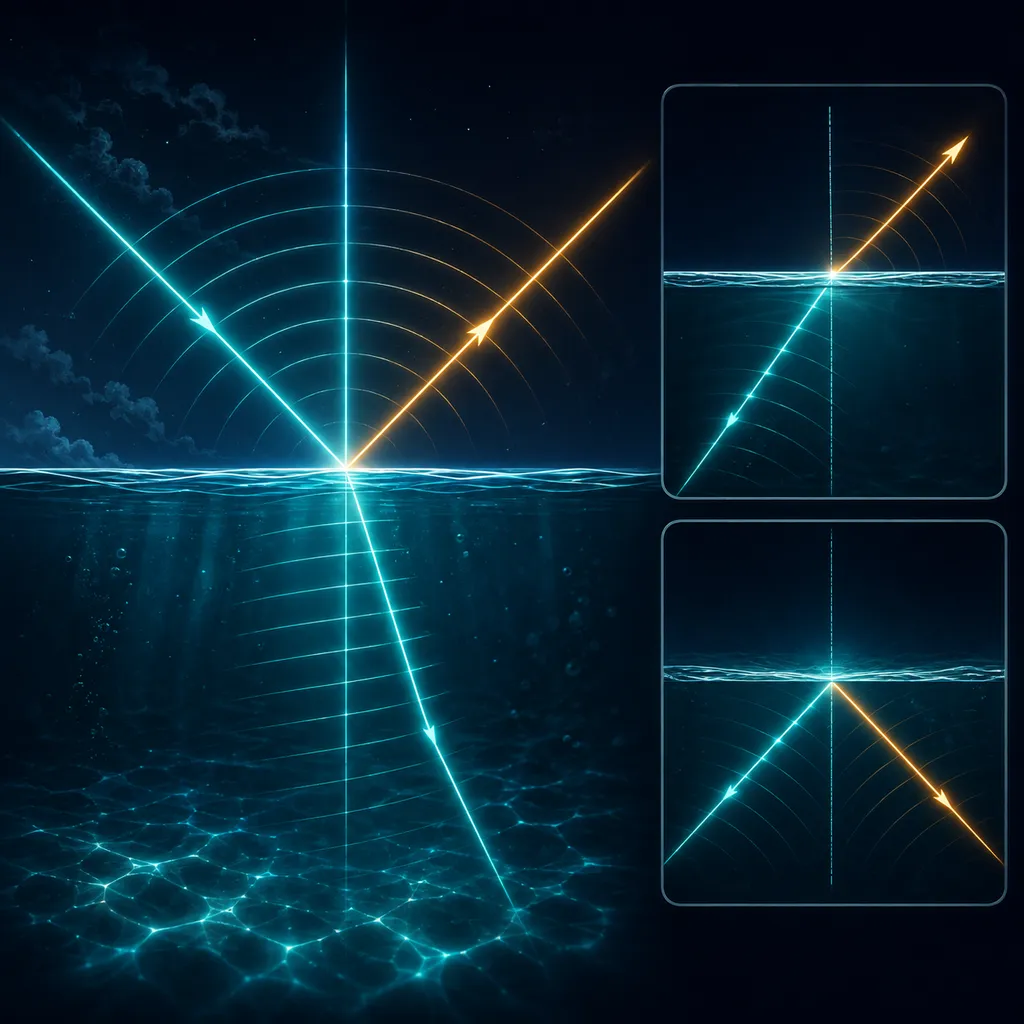
What you see on screen: The boundary between two media with the normal, the incident, reflected and refracted rays, an angle-of-incidence slider and a medium switch (air/water/glass). The bar shows the Snell's-law relation. Readouts: the refractive indices, the angles of incidence and refraction, the critical angle and the state (refraction / total internal reflection).
What just happened?
Entering water (an optically denser medium), the ray refracted CLOSER to the normal. Going back out into air, it would bend farther away.
Law of refraction (Snell's law):
n is the refractive index of the medium. Entering a medium with larger n (optically denser), the ray bends toward the normal; into a medium with smaller n — away from the normal. The angle of reflection always equals the angle of incidence.
Critical angle and total internal reflection:
passing into a rarer medium, above a certain angle the ray does not refract at all — all of it returns inside.
This effect powers optical fibres and makes the underside of a water surface behave like a mirror.
Why this matters for your exam:
Snell's law and computing angles and the critical angle are the basis of geometric-optics problems. The trick: write down n for both media and substitute into .
Remember: into a denser medium — closer to the normal, into a rarer one — farther; and above the critical angle light reflects completely.
Theory & formulas
Law of refraction (Snell's law)
At the boundary between two media: Entering an optically denser medium (larger ), the ray refracts toward the normal; into a rarer one — away from the normal.
Law of reflection
The angle of reflection equals the angle of incidence ().
Total internal reflection
Passing into a rarer medium above the critical angle, light does not refract at all — it reflects completely. The critical angle:
Notation: — refractive indices of the media, — angle of incidence, — angle of refraction, — critical angle.
Frequently asked questions
›What is Snell's law?
n₁·sinθ₁ = n₂·sinθ₂ — it relates the angles of incidence and refraction to the refractive indices of the media.
›When does light refract toward the normal?
When it enters an optically denser medium (with larger n), e.g. from air into water.
›What is total internal reflection?
Passing into a rarer medium above the critical angle, light does not refract but reflects completely (sinθ_c = n₂/n₁).
Teaching? Embed this experiment on your site.
Free widget — paste it on your school site, blog or notes. It links to the full version.