Alpha decay and quantum tunnelling
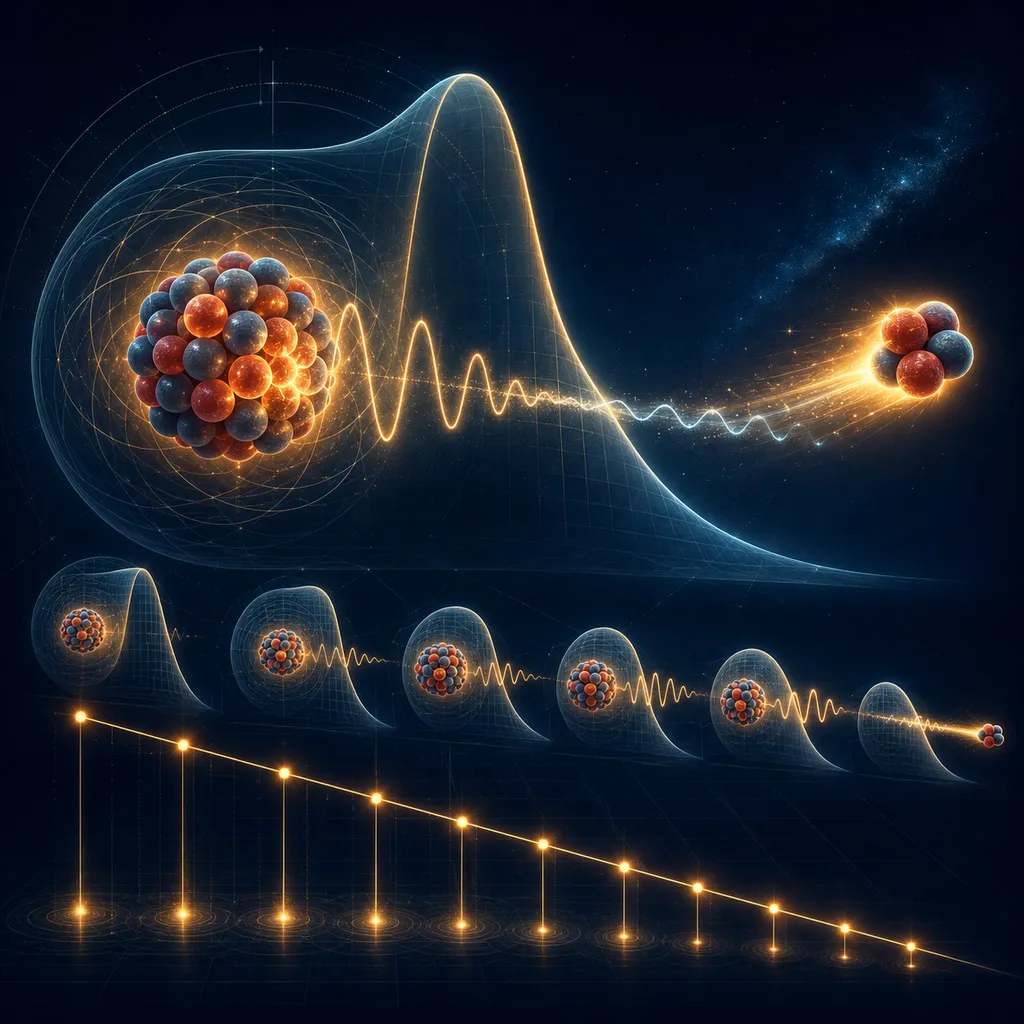
The alpha particle is trapped in the nucleus behind a tall Coulomb barrier. Classically it cannot escape — but quantum-mechanically its wavefunction “leaks” through the barrier (tunnelling). Set the alpha energy and the atomic number of the daughter nucleus, and you will see the half-life jump by orders of magnitude and line up along the straight line of the Geiger–Nuttall law.
I’ll give you a target log₁₀T½ — tune the alpha energy and Z so the point hits that value on the Geiger–Nuttall line.
What just happened?
The alpha particle sits in the nucleus as in a well surrounded by a tall Coulomb barrier (charge repulsion). Its energy is a few times smaller than the barrier top (tens of MeV). Classically — imprisoned forever. Quantum-mechanically the wavefunction does not vanish abruptly at the wall: it decays exponentially inside the barrier and on the other side has a nonzero value. The particle can “appear” there — this is tunnelling.
Gamow factor and the Geiger–Nuttall law:
The transmission probability decreases exponentially with the barrier “thickness” (Gamow factor ). Taking the logarithm gives a linear dependence between and — exactly what Geiger and Nuttall noticed in the data back in 1911. Gamow’s model (1928) was the first success of quantum mechanics in the nucleus.
Invariant — exponential sensitivity:
Because depends on energy through an exponential, a small change in (by ~1 MeV) changes the lifetime by a dozen-odd orders of magnitude. Across the whole 4–9 MeV range that is the difference between microseconds and a time longer than the age of the Universe — and all points lie on the same line (right panel).
Where will you meet this?
Isotopic dating, the radioactive decay series of uranium and thorium, the age of the Earth, and also — the same tunnelling physics — thermonuclear fusion in stars and the tunnel diode in electronics.
Why you need this for the exam:
This is an academic extension of the topic of radioactivity (decay types, the decay law ). At school you learn that nuclei decay with a given ; here you see why these times are so dramatically different — because quantum tunnelling governs them.
Remember: alpha decay is tunnelling through the Coulomb barrier. The lifetime is exponentially sensitive to energy — (the Geiger–Nuttall law).
Theory & formulas
The Coulomb barrier
The alpha particle is trapped in the nucleus. Beyond the nuclear attraction, Coulomb repulsion acts, forming a barrier tens of MeV high — higher than the energy of the alpha particle itself.
Quantum tunnelling
Classically escape is impossible, but the wavefunction “leaks” through the barrier. The probability decreases exponentially (Gamow factor ).
Geiger–Nuttall law
A small change in the energy changes by orders of magnitude.
Symbols: — half-life, — alpha particle energy, — atomic number of the daughter nucleus, — empirical constants, — Gamow factor.
Frequently asked questions
›How does the particle overcome the barrier without enough energy?
It does not “jump over” the barrier — its wavefunction penetrates the barrier and decays exponentially, but on the other side it has a nonzero value. The particle can appear there with a small probability. This is quantum tunnelling, impossible in classical physics.
›Why does a small change in energy change the lifetime so much?
The tunnelling probability decreases exponentially with the Gamow factor G ∝ Z/√E. Taking the logarithm gives the Geiger–Nuttall law: log₁₀T½ = a·Z/√E − b. Changing E by ~1 MeV shifts log₁₀T½ by a dozen-odd units — that is, T½ by a dozen-odd orders of magnitude.
›What is the Coulomb barrier?
The positive alpha particle and the positive nucleus repel each other (Coulomb force). Right next to the nucleus the nuclear attraction wins (the well), but farther out the repulsion dominates, forming a “wall” of potential energy — a barrier tens of MeV high, much higher than the energy of the alpha particle itself.
Teaching? Embed this experiment on your site.
Free widget — paste it on your school site, blog or notes. It links to the full version.