The relativistic Doppler effect (redshift)
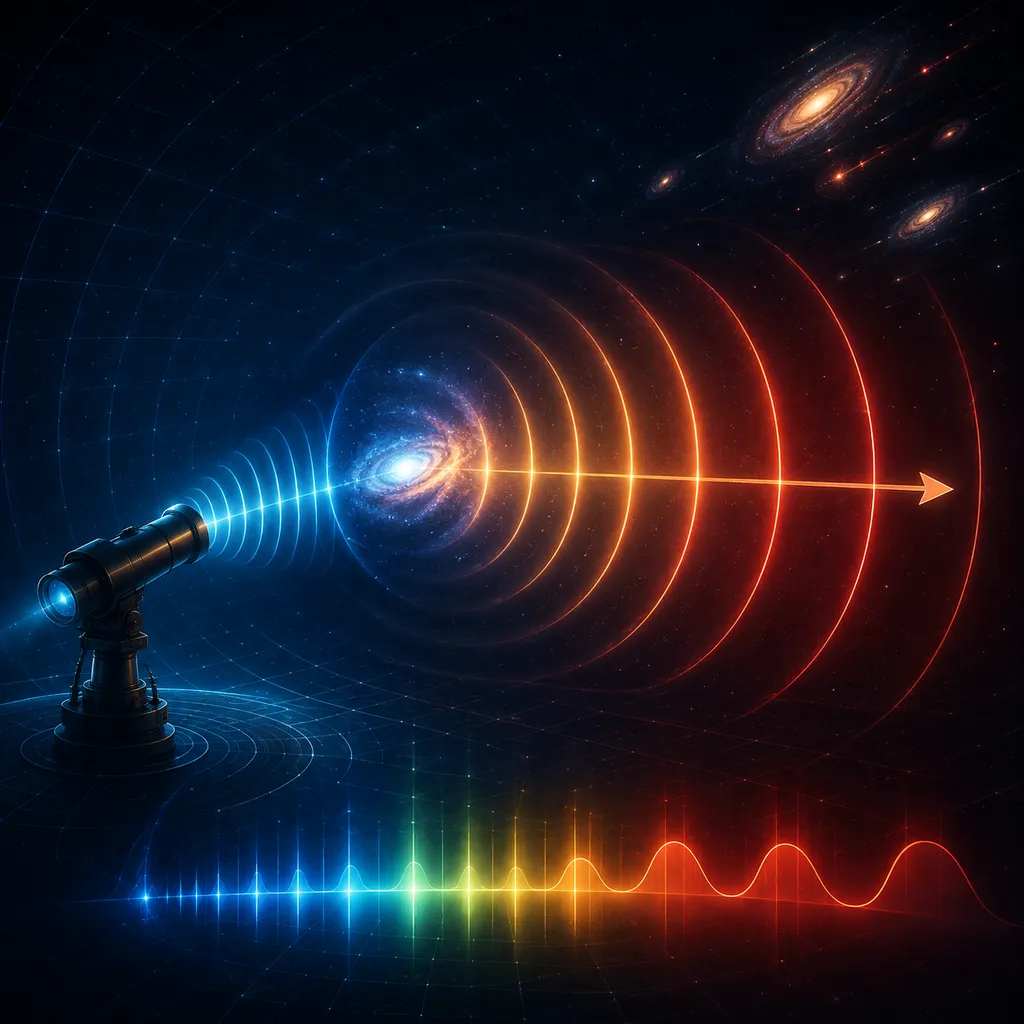
When a light source recedes, the wave is stretched and the colour shifts toward red. Set the recession velocity and you will see the frequency drop and the redshift z grow. The same effect for galaxies (Hubble's law) is the main evidence that the Universe is expanding.
I’ll give you a target redshift z — tune the recession velocity β to reach it.
What just happened?
When a light source recedes, successive wave “crests” reach us less and less often — the wave is stretched, the frequency drops, the colour shifts toward red. In the relativistic version the source’s time dilation adds on top, so the effect is stronger than in the classical Doppler effect.
Relativistic formula:
Redshift measures the relative stretch of the wavelength. For it gives ; as , .
Invariant — the transverse effect:
Even when the source moves across the line of sight (neither toward nor away from us), we observe a redshift — this is a pure time-dilation effect, which the classical Doppler effect does not predict at all. Proof that it is about time, not just wave geometry.
Why this matters for your exam:
This is a university-level extension of the Doppler effect and special relativity. The redshift of galaxy spectra (Hubble’s law) is the main evidence that the Universe is expanding — and you compute it with exactly this formula.
Remember: recession → longer wave (red), . The relativistic Doppler effect also has a transverse component (time dilation).
Theory & formulas
Redshift
For a receding source the wavelength grows. Redshift:
Relativistic formula
At this gives ; as , . Unlike the classical Doppler effect, it accounts for the source's time dilation.
Cosmology
Galaxies have a redshift that grows with distance (Hubble's law) — evidence that the Universe is expanding.
Notation: — redshift, — source wavelength, — observed, , — velocity, — speed of light.
Frequently asked questions
›How does it differ from the ordinary Doppler effect?
The classical Doppler effect accounts only for the changing distance between wave crests. The relativistic one adds the source's time dilation, so the effect is stronger. It also has a transverse component (motion across the line of sight) that the classical Doppler effect does not predict at all.
›What is the redshift z?
It is the relative stretch of the wavelength: z = (λ_obs − λ₀)/λ₀. For recession z = √((1+β)/(1−β)) − 1. At β=0.5 this gives z≈0.73; as β→1, z→∞. Astronomers quote galaxy velocities precisely through z.
›How do we know galaxies are receding?
Their spectra are redshifted, and more strongly the farther away they are (Hubble's law). The interpretation: the space between us and them is expanding. This is the foundation of Big Bang cosmology.
Teaching? Embed this experiment on your site.
Free widget — paste it on your school site, blog or notes. It links to the full version.