The electromagnetic spectrum
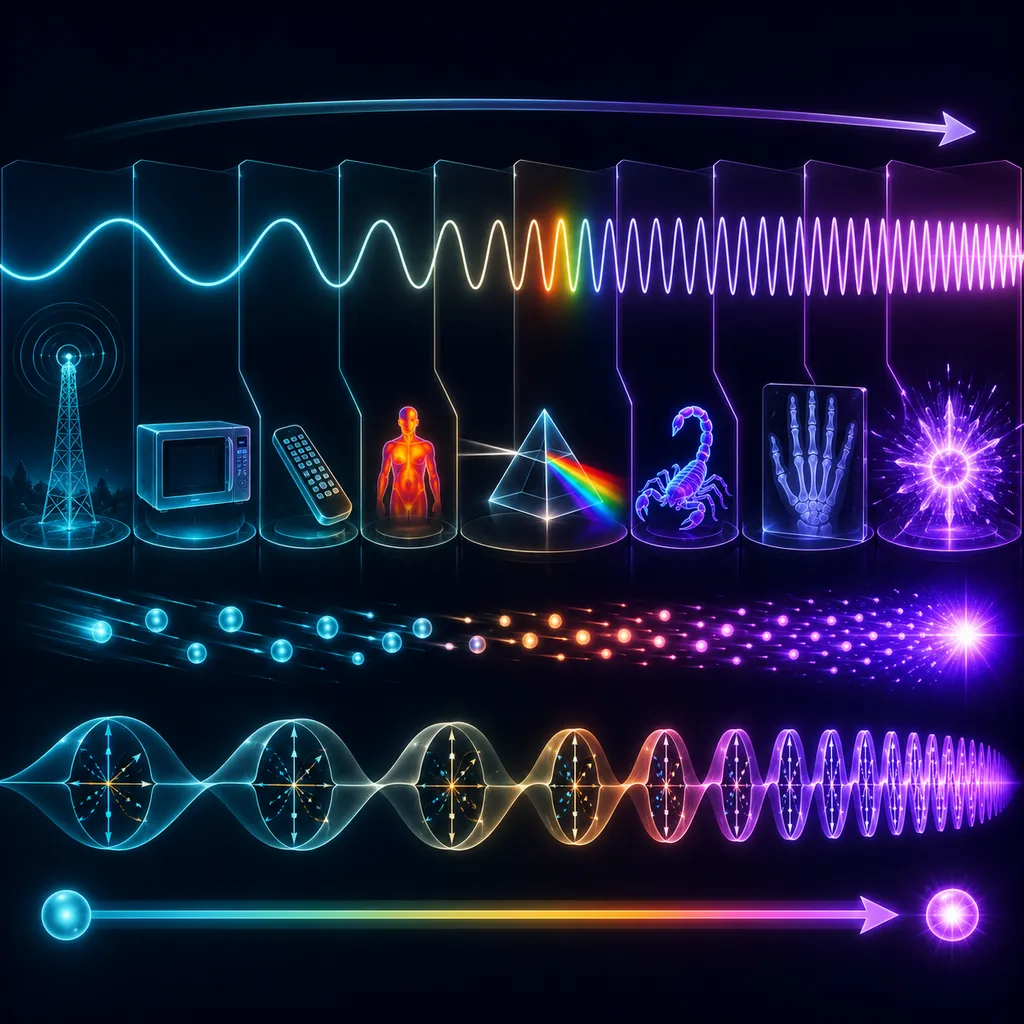
Radio waves, light and γ radiation are the same electromagnetic waves, differing only in wavelength. They are linked by c=λf, and the photon energy by E=hf: the shorter λ, the greater the energy. In a vacuum all EM waves travel at the same speed c. Change the wavelength and see where it sits on the spectrum.
I will give you a wavelength — guess which EM band it belongs to (no slider).
What do radio and light have in common?
They are the same electromagnetic waves — they differ only in wavelength λ. Radio waves, microwaves, infrared, visible light, ultraviolet, X-rays and gamma rays form one spectrum, ordered from the longest to the shortest waves.
The relation between λ, f and E:
λ — wavelength (m), f — frequency (Hz), E — photon energy (J), c = 3·10⁸ m/s, h ≈ 6.63·10⁻³⁴ J·s. Because c is constant, a shorter λ means a larger f, and through E = hf — a greater energy.
Which waves carry the most energy?
Gamma waves — have the shortest λ, the highest f and the greatest photon energy. Radio waves lie at the opposite end: long λ, small f, negligible energy. That is why gamma and X-ray radiation is ionizing, while radio is not.
Where is visible light?
It is a narrow slice of the spectrum with wavelength ~400–700 nm: from violet (shorter λ) to red (longer λ). Just beyond red begins infrared, just beyond violet — ultraviolet.
What is the invariant?
In a vacuum all EM waves travel at the same speed — regardless of λ. The slider changes λ (and with it f and E), but stays constant: .
Why you need this for the exam:
c = λf and E = hf solve most problems about EM waves and photons. Trick: c is constant, so λ and f are inversely proportional, and photon energy grows with frequency.
Remember: radio and light are the same EM waves — shorter λ = higher f = greater energy. Gamma radiation is the strongest, and c is constant across the whole spectrum.
Theory & formulas
One family of waves
Radio, microwaves, infrared, light, UV, X-rays and γ rays are the same EM waves, differing only in wavelength. In a vacuum they all travel at speed :
Photon energy
The shorter the wave, the greater the energy — that is why γ and X are the most dangerous, while radio is harmless. Visible light is a narrow range ~400–700 nm.
Notation: — speed of light, — wavelength, — frequency, — photon energy, — the Planck constant.
Frequently asked questions
›What do radio and light have in common?
They are the same kind of wave — an electromagnetic wave. They differ in wavelength (and frequency), and therefore in energy.
›Which waves carry the most energy?
Gamma radiation — it has the shortest wavelength and the highest frequency, so the greatest photon energy (E=hf).
›Where is visible light?
It is a narrow range ~400–700 nm, between infrared and ultraviolet — the only part of the spectrum the human eye can see.
Teaching? Embed this experiment on your site.
Free widget — paste it on your school site, blog or notes. It links to the full version.