Speed of EM waves in a medium — refraction
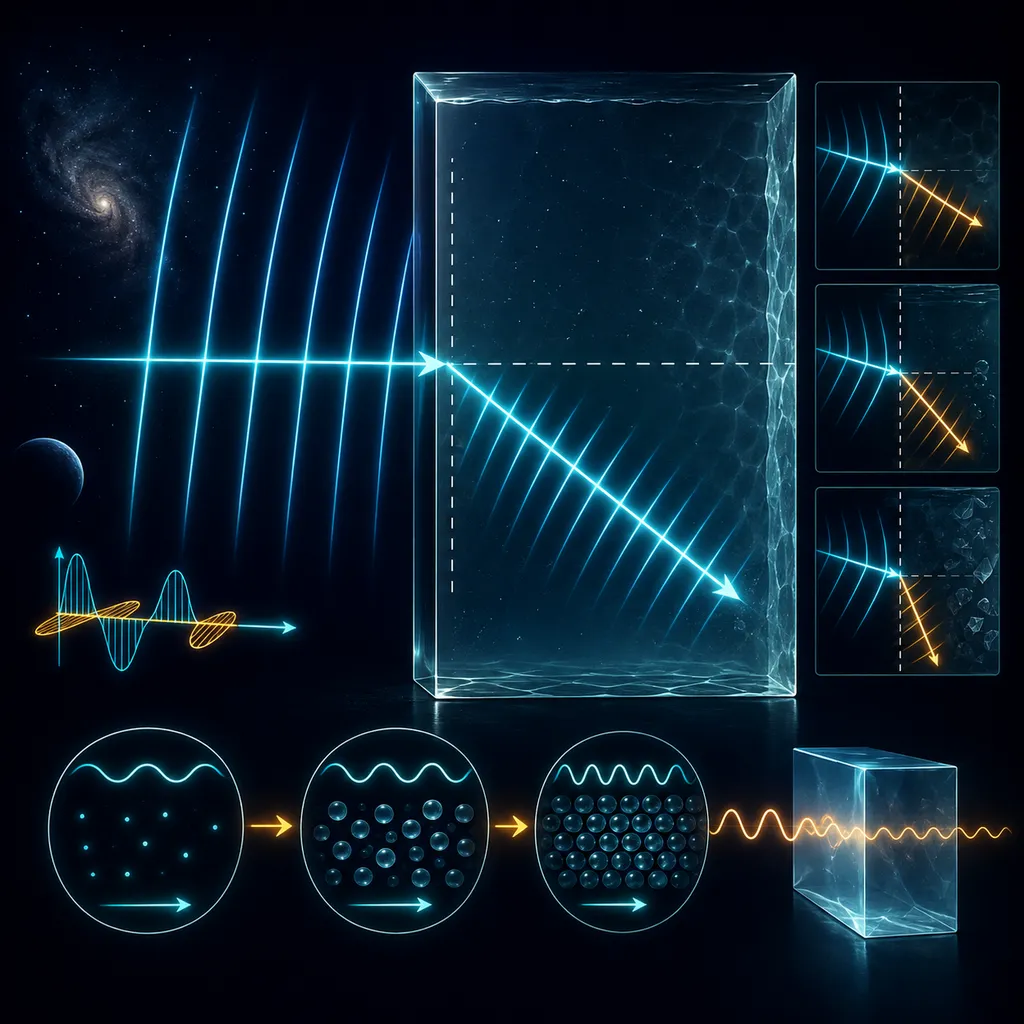
Change the medium (refractive index n). In vacuum an EM wave travels at speed c; in a medium it slows to v=c/n. Watch the wavefronts bunch up as the wave enters an optically denser medium.
I will give the EM wave speed as a % of the speed in vacuum — guess the medium. v = c/n.
What just happened?
The EM wave entered the medium from vacuum and slowed down. In vacuum every electromagnetic wave travels at speed , but inside matter it interacts with its atoms and travels slower — the more so, the larger the refractive index.
Speed of the EM wave in a medium:
— where is the speed of light in vacuum, and is the refractive index of the medium. The larger , the smaller .
What does it mean in practice?
The frequency of the wave does not change (the source sets it), so since decreases, the wavelength shrinks:
That is why in the animation the wavefronts inside the medium are packed more densely than in vacuum — a visible “trace” of the slower speed.
Why does light refract?
A change of speed at the boundary between media changes the direction of the ray — that is refraction (Snell’s law). A larger = a slower wave = stronger refraction. Diamond () slows and bends light strongly, hence its sparkle.
Why you need this for the exam:
The formula plus a constant frequency and solve most problems about light in media. Trick: remember that on entering a medium v and λ change, but not f.
Remember: in vacuum every EM wave travels at speed c; in a medium v = c/n < c — the more optically dense the medium, the slower it goes and the shorter the wave.
Theory & formulas
Slowing down in a medium
In vacuum an EM wave travels at speed ; in a medium it slows down: where is the refractive index (). For glass , so .
Consequence — refraction
On entering an optically denser medium the wavefronts bunch up and the ray refracts. In vacuum all EM waves have the same speed .
Symbols: — speed in the medium, — speed of light in vacuum, — refractive index.
Frequently asked questions
›How fast does light travel in glass?
Slower than in vacuum: v=c/n; for glass n≈1.5, so v≈2·10⁸ m/s.
›What is the refractive index?
The ratio of the speed of light in vacuum to its speed in the medium, n=c/v; the larger it is, the slower the light.
›Do different EM waves have different speeds in vacuum?
No — all of them (radio, light, X-rays) have the same speed c in vacuum.
Teaching? Embed this experiment on your site.
Free widget — paste it on your school site, blog or notes. It links to the full version.