Colour mixing — RGB and CMY
What we will do: We will mix colours in two ways — by overlapping lights (RGB) and by overlapping pigments (CMY) — and compare the results.
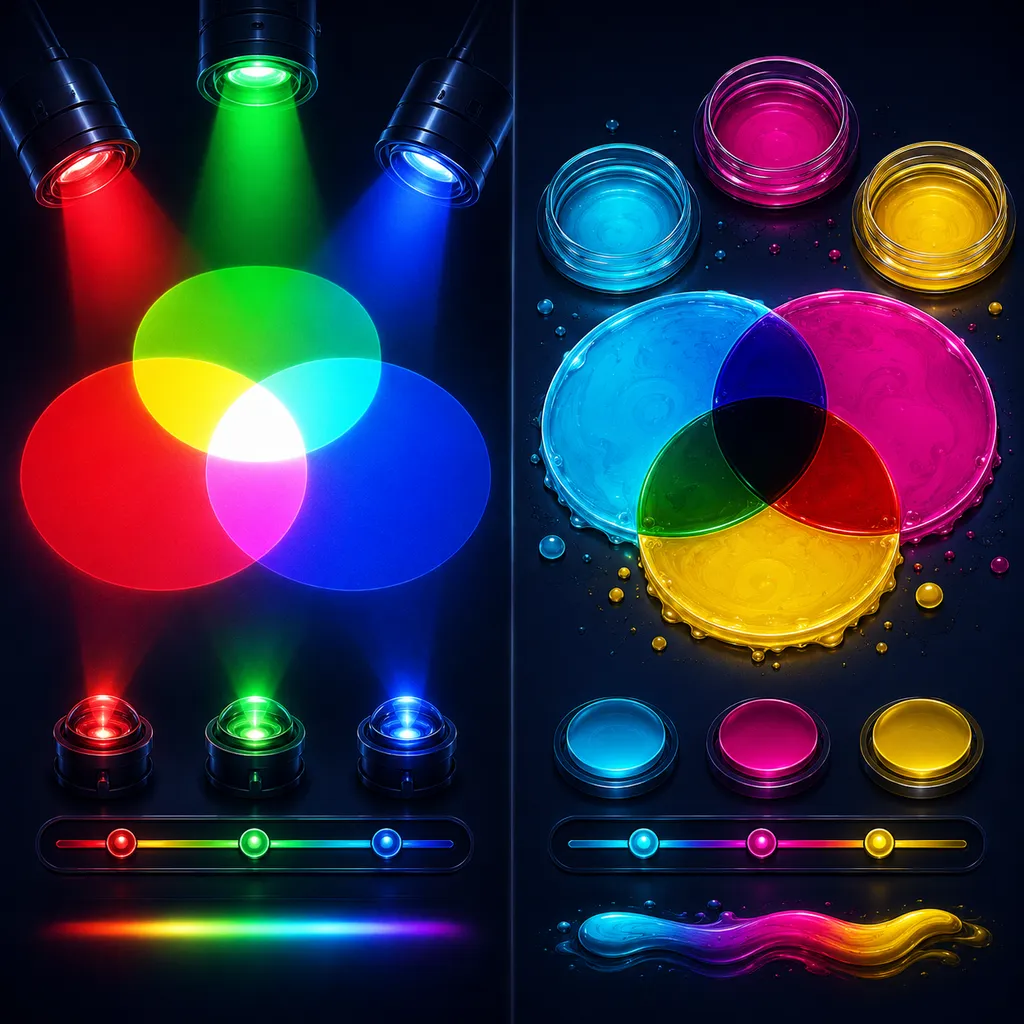
What you see on the screen: Three overlapping colour circles — in light mode RGB (overlaps give yellow, cyan, magenta, with a white centre) or in paint mode CMY (overlaps give red, green, blue, with a black centre) — plus intensity sliders and a mode switch. Readouts: mode, components and the result colour.
What just happened?
Overlapping red and green LIGHT produced yellow. But if you mixed red and green PAINT, you would get something completely different — because light and paint mix in two different ways.
ADDITIVE mixing (mixing light):
you start from darkness and ADD colours. The primary colours are red, green and blue (RGB). Their sums: R+G=yellow, G+B=cyan, R+B=magenta, and all together → WHITE. This is how screens and monitors work (RGB pixels).
SUBTRACTIVE mixing (mixing pigments):
you start from white and SUBTRACT colours — each pigment absorbs part of the light. The primary colours are cyan, magenta and yellow (CMY). Mixing them gives darker colours, and all together → almost BLACK. This is how printing works (CMYK).
Why three primary colours?
Because our eye has three types of cones — sensitive to red, green and blue. By mixing these three signals, the brain "sees" all colours.
Why this matters for the exam:
distinguishing additive from subtractive mixing and knowing the primary colours is a typical question about colour and vision.
Remember: light mixes additively (RGB → white), pigments subtractively (CMY → black); the eye has three types of cones.
Theory & formulas
Two kinds of mixing
Colours can be mixed in two opposite ways, depending on whether we overlap lights or pigments.
Additive mixing (lights, RGB)
We add the lights of the primary colours: red, green, blue.
- red + green = yellow,
- all three together = white.
Subtractive mixing (pigments, CMY)
A pigment absorbs part of the light and reflects the rest (cyan, magenta, yellow).
- overlapping pigments subtracts one colour after another,
- all three together = black.
The three primary colours follow from the structure of the eye — it has three types of cones sensitive to red, green and blue.
Frequently asked questions
›What is the difference between additive and subtractive mixing?
Additive is the mixing of lights (RGB → white), subtractive is the mixing of pigments (CMY → black).
›What colour results from combining red and green light?
Yellow (additive mixing).
›Why are there three primary colours?
Because the eye has three types of cones — sensitive to red, green and blue.
Teaching? Embed this experiment on your site.
Free widget — paste it on your school site, blog or notes. It links to the full version.
Related experiments