Colours of objects
What we will do: We will light objects with light of different colours and check what colour we see, and what colour filters let through.
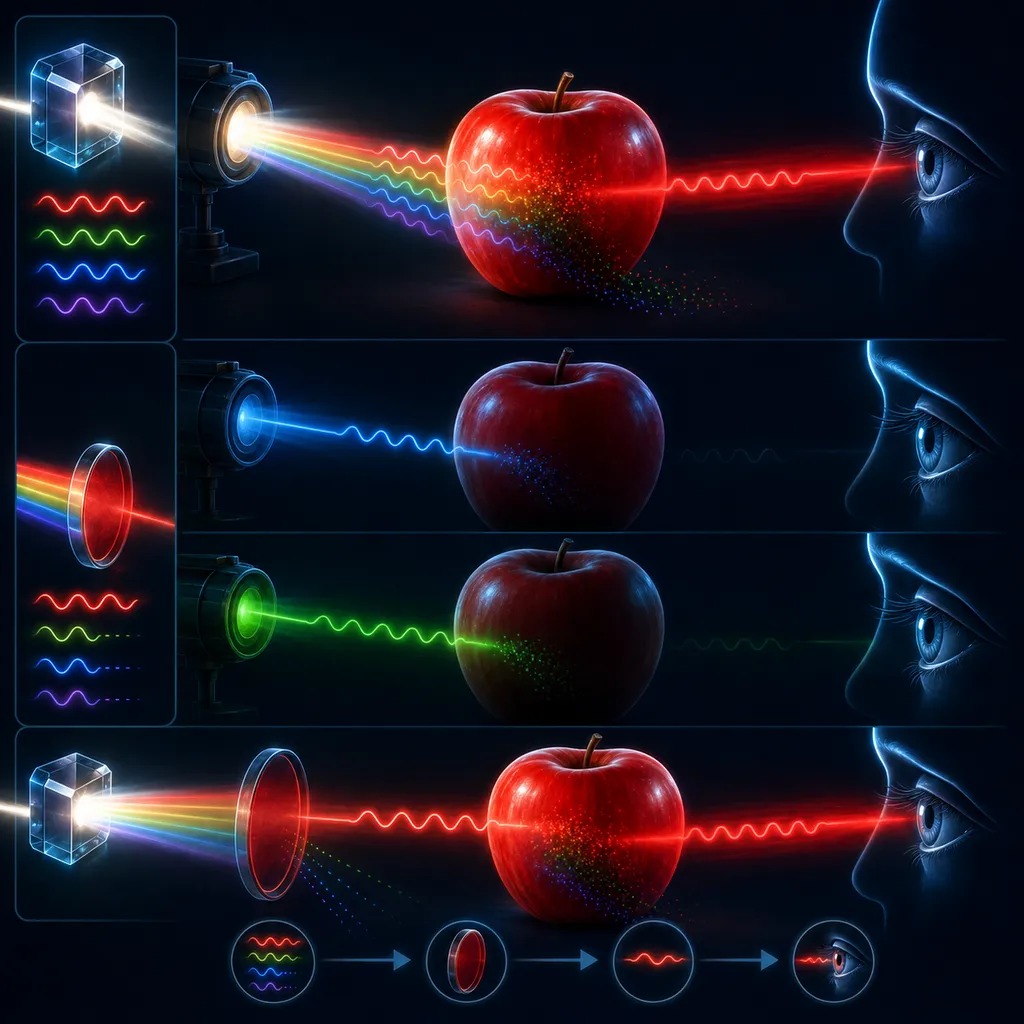
What you see on screen: A light source (with a selectable colour), an object and an observer, together with the incoming light — part of which is reflected (the colour you see) and the rest absorbed; you can also insert a colour filter. Readouts: the colour of the illumination, the colour of the object, the colour seen (reflected) and the absorbed colours.
I will give you a colour to see with the eye — set the illumination, object and filter so that you get exactly it.
What just happened?
A red apple lit with only blue light looked BLACK — because it had nothing to reflect.
Where does an object's colour come from?
An object lit with white light REFLECTS waves of one colour and ABSORBS the rest. What it reflects is what we see as its colour. A red apple reflects red and absorbs the other colours.
Why is the apple black in blue light?
Because the apple can reflect only red — and pure blue light contains no red at all. There is nothing to reflect, so no light reaches the eye and the object looks black.
Colour filters:
a filter passes light of its own colour and blocks the rest. A red filter passes red, so through it the world looks red.
Why you need this for the exam:
the mechanism behind the colour of objects (reflection and absorption) and how filters work is a classic colour question.
Remember: an object's colour is the light it reflects (it absorbs the rest); in light without its colour it looks black. A filter passes its own colour.
Theory & formulas
Where an object's colour comes from
An illuminated object reflects light of one colour and absorbs the rest. What we see is exactly the reflected colour. A red apple reflects red and absorbs the rest.
Colour versus illumination
What we see depends on the colour of the incoming light:
- a red object in white light — red,
- a red object in blue light — black (there is no red to reflect).
Colour filter
A filter passes light of its own colour and blocks the rest. A red filter passes only red. These are purely qualitative phenomena — governed by reflection and absorption, not by a formula.
Frequently asked questions
›Why do objects have a colour?
Because they reflect light of one colour and absorb the rest — we see the reflected colour.
›How does a red object look in blue light?
Black — in that light there is no red for it to reflect.
›What does a colour filter do?
It passes light of its own colour and blocks the rest.
Teaching? Embed this experiment on your site.
Free widget — paste it on your school site, blog or notes. It links to the full version.