Dispersion of light in a prism
What we'll do: We'll shine white light onto a prism and watch it split into the colours of the rainbow, then recombine them back into white.
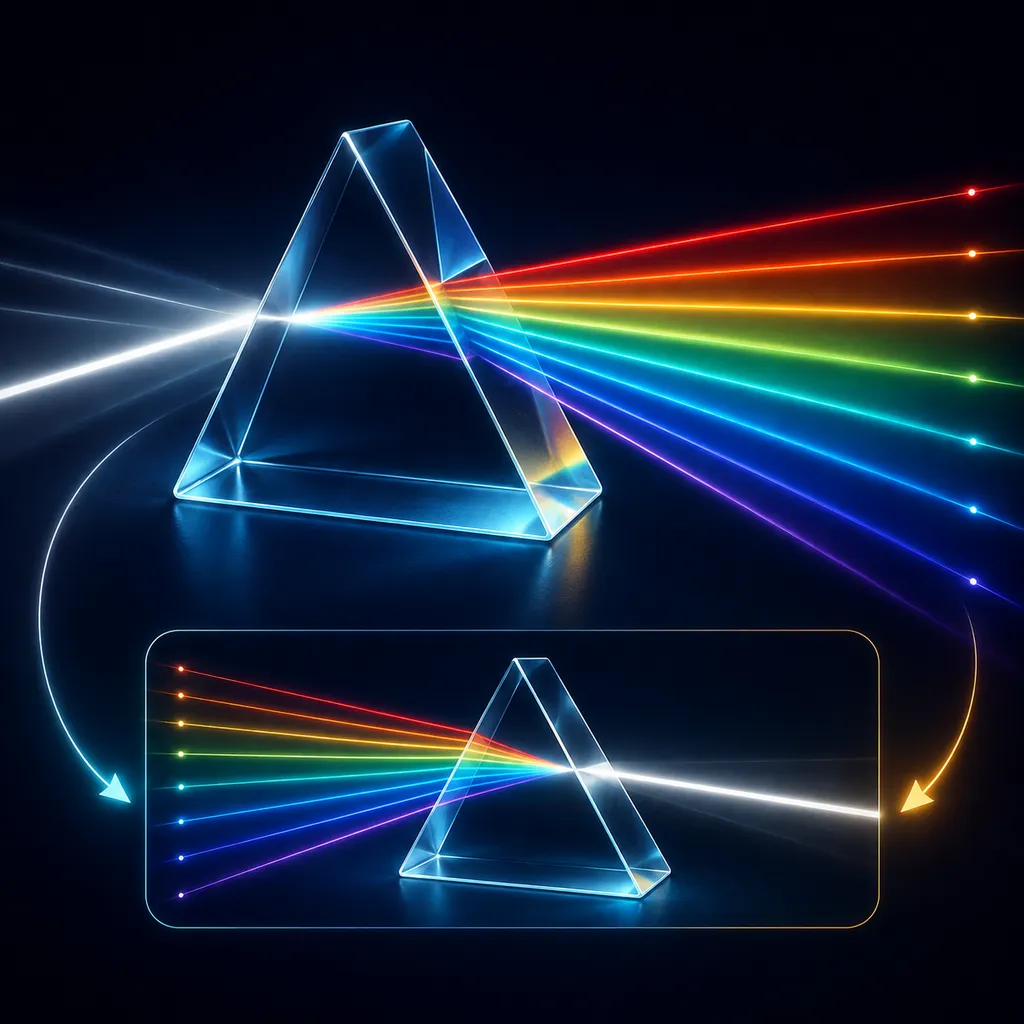
What you see on screen: A prism with an incoming beam of white light and a fan of colours at the output (from red to violet), plus a mode that recombines the colours with a second prism. Readouts: type of light, colour order, and which colour bends the most.
What just happened?
White light broke up in the prism into the colours of the rainbow — from red to violet. And when you recombined them, it turned white again.
Why does light disperse?
Because white light is a MIXTURE of all colours, and each colour refracts SLIGHTLY differently in glass. The refractive index depends on wavelength — we call this phenomenon DISPERSION.
Which one bends the most?
Violet (the shortest wavelength) refracts the most strongly, and red (the longest) the least. That is why the colours emerge arranged into a spectrum: red, orange, yellow, green, blue, violet.
Newton's proof:
when you pass the split colours through a second prism, they recombine into white light — which means white really is the sum of the colours.
Where does a rainbow come from?
Raindrops act like tiny prisms — they disperse sunlight, forming the arc of a rainbow.
Why this matters for your exam:
dispersion, the dependence of refraction on colour, and the formation of a spectrum are classic optics topics. Remember: violet refracts the most strongly, red the least. It also helps to know that — in glass, different colours travel at different speeds.
Remember: white light is a mixture of colours; a prism splits it (dispersion) because each colour refracts differently — violet the most, red the least.
Theory & formulas
Dispersion
The refractive index of glass depends on wavelength — light of different colours refracts slightly differently. This phenomenon is called dispersion.
Separation of colours
White light is a mixture of colours. In a prism each colour bends at a different angle:
- violet (the shortest wavelength, the largest ) — refracts the most strongly,
- red (the longest wavelength) — the least.
At the output a fan of rainbow colours appears; a second prism can recombine them back into white.
Speed in the medium
A colour with a larger travels more slowly in glass: . This is how a rainbow forms — raindrops act like prisms.
Notation: — refractive index, — wavelength, — speed of light in the medium, — speed of light in vacuum.
Frequently asked questions
›Why does a prism split white light into colours?
Because white light is a mixture of colours, and each of them refracts slightly differently in glass (dispersion).
›Which colour refracts the most strongly?
Violet (the shortest wavelength); red refracts the least.
›How does a rainbow form in the sky?
Raindrops act like prisms — they disperse sunlight into its colours.
Teaching? Embed this experiment on your site.
Free widget — paste it on your school site, blog or notes. It links to the full version.