The eye and vision defects
What we'll do: We'll check where the image forms inside the eye for different vision defects and which lens can correct each of them.
What you see on screen: A cross-section of the eye with rays focused on, in front of, or behind the retina, plus a switch for the eye state (normal, short-sighted, long-sighted); adding glasses shifts the focal point onto the retina and sharpens the image. Readouts: eye state, the image position relative to the retina, and the type of corrective lens.
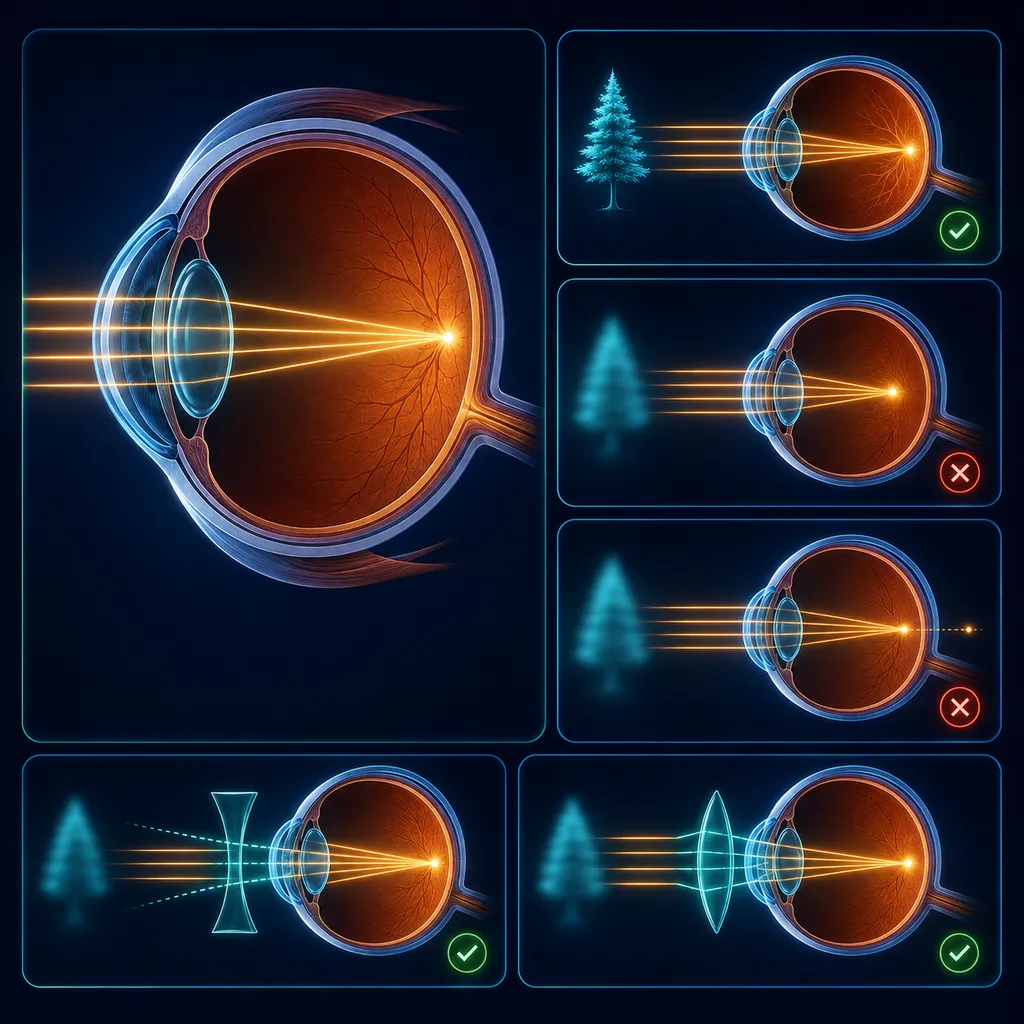
I'll draw a random vision defect — your task is to name the lens that corrects it.
What just happened?
In a short-sighted eye the image formed IN FRONT of the retina — that is why the image looked blurred. The diverging lens moved it exactly onto the retina.
The eye as an optical system:
the cornea and the eye lens focus light and form an image on the RETINA (that is where the light-sensitive cells are). To see sharply, the image must land exactly on the retina.
Short-sightedness (myopia):
the eye is "too strong" or too long — the image forms IN FRONT of the retina, so distant objects look blurred. It is corrected with a DIVERGING lens (which moves the focus onto the retina).
Long-sightedness (hyperopia):
the image forms BEHIND the retina — a problem with seeing up close. It is corrected with a CONVERGING lens (which brings the focus onto the retina).
Accommodation:
a healthy eye changes the shape of its lens to see objects at different distances sharply.
Why this matters for the exam:
the eye as an optical instrument, the mechanism of vision defects and choosing corrective lenses is a common optics topic. The trick: image in front of the retina → diverging; behind the retina → converging.
Remember: short-sightedness (image in front of the retina) is corrected with a diverging lens, and long-sightedness (image behind the retina) with a converging lens.
Theory & formulas
The eye as an optical system
The eye lens focuses light onto the retina. Its focusing power is: expressed in dioptres (, when is in metres). Accommodation is the change in shape (and therefore ) of the eye lens.
Short-sightedness
The image of distant objects forms in front of the retina. It is corrected with a diverging lens (negative power, ).
Long-sightedness
The image forms behind the retina. It is corrected with a converging lens (positive power, ), which shifts the focal point onto the retina.
Notation: — focusing power (lens power) in dioptres, — focal length in metres.
Frequently asked questions
›What is short-sightedness?
The image forms in front of the retina, so distant objects look blurred; it is corrected with a diverging lens.
›How is long-sightedness corrected?
With a converging lens — the image forms behind the retina and the focal point has to be brought onto the retina.
›What is accommodation of the eye?
The eye's ability to change the shape of its lens, which lets us see objects at different distances sharply.
Teaching? Embed this experiment on your site.
Free widget — paste it on your school site, blog or notes. It links to the full version.