Optical fibre
What we will do: We will send light into an optical fibre and check when it travels inside thanks to total internal reflection, and when it escapes.
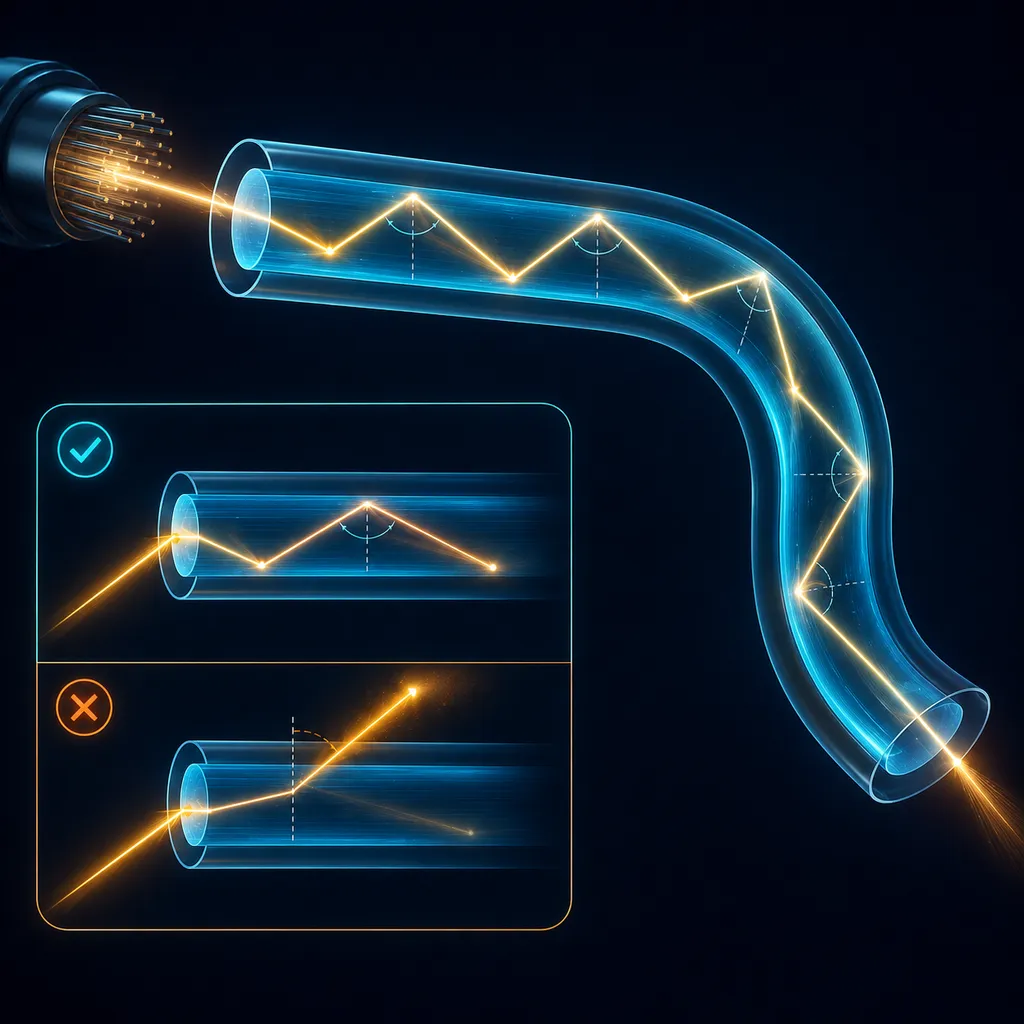
What you see on screen: An optical fibre (core and cladding) with a ray reflecting repeatedly off the walls and travelling along it — even around a bend; at too small an angle part of the light escapes. A launch-angle slider and a straight/curved fibre switch. Readouts: the angle of incidence at the wall relative to the critical angle, and the state.
I will give you a launch angle for the light — guess (without moving the slider) whether total internal reflection occurs or the light escapes.
What just happened?
Light sent into the fibre at the right angle bounced off the walls and travelled along it — even around a bend, without escaping outward.
How does an optical fibre work?
It is a thin fibre made of a core (with a higher refractive index) surrounded by cladding. When light hits the core wall at an angle GREATER than the critical angle, TOTAL INTERNAL REFLECTION occurs — all the light bounces back inside and nothing escapes.
Why does the light not escape around bends?
Because at every contact with the wall the angle still exceeds the critical angle, so the light reflects again and again and "follows" the shape of the fibre — even a coiled one.
When does the light escape?
If you launch it at the wrong angle, so that it hits the wall below the critical angle — then part of the light refracts and leaves the fibre (losses).
Where is this used?
Optical fibres carry internet and telephone signals over enormous distances (the light signal travels almost without losses), and are also used in medical endoscopy.
Why you need this for the exam:
total internal reflection and its use in optical fibres is a common optics example (you calculate the critical angle in the topic "Refraction of light").
Remember: an optical fibre works thanks to total internal reflection — above the critical angle the light reflects off the walls and travels inside the fibre, even around bends.
Theory & formulas
How it works
Light travels in the core of an optical fibre thanks to total internal reflection at the core–cladding boundary. It reflects off the walls again and again without escaping — even around bends.
Condition for total reflection
It occurs when light hits the wall at an angle greater than the critical angle: The core has a higher refractive index than the cladding .
Why it does not escape
As long as the angle of incidence exceeds the critical angle at every wall, the light is reflected completely each time. Applications: internet, telephony, endoscopy.
Notation: — refractive index of the core, — of the cladding, — critical angle.
Frequently asked questions
›How does an optical fibre work?
Thanks to total internal reflection — the light reflects off the core walls and travels along the fibre without escaping outward.
›Why does the light in an optical fibre not escape around bends?
Because at every wall the angle of incidence still exceeds the critical angle, so the light is reflected completely again and again.
›What are optical fibres used for?
For transmitting internet and telephone signals over long distances, and in medical endoscopy.
Teaching? Embed this experiment on your site.
Free widget — paste it on your school site, blog or notes. It links to the full version.